Bell
Of the bell, locative, occupational, or pseudonymous.
- Origin
- Yorkshire & the Humber, England
- Famous bearer
- Alexander Graham Bell (1847–1922), inventor of the telephone
- Register
- English family
The Bell arms, tartan and country

TartanBell tartanMicheletb · CC BY-SA 4.0 
Coat of armsArms of Bell (of Beaupré Hall)Borne by the Beaupré Hall line, one branch of the name rather than all of it.CC BY-SA 4.0

.svg)
- Tartan: The checked cloth the family is known by.
- Coat of arms: Granted to an individual and inherited down that one documented line. These are the arms of particular families of the name, not of everyone who shares the surname.
What is the Bell clan tartan?
One Bell sett is recorded, and it is the swatch above. A sett is the block of coloured bands the cloth is built from, repeated in both directions; the whole plaid is that one square enlarged.
Bell is an English name, and the sett is a Scottish invention. Tartan registration grew outward from the Highlands to cover surnames carried well beyond them, and a weaver who could sell a Bell tartan sold one: some of these setts are Victorian and some were designed within living memory. That is how most names outside the Highlands came by a sett at all. Nobody polices any of it. Wearing the Bell sett declares allegiance to the name, not descent from any particular line of it.
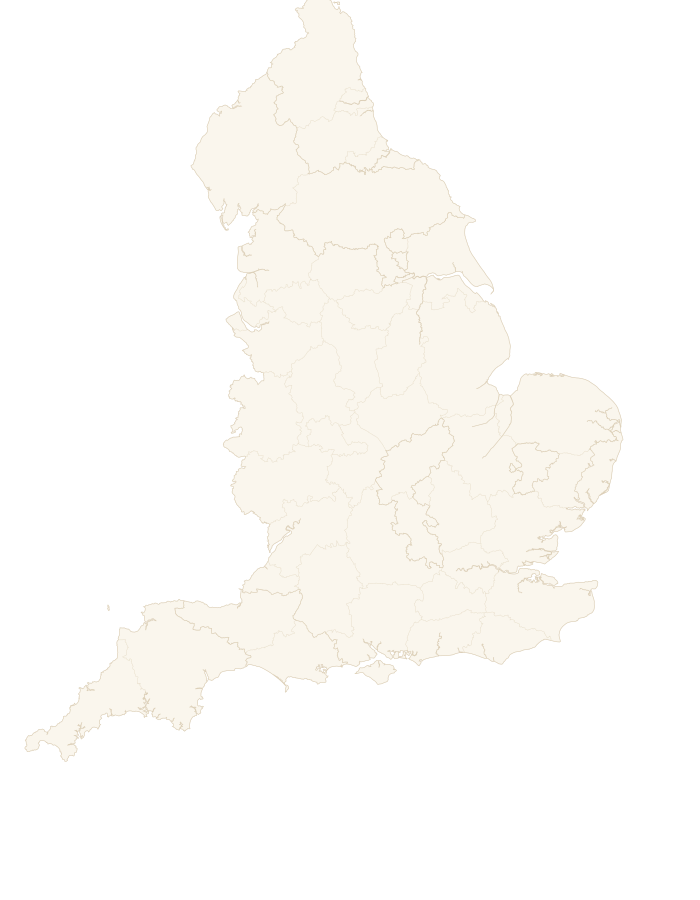
CoreHistoric reach
The seat of Bell
Seat vacantChief
No one leads the Bell community yet. When the movement opens, you can stand for its leadership, or help elect whoever does.
Current mission
No shared goal set yet. Once Bell has leadership, it sets the public focus: a restoration, a gathering, a real-world project that helps its own.
The Bell clan is being rebuilt. Join the waiting list for the movement today, and you help decide who leads it and what it does.
Help rebuild the Bell clan →What does the Bell name mean?
Multiple origins: locative, from someone living near the church bell or the inn-sign of the bell; occupational, from a bell-maker or bell-ringer; or from the Norman first-name Bel ('beautiful' or 'fair'), particularly common as a hypocoristic of Isabel. The Brontë sisters' pseudonyms, Acton, Currer and Ellis Bell, were a deliberately gender-ambiguous use of the surname. The various roots converged in the modern English surname pool, and Bell is a widespread Anglo-Scottish surname with a strong Borders concentration.
The history of Bell
Four different men who all ended up called Bell
Bell does not have an origin. It has four, and a reader tracing the name backwards needs to know which one is theirs. The surname comes from the Middle English bell, and from that one word three routes ran: an occupational name for the man who rang bells or founded them; a topographic name for the man who lived by an actual bell, or by a house sign or inn sign showing one; and a name from the mediaeval personal name Bel. The fourth route is not English at all. It is the Old French bel, handsome, hung on a man by Norman-speaking clerks who thought him good-looking.
Each route has its own dated first appearance in the rolls, which is the closest thing a Bell has to a birth certificate. Occupational: Seaman Belle, between 1181 and 1187, and Serlo Belle in 1190. From the personal name: Ailuuardus filius Belli in 1086, Ricardus filius Bell in 1279, Osbertus filius Belle in 1297: Ailward, Richard and Osbert, each the son of a man called Bel. From the sign: John atte Belle in 1332, John at the Bell. From the nickname: Hugo bel in 1148, then Robertus bellus and Robert le bel, both between 1186 and 1200, one byname written twice by two clerks, in Latin and in French, inside a single generation.
A minority come from elsewhere: place-names in Norway and the Rhineland, and sometimes an anglicised German Boehl or Boell. Bell sits in the top hundred in England, Scotland and Northern Ireland, is the thirty-sixth commonest in Scotland and the sixty-seventh in the United States, and lies denser on the Anglo-Scottish Border than anywhere on earth.
The bell pit, the loam and the horse manure
Take the founder first, because he made the name mean something to a whole parish. Bellfounding in Europe dates to the fourth or fifth century, and it was not a trade you sent away to: a church bell weighs tons, and before rail or road could move one the founder came to the bell. A pit was dug in the ground of the building where the bell was to hang, the founder arrived with his casting tools, and a furnace was built beside it. For a few weeks a working foundry stood in a churchyard that had never had one and never would again.
The mould was built by hand from what any farm could supply. An inner core was raised on a base-plate out of porous coke or brick, covered in loam mixed with straw and horse manure, worked to the exact profile of the inside of the finished bell and faced with graphite and whiting. The outer section was shaped the same way inside a perforated cast-iron case, then inverted mouth-downwards, lowered over the core and buried in the pit to cool evenly. The metal was bell metal, a bronze of about twenty-three per cent tin, arrived at empirically over centuries because it gives the most pleasant tone; the thickness at the sound bow is usually a thirteenth of the diameter. None of it could be tested until the metal was cold.
And a bell is not one note. A struck bell sounds a hum note an octave below the named note, the strike tone itself, a tierce a minor third above, a quint a fifth above and a nominal an octave above, and it is good only when those harmonics are in harmony with each other and with the strike note, in tune with itself. Because castings vary, the cold bell is clamped on a rotating table and metal cut away at chosen points, each cut moving one harmonic and disturbing another. A bell hung exactly as it left the mould, never cut at all, is a maiden bell, the highest compliment the trade pays. A parish commissioning a bell poured years of its own income into a hole in the ground, in one minute, on the word of the man called Bell.
The rope, the wheel and the hour of the day
The other occupational Bell pulled the rope, and his was a public office. The English word clock descends from the Latin cloca, a bell, because for most of the life of this surname the bell was the clock, sounding the hours and quarters over a distance no other signal could cover at a time when clocks were beyond ordinary ownership. English practice took the ringing of them to its limit. Bells hung for full-circle ringing are swung through just over a complete circle from mouth uppermost, held at the balance point by a wooden stay, the rope running off a wheel. One ringer takes one bell in the chamber below, and a band works a ring of four to twelve or more through change ringing: a peal of five thousand or more patterns, hours at a stretch, without a break or a repetition.
The ringer also handled the parish's grief. Leather muffles are strapped round the clappers to quieten a bell, and at funerals half-muffles give a full open sound on one round and a muffled sound on the next, an effect used at the funeral of Diana, Princess of Wales, in 1997. In Scotland, up to the nineteenth century, a dead bell was rung at a death and again at the funeral.
At the sign of the bell, and the century the name froze
John atte Belle, in 1332, was neither founder nor ringer. He was the man at the Bell, known by the sign over his door or over the inn he kept. In a country where most people could not read, a house, a shop or an inn was known by its picture, and the bell was among the commonest and most legible of them. A stranger asking directions was sent to the Bell, and the man who lived there took the name of the object.
That such a label stuck at all was a recent change. The introduction of family names in England is generally attributed to the preparation of the Domesday Book in 1086, taken up first among the feudal nobility and gentry and spreading only slowly downward; the first recorded use of a surname inherited across several generations has been placed around 1140. The change was complete across England and Lowland Scotland by 1400, when most families carried a name their children would inherit. The consequence for a Bell is exact. A man called Bell in the 1200s was called it for a reason true of him: he rang, he cast, he lived by the sign, he was handsome, his father was Bel. His great-grandson in the 1400s was Bell whatever he did and wherever he went, and every Bell alive descends from that freeze.
Le bel: the handsome man and the clerk's Latin
The Norman strand needs the Conquest to explain it. After 1066 William granted the lands of the English elite to his own followers and built castles to hold them; by the Domesday survey of 1086 only about five per cent of the land in England south of the Tees was still in English hands. With that came a change in the language of power: a dialect of French became the speech of the elites, and official documents shifted from Old English to Latin. That is why an English farmer's nickname meaning handsome reaches us in French: Hugo bel in 1148, Robertus bellus and Robert le bel between 1186 and 1200. A quieter branch: the feminine form of the name Bel is a short form of Isobel, so a minority of Bells carry a matronymic, a surname taken from a mother or grandmother rather than a father, genuinely rare in English naming.
One caution, because it is the honest thing to tell a reader about to feel flattered. Nicknames in the surname record are not reliable descriptions. A standard dictionary of English surnames notes that names of office such as Abbot, Bishop and King are usually nicknames rather than jobs, given to a man who behaved like a bishop or was as stout as one; and the leader of the University of the West of England study, which reported in 2016 on 45,602 British and Irish surnames, observed that Short may well have begun as an ironic nickname for a tall man. Some ancestor of some Bells was called handsome because he was, and another because he was not, and the record cannot tell you which stands at the head of your line.
A riding surname on the West March
Now the ground where the name lies thickest. The Bell concentration on the Anglo-Scottish Border is no accident of dialect: the Bells were a riding clan, one of the surnames of the Border country in the late mediaeval period, counted among the sub-septs of the great riding families. For roughly two and a half centuries, down to the Union of the Crowns in 1603, the land between Solway and Tweed was administered on paper by wardens of three Marches on each side of the line, and governed in practice by surnames. A riding surname was a kinship that could put horsemen in the saddle at short notice, lift cattle across a national frontier, take blackmail (protection money, paid by gentlemen in Cumberland and Westmorland, with receipts honoured) and hold a stone tower against the reprisal. The West March, where the Bells rode, ran through Annandale and Eskdale and the Debatable Land, the strip neither kingdom would concede and neither could police.
This atlas tells the set-pieces of that country from the pages of the families they happened to. The Armstrongs of Liddesdale carry Carlanrig, where in the summer of 1530 James V hanged their chief and forty-eight of his riders who had come in under a king's safe conduct; the Johnstones of Annandale and the Maxwells of Caerlaverock carry Dryfe Sands, the last great clan battle fought on Scottish soil, on the sixth of December 1593. The Bells carry none of these, and it is more honest to say so than to borrow them. What the Bells were was the thing those stories require and never name. A Border battle is not fought by chiefs; it is fought by the four hundred men a chief can raise out of the dales around him. The Bells were numerous where numbers were the whole of a family's power, and the proof is still on the map: four hundred years after the wardenry was abolished, the name lies denser on that country than anywhere else.
The reiving country was then closed deliberately. After 1603 James VI set about breaking the riding clans, the Borders were renamed the Middle Shires, and whole surnames were reduced, executed under royal commission, or transported to Ireland. The Bell name went to Ulster in the same century's movement of people, was carried heavily into seventeenth-century New England, and went out of Ulster again into the Scots-Irish diaspora of Pennsylvania and the Appalachians, which is why so many American Bells trace back through Ulster to a Border dale. Killevy Castle in County Armagh came to the Bell family by 1881 and stayed with them until the death of Maureen Bell in 2000.
The Bells who are remembered
There is a second family of Bells whose work you can stand inside. In Aberdeenshire a dynasty of master masons of that name is credited with the finest group of Scottish tower houses of the early seventeenth century: Castle Fraser, one of the grandest of the Castles of Mar. Craigston Castle, built between 1604 and 1607 near Turriff, belongs to what architectural historians simply call the Bell group, and Cluny Castle, completed in 1604, is attributed to the master mason Ian Bell.
The name runs deep in medicine and letters. Charles Bell (1774–1842) was a Scottish surgeon. Joseph Bell taught clinical medicine at the Edinburgh Royal Infirmary, where between 1877 and 1881 a student named Arthur Conan Doyle watched him read a stranger's trade off the tan on a cheekbone and the wear on a trouser knee, and built Sherlock Holmes out of the method. Andrew Bell (1726–1809), the Edinburgh engraver, was a founder of the Encyclopaedia Britannica. Elizabeth Bell (1869–1934) was Ireland's first woman doctor, and Anthea Bell (1936–2018) the translator who carried Asterix into English.
The name was also, once, a disguise. In the autumn of 1845 Charlotte Bronte opened her sister Emily's desk at the parsonage in Haworth and read nine years of poems she had never been shown. The result was a joint volume, Poems by Currer, Ellis and Acton Bell, under three deliberately ungendered pseudonyms; it sold two copies. Two years later Thomas Cautley Newby published Wuthering Heights under the name Ellis Bell, and reviewers took it for the work of a violent man. The sisters chose Bell because it was ordinary and told a reader nothing, which is a backhanded tribute to how far the name had spread.
Gertrude Bell (1868–1926), born in County Durham, was an archaeologist and diplomat who played a central part in drawing the modern state of Iraq. Vanessa Bell (1879–1961), the painter and sister of Virginia Woolf, stood at the centre of the Bloomsbury Group. And Alexander Graham Bell (1847–1922) was born at 16 South Charlotte Street, Edinburgh, into a household where the human voice was the family trade: his father, Alexander Melville Bell (1819–1905), devised Visible Speech, an alphabet that wrote down not words but the positions of the tongue and lips that made them. The patent he held in March 1876, number 174,465, and the sentence he spoke over it in a Boston garret, are told in full elsewhere on this page.
That is the range of one surname: a founder pouring bronze into a hole in a churchyard, a rider on the Solway mosses with a lance and no land, a mason in Aberdeenshire, three sisters hiding behind a name that told nobody anything. The spelling will not tell you which of them you came from. What it can tell you is that the name was earned every time: by work, by nerve, or by the plain fact of being the man everybody in the parish could find.
Champions of the Bell name
The bearers whose lives are inseparable from this surname. Each has their own page, biography, achievements, geography, connection to the family.
Historic Places, Rebuilt
Explore the streets and seats the Bell name knew, rebuilt with AI as they stood in history.
Castles the Bell held
Strongholds this name held for a decade or more, look one up, or rebuild it to explore.
- Killevy Castle
Held by the Bell family from 1881 until the death of Maureen Bell in 2000.
The castles of the homeland
The great strongholds of the homeland, look one up, see what it looked like in its prime, and recreate it to explore.
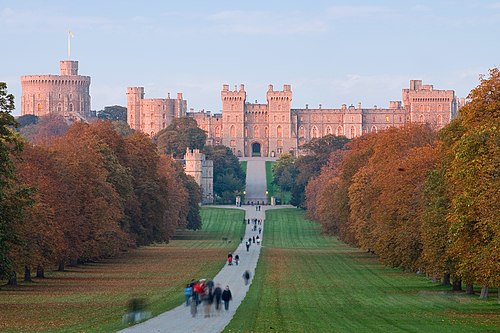 Windsor CastleRestored · prime 1820
 Tower of LondonRestored · prime 1285
 Bamburgh CastleRestored · prime 1904
All castles in England → · Strongest castles in England → · Castles of Europe
Play As Your Clan
Hold a real castle against whatever you choose to send at it, take a ship out in her own service years, or stand at the shoulder of someone the record remembers. The chronicler sets the scene; the deeds are yours.
Notable bearers of the Bell name
- Alexander Graham Bell (1847–1922), inventor of the telephone
- Vanessa Bell (1879–1961), painter, Bloomsbury Group
- Gertrude Bell (1868–1926), archaeologist, diplomat, 'Queen of the Desert'