Cavendish
Dukes of Devonshire, the Chatsworth dynasty.
- Origin
- East Midlands, England
- Motto
- Cavendo tutus
- Famous bearer
- Bess of Hardwick (1527-1608), Countess of Shrewsbury, builder of Chatsworth and Hardwick
- Register
- English family
Ranked of all time
The 15 Most Powerful English Houses of All Time
The Cavendish arms and country

Coat of armsArms of CavendishCC BY-SA 4.0

- Coat of arms: Granted to an individual and inherited down that one documented line. These are the arms of particular families of the name, not of everyone who shares the surname.
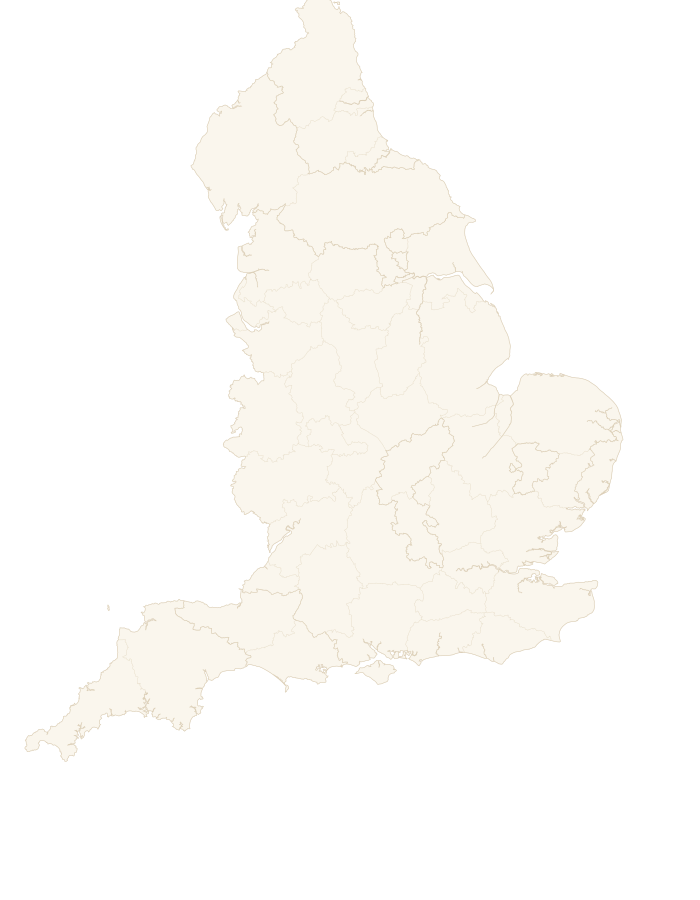
CoreHistoric reach
The seat of Cavendish
Seat vacantChief
No one leads the Cavendish community yet. When the movement opens, you can stand for its leadership, or help elect whoever does.
Current mission
No shared goal set yet. Once Cavendish has leadership, it sets the public focus: a restoration, a gathering, a real-world project that helps its own.
The Cavendish clan is being rebuilt. Join the waiting list for the movement today, and you help decide who leads it and what it does.
Help rebuild the Cavendish clan →Motto
Cavendo tutus
“Safe by being cautious”
What does the Cavendish name mean?
From Cavendish in Suffolk, the East Anglian village from which the family took their surname. The first prominent Cavendish was Sir John Cavendish (d.1381), Chief Justice of the King's Bench under Edward III. The family acquired the Derbyshire estates in the 16th century through Sir William Cavendish's marriage to Bess of Hardwick.
The history of Cavendish
Cafna's enclosure, and the judge who made the name matter
The surname is a Suffolk village. Cavendish appears in the Domesday Book of 1086 as Kavandisc, from the Old English byname Cafa or Cafna, meaning bold or daring, joined to edisc, an enclosed pasture. Family names in England are generally dated to that same survey, first taken by the feudal nobility, some of whom marked themselves out by fixing 'de', of or from, before their village. Cavendish is exactly that kind of territorial surname: a family of Anglo-Norman origin carrying an Anglo-Saxon place-name.
The spelling settled slowly: Kanauadisc in 1086, Cavenedis around 1190 and again in 1242, de Cavendis in 1201, de Cavendish by 1302, the Middle English Cauendish and Caundish leaving the shortened Candish and Cantis behind them. By 1400 most English families held a hereditary surname, and the Cavendishes were a settled Suffolk line: middling gentry with financial roles at court.
The first of them to hold real office was Sir John Cavendish (d.1381), Chief Justice of the King's Bench under Edward III, and the notable lines all descend from him. His brother Roger founded a line of his own, and from it came Thomas Cavendish the Navigator (d.1592), the English admiral whose name the Cavendish tobacco still carries. Until the Tudors, though, the family stayed gentry living beside the manor that had named them.
Dissolution money, and the wife who spent it in Derbyshire
Sir William Cavendish (1505-1557) did very well out of the end of the monasteries. He was one of the commissioners for the dissolution and made a great deal of money handling the disposal of the spoils, which is how a middling Suffolk family came by the capital everything afterwards rests on. What he did with it was decided largely by his second wife.
Elizabeth Hardwick, remembered as Bess of Hardwick (1527-1608), was much the younger of the two, and it was probably she who persuaded him to sell the southern lands around the manor of Cavendish and buy the Chatsworth estate in her native Derbyshire. That one transaction cut the family loose from the village that had named them; the Cavendishes have been at Chatsworth since 1549. Bess built the estate around the house, and built Hardwick Hall, and both are in the family still.
She outlived Sir William by almost fifty years and dominated her Cavendish children by force of personality and by her money, in a household, and that of her last husband George Talbot, 6th Earl of Shrewsbury, marked by fractious relationships. She disinherited the eldest son, Sir Henry. The bulk of her wealth went instead to the second son, William, created Baron Cavendish of Hardwick in 1605 and Earl of Devonshire by James I in 1618, a title for which he is supposed to have paid ten thousand pounds.
Bolsover, Ogle and the second house the family built
Bess's third Cavendish son, Sir Charles, founded the line that became the Dukes of Newcastle, and he began by buying a ruin. George Talbot, 6th Earl of Shrewsbury, keeper of Mary, Queen of Scots at Chatsworth, died in 1590; his son Gilbert, the 7th Earl, sold the wrecked castle at Bolsover to Sir Charles, his step-brother and brother-in-law. Sir Charles wanted a new castle on the old ground, and between 1612 and 1617 raised the Little Castle on the medieval earthworks.
Ogle in Northumberland arrived the other way, by marriage: the heiress of that fortified manor (1568-1629) married Sir Charles, and on her death it passed to their son William Cavendish, later 1st Duke of Newcastle. William bought his own royal ruin in 1630, while still Earl of Newcastle: the King's Houses at Clipstone in Sherwood Forest, which had taken King John's name although he spent nine days there in total. One stone chamber survives.
The 1st Duke was a leading Royalist in the civil war, an important commander though, by report, not a very good general. He went into exile, kept favour through the first years of the Restoration, then drifted from the court. He was England's leading authority on the training of fighting horses, the odd and exact achievement the Newcastle line is remembered for.
The household that hired Thomas Hobbes
Thomas Hobbes was employed as a tutor by the Cavendish family, mainly for William Cavendish, 2nd Earl of Devonshire, and the two went on an early Grand Tour of Europe from 1610. Hobbes stayed attached to the house for the rest of a long life, which is the clearest measure of what the new wealth actually bought: not only masonry, but a permanent place in the household for a philosopher.
The next generation paid for its politics. William Cavendish, 3rd Earl of Devonshire, was a prominent Royalist who was impeached and had his estates sequestrated, spending years in exile until the Restoration returned them. On the Newcastle side, Margaret Cavendish, Duchess of Newcastle-upon-Tyne (1623-1673), was an aristocrat, writer and philosopher.
The Invitation to William, and the dukedom it paid for
In 1688 William Cavendish, then Earl of Devonshire, co-wrote the Invitation to William, the letter asking William of Orange to come to England and exclude Catholics from the monarchy. Its authors became known as the Immortal Seven. The Invitation set the Glorious Revolution in motion that year, and its longer consequence was to shift power towards Parliament: a Cavendish helped write away part of the authority his own class rested on.
The new king paid for it. On his accession the Earl received both the Dukedom of Devonshire, created in 1694, and the office of Lord Steward of the Household: the first of the name to rise to duke. He also rebuilt the great house at Chatsworth in the Baroque, and that rebuilding is the Chatsworth that survives.
One premiership taken, three refused
From 1688 until about 1887 the high appointments came steadily to the Cavendishes, who stood with the Marquesses of Salisbury and the Earls of Derby at the centre of British government, gathering the Dukedom of Newcastle and the baronies of Waterpark and Chesham around the main line. William Cavendish, 4th Duke of Devonshire (1720-1764), was Prime Minister in 1756-57. Later, Spencer Cavendish, Marquess of Hartington until he succeeded as 8th Duke in 1891, was offered the premiership three times, in 1880, 1886 and 1887, and declined on each occasion, serving instead in Liberal and Liberal Unionist cabinets under Gladstone and Salisbury. Of the two records the refusals are the more characteristic: the family motto is Cavendo tutus, safe by being cautious.
The Portland branch reached the same offices by a different road. A daughter of the 2nd Duke married into the Bentinck family, a house of the eastern Netherlands recorded from Johan Bentinck, a landowner near Heerde in documents of 1343 to 1386, which came to England with Hans Willem Bentinck, 1st Earl of Portland, in William of Orange's train. The combined surname Cavendish-Bentinck follows from that marriage, and Welbeck Abbey in Nottinghamshire came to the Dukes of Portland through the Cavendish connection.
The 3rd to 9th Dukes of Portland descended from the Cavendishes through the female line and used the name: William Bentinck, 3rd Duke, was twice Prime Minister, and Lord William Henry Cavendish-Bentinck (1774-1839) was Governor General of India. The Portland dukedom ceased in 1990, and the Lords reforms of 1911, 1958, 1963 and 1999 ended the standing influence the family had held since the Invitation.
A private laboratory on Clapham Common
Henry Cavendish (1731-1810) was born at Nice, eldest son of Lord Charles Cavendish and Lady Anne Grey, grandson of the 2nd Duke of Devonshire on one side and of Henry Grey, Duke of Kent, on the other. His mother died when he was two. His father, himself a careful experimental philosopher and a fellow of the Royal Society, raised him in London, put him at eleven into Dr Newcome's Academy at Hackney and then to Peterhouse, Cambridge in 1749. He left after three years without a degree, for his father's laboratory in Great Marlborough Street.
He inherited enough never to need to earn, and gave sixty years to the bench instead. He kept almost no company beyond the weekly meetings of the Royal Society and its club, and built at Great Marlborough Street and later at a large house on Clapham Common a private laboratory contemporaries thought the best equipped in Europe. Sir Humphry Davy, who saw it after his death, called it simply the finest in the world.
The Three Papers Containing Experiments on Factitious Airs of 1766 identified inflammable air, now called hydrogen, as a distinct substance and fixed the procedures for measuring gases that Lavoisier, Priestley and Black would build on. In 1783 and 1784 he burned hydrogen with oxygen and proved water a compound rather than, as the older chemistry held, an element. In 1797 and 1798, at sixty-six, he used the torsion apparatus bequeathed to him by John Michell to calculate the mean density of the Earth.
He died at Clapham in 1810 and was buried in the family vault at Derby. A mass of unpublished electrical work was found among his papers and edited a generation later by James Clerk Maxwell, who established that Cavendish had anticipated both Coulomb's law and Ohm's law by decades. Maxwell was working at the Cavendish Laboratory at Cambridge, founded in 1874 in Henry's memory by his cousin the 7th Duke of Devonshire, and from that building came the electron, the neutron and the structure of DNA.
Lismore, Gleaston and a habit of inheriting other families' ruins
The Cavendish map is largely assembled from other houses' losses. Lismore stands above the Blackwater on the site of a 7th-century monastery, and Prince John, Lord of Ireland, built the first castle there in 1185. It belonged to the FitzGerald Earls of Desmond until their lands were broken up after the killing of the 14th Earl in 1583; Sir Walter Raleigh acquired it and sold it during his imprisonment to Richard Boyle, 1st Earl of Cork. It passed by marriage to the Cavendishes in 1753, was rebuilt in Gothic style for the 6th Duke, and has been the family's Irish house ever since.
Gleaston came by the same pattern down a longer chain. Built most likely for John Harington, 1st Baron Harington, in the 14th century and first mentioned in 1389, it descended through the Haringtons until the 5th Baron died in 1458, passed by marriage to William Bonville and was abandoned, went to the Greys until Henry Grey, 1st Duke of Suffolk, was executed for treason in 1554, reverted to the Crown, and reached the Cavendishes from the Prestons, who bought it in the 17th century.
What the family holds now is remarkable for its spread rather than its bulk: Chatsworth and Hardwick Hall in Derbyshire, Bolton Abbey in Yorkshire, Lismore in County Waterford. Bolsover, the Little Castle Sir Charles raised, is in the care of English Heritage. Gleaston, deserted barely a century after it was built and so preserving unaltered 14th-century work, is Grade I listed and on the Heritage at Risk register, standing inside a working farm.
Thirty-five stages, and a Cavendish from Douglas
Sir Mark Cavendish was born at Douglas on the Isle of Man on 21 May 1985, son of David Cavendish, an insurance salesman, and Adele Cunningham. He took up cycling at twelve with the Manx Viking Wheelers, left Castle Rushen High School at sixteen for a bank clerk's job with Barclays, kept riding on the British junior circuit, and at eighteen won a place at the British Cycling Olympic Academy in 2003.
He turned professional with the German team T-Mobile in 2007 and took his first major stage win at the Tour of Catalonia that year. In 2008 alone he won four stages of the Tour de France, four of the Giro d'Italia and seven of the Vuelta a Espana. He won Milan-San Remo in March 2009, the first British rider to take a Monument since Tom Simpson in 1964, the green jersey at the 2011 Tour, and the world road title at Copenhagen on 25 September 2011, the first British road world champion since Simpson in 1965.
The number that defines him is the Tour stage count: four in 2008, twenty by 2013, thirty in 2016, thirty-four in 2021, and on 3 July 2024, at the finish of the fifth stage at Saint-Vulbas, a thirty-fifth, passing the record Eddy Merckx set between 1969 and 1975. He closed with 165 professional victories, was BBC Sports Personality of the Year in 2011, was knighted in the 2024 Birthday Honours and retired at the end of that season at thirty-nine. Where the name was once counted in dukedoms and acres, it is now counted in Tour stages: thirty-five.
Champions of the Cavendish name
The bearers whose lives are inseparable from this surname. Each has their own page, biography, achievements, geography, connection to the family.
- Henry Cavendish
The reclusive grandson of two dukes who isolated hydrogen in 1766, proved water to be a compound, and in his Clapham garden weighed the Earth.
- Sir Mark Cavendish
The Douglas-born Isle of Man road sprinter whose career stage-wins total of one hundred and sixty-five career professional victories and thirty-five Tour de France stage wins (the all-time record, surpassing Eddy Merckx at the 2024 Tour) make him the most successful sprinter in the history of professional road cycling.
Historic Places, Rebuilt
Explore the streets and seats the Cavendish name knew, rebuilt with AI as they stood in history.
Castles the Cavendish held
Strongholds this name held for a decade or more, look one up, or rebuild it to explore.
- Lismore Castle
Passed to the Cavendish family, Dukes of Devonshire, in 1753, their Irish home ever since.
- Bolsover Castle
Bought by Sir Charles Cavendish, who built the present castle from 1612 to 1617.
- King John's Palace
Purchased by William Cavendish, Earl of Newcastle, in 1630.
- Ogle Castle
Passed by marriage to Sir Charles Cavendish and then to his son William Cavendish, later 1st Duke of Newcastle, in the 17th century.
- Gleaston Castle
Passed from the Prestons to the Cavendish family.
Landmarks the Cavendish held
Palaces, houses and great buildings tied to this name, look one up, or rebuild it to explore.
- Chatsworth House
Seat of the Cavendish Dukes of Devonshire; the family has held Chatsworth since 1549.
- Hardwick Hall
Passed from Bess of Hardwick to her son William Cavendish, 1st Earl of Devonshire, in 1608, and held by the Cavendish Earls and Dukes of Devonshire until transfer to the Treasury in 1956.
- Chiswick House
Passed by marriage to William Cavendish, 4th Duke of Devonshire, in 1753 and held by the Dukes of Devonshire until 1929.
- Welbeck Abbey
Bought by Sir Charles Cavendish in 1607 and expanded by his son William, Duke of Newcastle.
The castles of the homeland
The great strongholds of the homeland, look one up, see what it looked like in its prime, and recreate it to explore.
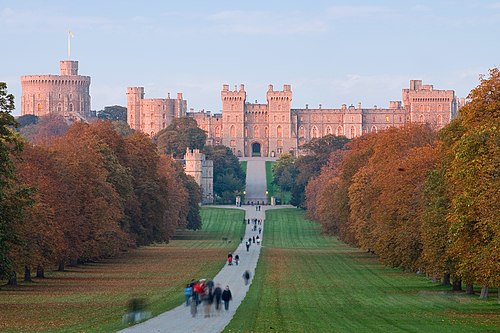 Windsor CastleRestored · prime 1820
 Tower of LondonRestored · prime 1285
 Bamburgh CastleRestored · prime 1904
All castles in England → · Strongest castles in England → · Castles of Europe
Play As Your Clan
Hold a real castle against whatever you choose to send at it, take a ship out in her own service years, or stand at the shoulder of someone the record remembers. The chronicler sets the scene; the deeds are yours.
Notable bearers of the Cavendish name
- Bess of Hardwick (1527-1608), Countess of Shrewsbury, builder of Chatsworth and Hardwick
- William Cavendish, 1st Duke of Devonshire (1640-1707), signatory of the Glorious Revolution
- William Cavendish, 4th Duke of Devonshire (1720-1764), Prime Minister 1756-57
- Henry Cavendish (1731-1810), natural philosopher who measured the density of the Earth
- Peregrine Cavendish, 12th Duke of Devonshire (b.1944), current head of the Cavendish line