Clan Ferguson
also Fergusson, Clan Ferguson
Sweeter from hardship, the descendants of Fergus across many countries.
- Origin
- Perthshire, Scotland
- Motto
- Dulcius ex asperis
- Famous bearer
- Patrick Ferguson (1744–1780), inventor of the Ferguson breech-loading rifle
- Register
- Scottish clan
The Ferguson arms, crest badge, tartan and country

Crest badgeClan member crest badge - Clan FergussonCeltus · CC BY-SA 3.0 
TartanTartan FergusonUnknown author Unknown author · OGL v1.0 
Coat of armsFergusson of Kilkerran coat of armsBorne by the Kilkerran line, one branch of the name rather than all of it.Czar Brodie~commonswiki · CC BY-SA 4.0 
Clan plateFerguson (R. R. McIan)Robert Ronald McIan (1803-1856). · Public domain


.jpg)
- Crest badge: The chief's crest inside a belt and buckle: the badge a clansman wears to show whose following he is in.
- Tartan: The checked cloth the family is known by.
- Coat of arms: Granted to an individual and inherited down that one documented line. These are the arms of particular families of the name, not of everyone who shares the surname.
- Clan plate: Period portrait art of the clan, from the great 19th-century illustrated surveys.
What is the Ferguson clan tartan?
One Ferguson sett is recorded, and it is the swatch above. A sett is the block of coloured bands the cloth is built from, repeated in both directions; the whole plaid is that one square enlarged.
Almost no clan tartan is medieval. Highland dress was proscribed from 1746 until 1782, and when it returned it returned as ceremony rather than everyday cloth, so the surname-to-sett map was fixed after the break, by the Bannockburn weavers’ pattern books, the royal visit to Edinburgh in 1822, and the Vestiarium Scoticum of 1842. The Fergusons wore tartan long before any of that. What the registers fixed was which one. Nobody polices any of it. Wearing the Ferguson sett declares allegiance to the name, not descent from any particular line of it.
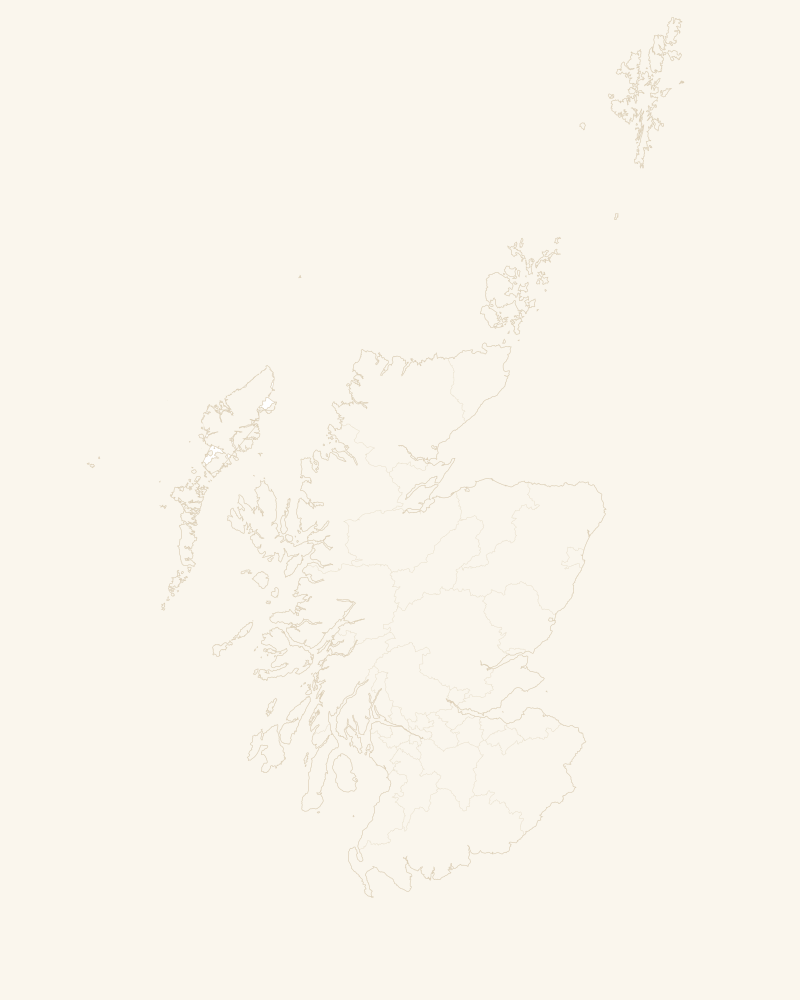
CoreHistoric reach
The seat of Clan Ferguson
Seat vacantChief
No one leads the Clan Ferguson community yet. When the movement opens, you can stand for its leadership, or help elect whoever does.
Current mission
No shared goal set yet. Once Clan Ferguson has leadership, it sets the public focus: a restoration, a gathering, a real-world project that helps its own.
The Ferguson clan is being rebuilt. Join the waiting list for the movement today, and you help decide who leads it and what it does.
Help rebuild the Ferguson clan →Motto
Dulcius ex asperis
“Sweeter from hardship”
What does the Ferguson name mean?
From Mac Fhearghuis, son of Fergus (the Gaelic personal name Fearghus, 'man-strength', borne by the legendary Fergus Mór who is said to have led the Gaels from Antrim to Argyll in the 5th century to found the kingdom of Dál Riata). Multiple Ferguson kindreds developed independently across Scotland, the principal lines being the Fergusons of Strathardle and Glen Shee in highland Perthshire (Atholl Fergusons), the Fergusons of Kilkerran in Carrick (Ayrshire Fergusons), and the Fergusons of Argyll. All Anglicised as Ferguson or Fergusson by the 17th century.
The history of Clan Ferguson
Sons of Fergus, and not one family of them
The Gaelic form of the name is MacFhearghuis, son of Fergus, from the personal name Fearghus, 'man-strength', though the patronymic can also be read as son of the angry. Fergussons are recorded from Ross-shire in the north to Dumfriesshire in the south, and an old tradition holds that all of them share a common ancestor. No evidence supports it, and the heraldry makes the point as plainly as heraldry can: the arms of the chief's family are significantly different from those borne by the other Fergusson families, which is not how one kindred marks itself.
That plurality is what the name is, rather than a gap in the record of it. Gaelic clan surnames were carried by the descendants and dependants of a particular ancestor, not by everyone who happened to live in a chief's territory; the wholesale application of a clan name to a whole district came later, with an administration that did not speak Gaelic. A byname built on a name as ordinary as Fergus was always going to arise in more places than one. Argyll, highland Perthshire, Carrick, Dumfriesshire and Aberdeenshire each produced Fergussons, and the honest account of them is several histories rather than one.
Fergus Mór, Fergus of Galloway and the boar's head
The Fergussons of Argyll claim descent from Fergus Mór, king of Dál Riata, who came from Ireland across Argyll. Most shields of that family carry a boar's head, read as a mark of connection with the early Scots of Dál Riata, and the device survives in the chief's arms: azure, a buckle argent between three boars' heads couped close or.
The Ayrshire and Dumfries Fergussons are linked by evidence to a different Fergus altogether. Fergus of Galloway was a figure of real weight in the reigns of David I and Malcolm IV; he restored the church at Whithorn, founded Dundrennan Abbey and died in 1161 at Holyrood Abbey, and the Earls of Carrick descend from him. Among Scottish clans generally, progenitors can rarely be authenticated further back than the 11th century and an unbroken line is seldom traceable before the 13th or 14th, so both claims are best read as what each branch believed about itself.
Kilkerran, 1464, and the lairds of southern Carrick
The Fergussons held lands at Kilkerran in Carrick probably from the 12th century, but the first certain record is John Fergusson of Kilkerran in 1464. He may have descended from John, son of Fergus, a witness to a charter of Edward Bruce signed in 1314 after the Battle of Bannockburn, though the link is not proven. The density of the name in that corner of Ayrshire is not in doubt: by 1600 there were Fergussons all over southern Carrick, and all of them acknowledged Fergusson of Kilkerran as their chief.
That made them a force in a violent local quarrel. The Fergussons allied with the Kennedy chiefs, the Earls of Cassillis, against the Kennedy Lairds of Bargany, and they rode in John Kennedy, 5th Earl of Cassilis's band in 1601 when a skirmish at Maybole ended with the Laird of Bargany dead. The Ayrshire Fergussons took the Protestant faith at the Reformation, and Sir John Fergusson of Kilkerran fought for the royalists in the Scottish Civil War.
Advocate, judge and general: the Kilkerran baronets
The Kilkerran rise in the following century came through the law rather than the sword. Sir John Fergusson, born about 1653, was a distinguished lawyer and a member of the Faculty of Advocates, and in 1703 he was created a Baronet of Nova Scotia. His son James Fergusson became a judge of the Supreme Court in 1735 and took the title Lord Kilkerran, putting the name on the Scottish bench.
Later baronets kept up the record of service: General Sir Charles Fergusson, the 7th Baronet, served in the British Army for almost forty years. The chiefship of the name and arms is held today by Sir Adam Fergusson of Kilkerran, 10th Bt. That recognition matters more than it sounds. Under Scots law a clan or family is a legally recognised body only once it has a chief acknowledged through the Court of the Lord Lyon; a name group without one has no equivalent standing, whatever it calls itself.
Strathardle, Glen Shee and the Highland Fergusons
The Atholl Fergusons of Strathardle and Glen Shee, in highland Perthshire, are the Highland line, and the catalogue record describes them as the chiefly Ferguson family recognised by the Lord Lyon. The clan account instead names Fergusson of Kilkerran in Carrick as Chief of the Name and Arms. The two statements do not agree, and the question is better shown as contested than quietly settled. The tartans preserve the same split: Fergusson of Atholl, Fergusson of Balquhidder, and Fergusson Dress are separate setts, not variations on one.
The 19th century produced the sept lists, drawn up by clan societies and tartan manufacturers to attach as many surnames as possible to a clan whether or not any connection existed. For a patronymic as widespread as Ferguson the effect is worth naming: these branches are genuinely separate lines, not offshoots of one stem.
Inverugie and the Fergusons of Pitfour
A fourth Ferguson country lies in Aberdeenshire. Inverugie Castle in Buchan was first fortified by the Cheyne, or le Chen, family in the 13th or 14th century, and the ruin is still known as Cheyne's Tower. On the death of Reginald le Chen, Baron Inverugie, in 1345, the estate passed to the Keith Earls Marischal through the marriage of Edward Keith to the heiress Marjory, though the Keiths kept their main seat at Dunnottar on the coast.
The Keith lands were forfeited after the Jacobite rising, and some time after 1745 Inverugie passed to James Ferguson, third Laird of Pitfour, who kept the building in a perfect state until his death in 1820. It is a small, exact illustration of the wider point: a north-eastern Ferguson family holding a Buchan castle, with no recorded connection to Kilkerran or to Strathardle.
The philosopher, the poet and the name since
Sir Adam Ferguson (1723-1816), of the Kilkerran line, was the moral philosopher whose An Essay on the History of Civil Society (1767) is a foundational text of the Scottish Enlightenment alongside Hume, Smith and Robertson. Robert Fergusson (1750-1774), the Edinburgh poet, was the immediate inspiration for Robert Burns's vernacular verse; Burns paid for his headstone in the Canongate Kirkyard in 1787. Patrick Ferguson (1744-1780) invented the Ferguson breech-loading rifle.
The name has kept that reach. Niall Ferguson (b. 1964), born in Glasgow, is the historian of Empire, The Ascent of Money and Civilization. Sarah Ferguson (b. 1959), Duchess of York, descends from a Galloway-Ferguson line and carried the surname into the modern British royal family. Sir Alex Ferguson (b. 1941), born in the Govan shipyard district, carried the name to the summit of the European game. Several separate kindreds, one patronymic, and a long run of people who made something of it.
Champions of the Ferguson name
The bearers whose lives are inseparable from this surname. Each has their own page, biography, achievements, geography, connection to the family.
Historic Places, Rebuilt
Explore the streets and seats the Ferguson name knew, rebuilt with AI as they stood in history.
Historic Places, Rebuilt · New
The Campbells of Glenorchy's stronghold on its island in Loch Awe, garrisoned under Ben Cruachan.
Historic Places, Rebuilt · New
The holy isle at its medieval height, the abbey, the high crosses and the kings' graves, under the Lordship of the Isles.
Castles the Ferguson held
Strongholds this name held for a decade or more, look one up, or rebuild it to explore.
- Inverugie Castle
Held by James Ferguson, third Laird of Pitfour, from some time after 1745 until his death in 1820.
The castles of the homeland
The great strongholds of the homeland, look one up, see what it looked like in its prime, and recreate it to explore.
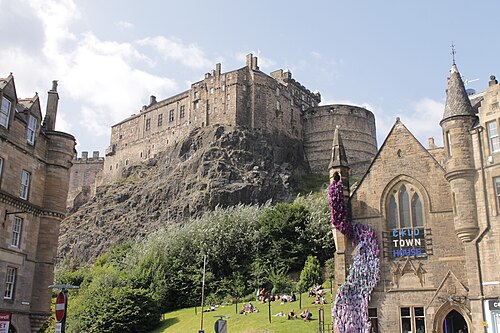 Edinburgh CastleRestored · prime 1520
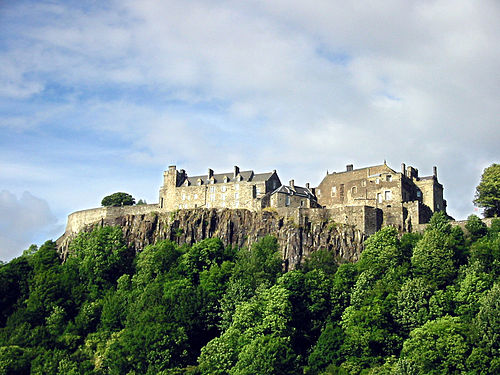 Stirling CastleRestored · prime 1542
 Glamis CastleStill standing · prime 1900
All castles in Scotland → · Strongest castles in Scotland → · Castles of Europe
Play As Your Clan
Hold a real castle against whatever you choose to send at it, take a ship out in her own service years, or stand at the shoulder of someone the record remembers. The chronicler sets the scene; the deeds are yours.
Notable bearers of the Ferguson name
- Patrick Ferguson (1744–1780), inventor of the Ferguson breech-loading rifle
- Sir Adam Ferguson (1723–1816), moral philosopher, An Essay on the History of Civil Society
- Robert Fergusson (1750–1774), Edinburgh poet, formative influence on Burns
- Sir Alex Ferguson (b. 1941), Manchester United manager 1986–2013
- Niall Ferguson (b. 1964), historian (Empire, The Ascent of Money)