Clan Robertson
also Donnachaidh
Children of Duncan, fierce when roused.
- Origin
- Perthshire, Scotland
- Motto
- Garg 'n uair dhuisgear
- Famous bearer
- Alexander Robertson of Struan (c.1670–1749), poet, chief of Clan Donnachaidh, Jacobite of the '15 and '45
- Register
- Scottish clan
Ranked of all time
The 10 Oldest Clans in Scotland
The Robertson arms, crest badge, tartan and country

Crest badgeClan member crest badge - Clan RobertsonCeltus · CC BY-SA 3.0 
TartanRobertson tartan (Vestiarium Scoticum)As printed in the Vestiarium Scoticum, 1842, a collection whose claimed medieval source was never produced, and which is now generally held to be a forgery. Families adopted its patterns anyway, and wear them still.Celtus · CC BY 2.5 
Coat of armsRobertson-ArmsCharles Robertson · Public domain 
Coat of armsRobertson of Struan ArmsBorne by the Struan line, one branch of the name rather than all of it.Czar Brodie · CC BY-SA 3.0 
Clan plateRobertson (R. R. McIan)Robert Ronald McIan (1803-1856). · Public domain

.png)


.jpg)
- Crest badge: The chief's crest inside a belt and buckle: the badge a clansman wears to show whose following he is in.
- Tartan: The checked cloth the family is known by.
- Coat of arms: Granted to an individual and inherited down that one documented line. These are the arms of particular families of the name, not of everyone who shares the surname.
- Clan plate: Period portrait art of the clan, from the great 19th-century illustrated surveys.
What is the Robertson clan tartan?
One Robertson sett is recorded, and it is the swatch above (the plate printed in the Vestiarium Scoticum in 1842). The Vestiarium claimed to copy a medieval manuscript that was never produced, and is now generally held to be a forgery; families adopted its patterns anyway, and wear them still. A sett is the block of coloured bands the cloth is built from, repeated in both directions; the whole plaid is that one square enlarged.
Almost no clan tartan is medieval. Highland dress was proscribed from 1746 until 1782, and when it returned it returned as ceremony rather than everyday cloth, so the surname-to-sett map was fixed after the break, by the Bannockburn weavers’ pattern books, the royal visit to Edinburgh in 1822, and the Vestiarium Scoticum of 1842. The Robertsons wore tartan long before any of that. What the registers fixed was which one. Nobody polices any of it. Wearing the Robertson sett declares allegiance to the name, not descent from any particular line of it.
The seat of Clan Robertson
Seat vacantChief
No one leads the Clan Robertson community yet. When the movement opens, you can stand for its leadership, or help elect whoever does.
Current mission
No shared goal set yet. Once Clan Robertson has leadership, it sets the public focus: a restoration, a gathering, a real-world project that helps its own.
The Robertson clan is being rebuilt. Join the waiting list for the movement today, and you help decide who leads it and what it does.
Help rebuild the Robertson clan →Motto
Garg 'n uair dhuisgear
“Fierce when roused”
What does the Robertson name mean?
Anglicised from Clann Dhonnchaidh, children of Duncan. The change to 'Robertson' dates to Robert Riabhach Duncanson, 4th chief.
The history of Clan Robertson
Clann Dhonnchaidh: the children of a man called Duncan
The clan's own name is older than the surname that now covers it. In Gaelic it is Clann Dhonnchaidh, the children of Duncan, and the Duncan in question was a Highland Perthshire chief of the early fourteenth century, not a king. Highland surnames were overwhelmingly patronymic, built with mac, son, so a descendant of Donnchadh was MacDhonnchaidh. A clan surname was historically carried by the descendants and dependants of an ancestor rather than by everyone living in the clan's country; only when a non-Gaelic-speaking administration began recording the Highlands were clan surnames applied to whole districts at once.
Gaelic kept several forms of the name in use side by side. MacDhonnchaidh is son of Duncan and MacRaibeirt is son of Robert; Robasdan is the surname used after a first name, An Robasdanach is the Robertson standing alone without one, and Na Robasdanaich is the kindred as a whole. The MacDhonnchaidh forms were usual on the mainland and the Robasdan forms on the islands, and the anglicised surname MacConnochie comes off the same root.
The switch to Robertson came from a forename. Robert Riabhach Duncanson, the fourth chief, was so far the making of the kindred that his descendants took his name for their own, and Robertson, Reid and Duncan became the principal surnames of the clan, Duncan and Duncanson being straight translations of MacDhonnchaidh into English and Scots. The clan slogan is Garg 'nuair dhùisgear, fierce when roused, its motto Virtutis gloria merces, glory is the reward of valour, and its plant badge is bracken, taken from Loch Rannoch, Loch Raineach in Gaelic, the loch of bracken.
Stout Duncan, Dunkeld and the king after Methven
The first recognised chief was Donnchadh Reamhar, Stout Duncan, son of Andrew de Atholia, which is Latin for Andrew of Atholl. He was a minor landowner and the leader of a kin-group around Dunkeld in Highland Perthshire. Two accounts of where his line came from have long competed. One makes the founding Duncan the second son of Angus MacDonald, Lord of the Isles. The other makes the Robertsons lineal descendants of the Celtic Earls of Atholl, whose progenitor was King Duncan I, Donnchadh in Gaelic; that is the descent the Collins Scottish Clan and Family Encyclopedia supports, and it is the one the clan itself has carried.
What fixed Stout Duncan in memory was the company he kept. He was held to be an enthusiastic and faithful supporter of Robert I, king from 1306 to 1329, during the Wars of Scottish Independence, and clan tradition has him looking after King Robert after the defeat at Methven in 1306. The clan also asserts that Duncan's relatives and followers, who were not yet called Robertsons by anyone, stood with Bruce at Bannockburn in 1314. Loyalty to the Bruce and then to the Stewart kings became the through-line of the chiefs for the next four centuries.
Duncan is said to have been killed at the Battle of Neville's Cross, and was succeeded by his son Robert. His descendants were known in English and Scots as the Duncansons and in Gaelic as Clann Dhonnchaidh, and the kindred kept both labels for generations before the surname settled. Robert's brother Patrick founded the Robertsons of Lude, which became the principal cadet branch of the clan and would hold its own lands and fight its own wars for the next three hundred years.
Raiders in Angus and the feud with the Stewarts of Atholl
In 1394 the clan fought a pitched battle against Clan Lindsay, with Clan Ogilvy involved, during a cattle raid into Angus. The Ogilvys were the hereditary sheriffs of Angus, the men whose job was to stop such raids, and Sir Walter Ogilvy was killed in the fighting. Clandonoquhy, as the Scots records spelled them, had a considerable reputation as raiders and feuders in late medieval Scotland, even while their chiefs stayed loyal to the Bruce and Stewart dynasties. The cattle were not incidental. One of the clan's own pipe marches is Till an Crodh Dhònnchadh, turn the cattle, Duncan.
The feuding did not stay outward-facing. Robert Riabhach died in 1460 of wounds taken in battle and the chiefship passed to his eldest son Alexander, after which the clan fell into a long quarrel with the Stewarts of Atholl, their nearest and most powerful neighbours. William Robertson, the sixth chief, was killed while trying to recover lands the Stewarts had seized. The eighth chief was murdered and his brother inherited the estate. Two chiefs lost to violence is a measure of how narrow the margin was for a Perthshire kindred holding good ground against a better-connected rival.
Against that, the kindred spread. Cadet houses took root at Lude, at Auchleeks, where the family held a castle from the 1530s, and at Faskally, Inches, Kindeace and Kinlochmoidart, each with its own lands, its own laird and its own line of descent, while the chiefly house held Struan. This was how a Highland clan grew: not as a single household but as a set of related lairds, with lesser families attached by tenancy, marriage or bonds of manrent, who counted themselves Robertsons away from their own glen.
The hand that held up a crown
In 1437 James I was murdered at the Blackfriars Dominican friary in Perth. Robert Riabhach, the Grizzled, Duncanson, fourth chief of Clann Dhonnchaidh, had been a strong supporter of the king, whose reign had begun in 1406, and was incensed by the killing. He hunted the conspirators himself. Two of the regicides, Sir Robert Graham and the king's own uncle Walter Stewart, Earl of Atholl, were run to ground as they hid above Invervack in Atholl, taken by Robert Riabhach and his men, and handed over to the Crown.
The end of that story was brutal. Both men were tortured to death in the Grassmarket in Edinburgh on the orders of the Regent, James I's widow Joan Beaufort, who died in 1445; the Collins Scottish Clan and Family Encyclopedia records that they were put to death with considerable savagery. For a kindred whose recent history was cattle raids and border quarrels with sheriffs, delivering the murderers of a king was a transformation of standing, and the Crown paid for it in the currency that mattered most, which was land and heraldry.
On 15 August 1451 James II awarded the fourth chief the crest that Robertsons still carry: a dexter hand holding up an imperial crown, all proper. Below the shield the arms carry a highly unusual third supporter, a savage man in chains, referring directly to the taking of Graham. James II also erected the clan lands into the Barony of Struan, taking in Glen Errochty, the north and south banks of Loch Tay and the country around Loch Rannoch. It was in honour of Robert Riabhach that his descendants took the name Robertson. None of the barony lands remain in the clan's possession.
Invervack, Auchleeks and the island prison on Loch Rannoch
The original seat was Invervack in Atholl, the same ground above which the regicides were caught, and it was lost in the civil wars of the seventeenth century when Cromwell's forces burned it. Mount Alexander was also among the original seats of the chiefs and was eventually replaced by Dall House. What was destroyed at Invervack was not only a building: many of the family's records burned with it, which is why so much of the clan's early history survives in tradition and royal grant rather than in its own papers.
Lude Castle was in Robertson hands from at least the seventeenth century and went the same way. Alexander Robertson of Lude fought for Charles I at the Battle of Tippermuir in 1644, and in 1650 Cromwell's forces torched Lude in retaliation. Auchleeks Castle, held from the 1530s, was in time replaced by a mansion; the family sold the property in 1962 and its garden is occasionally opened to the public.
The strangest of the clan's holdings sat in the water. Eilean nam Faoilaig, an island near Kinloch Rannoch, carried a castle held by the Robertsons of Struan and used both as a refuge and as a prison, a place to keep men where no rescue party could ride. It says what kind of country this was to hold: bracken, water and long glens, defensible but poor.
One landmark is persistently misattributed. The ruin at Dunalastair has no historical connection to Clan Donnachaidh at all. The house that stood there before it was sold by the then chief to General John Macdonald of Dalchosnie in 1853, and it was Macdonald who built the mansion whose shell now stands. What the family of Struan does retain there is the burial vault in the grounds, and the title Baron of Struan still passes with Dunalastair.
The kirk at the meeting of the waters
Struan, in Gaelic Sruthan, streams, is a parish church of early Christian origin dedicated to St Fillan, standing where the Errochty Water meets the Garry. It gave the chiefs their territorial designation, so that the head of the clan is Robertson of Struan and is styled Struan Robertson. Many of the medieval chiefs were buried in this church, though not one of their individual monuments has survived. The building that stands today was put up in the early nineteenth century, and the foundations of its predecessor can still be traced in the churchyard around it.
Stout Duncan himself is said to lie elsewhere, in the parish church of Dull near Aberfeldy, Gaelic Dul, a meadow or haugh. Members of the Clan Donnachaidh Society excavated within the now redundant church at Dull looking for that grave and did not find it, although they uncovered other burials and a group of early medieval carved stones. The chiefs of recent generations have been buried in the family vault at Dunalastair near Kinloch Rannoch, which remains the one piece of the old ground still in the family's hands.
The clan also kept its history in music, in the piobaireachd written for its chiefs. The salute is Fàilte Thighearna Sruthain, the Laird of Struan's Salute; the gathering is Thàinig Clann Dhònnchaidh, the Robertsons Are Come; the marches include Riobain Gorm, the blue ribbon, and Teachd Chlann Dhònnchaidh, the coming of the Robertsons; and the lament is Cumha Sruthain, the lament for Robertson of Struan. A gathering tune, a march and a lament are the three moments of a clan's public life, and Clann Dhonnchaidh had a piece for each of them.
Montrose's men and the burning of Lude
Under Alexander Robertson, the twelfth chief, the clan is said to have followed James Graham, first Marquis of Montrose, through every battle of his royalist campaign in the Scottish Civil War. It was in this period that the main Robertson castle at Invervack, close to where the clan museum now stands, was burned by Cromwell's forces and the family records lost with it. Following Montrose was consistent with everything the chiefs had done since Stout Duncan; it also cost them their seat.
The clan played a major part in the fighting at the Battle of Inverlochy in 1645, where they put the king's enemies to flight. Alexander Robertson of Lude had already fought for Charles I at Tippermuir, and the burning of Lude by Cromwell's men in 1650 was the bill for it. Between Invervack and Lude the clan lost both its chief seat and the seat of its principal cadet branch.
The last royalist effort in the glens was a shambles. In 1653 the Earl of Glencairn came into Rannoch looking for men for Charles II. He raised Clan MacGregor from the Isle of Rannoch while Alexander Robertson brought his own men out from Fea Corrie; the two forces met above Annat and marched together up the old path towards Loch Garry. The leaders then quarrelled among themselves so bitterly that Cromwell's General George Monk had little difficulty in winning the Battle of Dalnaspidal that followed.
The poet chief of Struan
Alexander Robertson, thirteenth chief, born in 1668, spent most of his adult life either in arms for the Stuarts or in exile for having been. He joined the Jacobite rising of 1689 as a young man and was taken prisoner a few weeks after the Jacobite defeat at the Battle of Dunkeld. Released, he went to live in France for thirteen years, served for a time in the French army, and did not return to Scotland until 1703. He was a poet as well as a chief of Clan Donnachaidh.
In 1715 he led five hundred men of Clan Robertson to the Earl of Mar at Sheriffmuir. He was captured in the aftermath, rescued by his own people, and took refuge in France for the second time. General Wade's report on the Highlands in 1724 put the clan's strength at eight hundred men, and its fighting force was still reckoned at seven hundred in 1745, when Struan, by then in his seventies, came out for the Stuarts a third and final time. He died in 1749, having been on the losing side of every rising of his lifetime.
The reckoning fell on the clan rather than on the old man. After the defeat of the rising of 1745 the Robertson lands were taken into the Forfeited Estates, and the government kept them until 1784, when most were returned to the chief of the day, another Alexander Robertson, once it was accepted that the Central Highlands were wholly pacified. The legislation that followed Culloden went further than confiscation: the Heritable Jurisdictions Act extinguished the right of chiefs to hold their own courts and handed that role to the judiciary, and the ban on Highland dress stood until its repeal in 1782.
Bracken, blackface and the bard of Tongue
The slower change had begun long before Culloden. The Statutes of Iona of 1609 required chiefs to spend much of the year in Edinburgh and to educate their heirs in the English-speaking Lowlands, an expensive obligation in a Highlands that ran on almost no cash. The result was chronic indebtedness and a shift from managing land as a social system to exploiting it commercially. From the 1770s the tacksmen, the middle tier who sublet and organised a clan's farming, were squeezed out; T. M. Devine calls their displacement one of the clearest demonstrations of the death of old Gaelic society.
Where the sheep did come, Robertsons are found among the voices raised against them. In Sutherland, Eòghainn MacDhonnchaidh, Ewan Robertson of Tongue, who lived from 1842 to 1895, was called the Bard of the Clearances. His best known song is Mo mhallachd aig na caoraich mhòr, my curses upon the big sheep, the blackface and Cheviot flocks brought up from England, and it mocks among others the Duchess of Sutherland and the factor Patrick Sellar. It has been recorded by Julie Fowlis and Kathleen MacInnes, and there is a monument to Robertson at Tongue.
The branch lairds did not all keep the course the chiefs of Struan kept. The Strathcarron clearances of 1845 were carried out at Glencalvie by the factor James Gillanders of Highfield Cottage near Dingwall on behalf of the Robertsons of Kindeace. They produced one unexpected legacy. A Gaelic poem denouncing Gillanders for the brutality of those evictions was sent anonymously to Pàdraig MacNeacail, who edited the Gaelic column of The Casket in Antigonish, Nova Scotia, and printed there among emigrant readers. Drawing on eyewitness accounts, it is held to be the only Gaelic-language source for the Glencalvie evictions: a Highland clearance recorded in verse by the people it had sent to Canada.
William Robertson, principal of Edinburgh
William Robertson was born at the manse of Borthwick in Midlothian on 19 September 1721, the eldest of eight children of the Reverend William Robertson, parish minister of Borthwick and later of Old Greyfriars in Edinburgh, and of Eleanor Pitcairn, of the Pitcairn family of mathematicians and physicians. The family moved to the Old Greyfriars manse in 1733; he went to the High School of Edinburgh at twelve and to the University of Edinburgh from 1733 to 1741. Licensed to preach in 1741 and ordained in 1743 to Gladsmuir in East Lothian, he served that country parish for fifteen years and used its leisure to read his way through the historical literature of Europe in five languages.
In January 1746 he was one of a body of Edinburgh volunteers who marched out under Henry Erskine of Cardross to help Hawley's army against the Jacobite advance, and he stood in the centre of the line at the rout of Falkirk Muir on 17 January. In 1759 he published the History of Scotland during the Reigns of Queen Mary and of King James VI in two volumes. The book turned the standard chronicle of the period into the new narrative form that he, David Hume and Edward Gibbon were inventing between them: sources read critically, material ordered by cause and consequence, and a sustained account of the life of a nation rather than a list of events. It went through fourteen editions in his lifetime.
On the strength of it he was elected Principal of the University of Edinburgh on 24 March 1762, at forty, and held the post for thirty-one years. He was chosen Moderator of the General Assembly in 1763 and became leader of the Moderate party against the strict Evangelical wing on patronage, the theatre and the Westminster Confession. By the general agreement of European observers, the Edinburgh of his principalship was the most active intellectual centre in Europe, the city in which Smith, Black, Hutton, Adam Ferguson, Dugald Stewart and Walter Scott all came to maturity.
His later books carried his reputation abroad. The History of the Reign of the Emperor Charles V, three volumes in 1769, was read by Voltaire in 1771 and called by him the most readable historical work of the century; its long preliminary View of the Progress of Society in Europe traced a thousand years of structural change and was singled out by Marx, reading it as a student in Berlin, as a foundational text of the modern philosophy of history. The History of America followed in 1777, written largely from manuscripts obtained through Spanish friends at the court of Madrid. He retired from university duties in 1791, produced the Historical Disquisition Concerning the Knowledge Which the Ancients Had of India that same year, and died at the Grange on 11 June 1793, aged seventy-one.
The name that travelled
In Scotland the surname attached itself to a long line of makers and observers. Allan Robertson, 1815 to 1859, was a Scottish golfer. Christina Robertson, 1796 to 1854, was a Scottish painter and Andrew Robertson, 1777 to 1845, a miniaturist portrait painter. George Croom Robertson, 1842 to 1892, was a Scottish philosopher and Douglas Argyll Robertson, 1837 to 1909, a Scottish ophthalmologist. James Robertson, 1758 to 1820, was a Scottish Benedictine monk who worked as a British intelligence agent during the Napoleonic wars, and Anne Strachan Robertson, 1910 to 1997, a Scottish archaeologist and numismatist. A. E. Robertson, 1870 to 1958, was the first person to climb all 283 of Scotland's peaks.
The emigrant Robertsons carried the name across the English-speaking world. James Robertson, 1742 to 1814, was an explorer and pioneer in what became the state of Tennessee, and John Robertson, 1816 to 1891, served as fifth Premier of New South Wales. George Robertson, 1860 to 1933, a Scot in Australia, founded the publishing house of Angus and Robertson. In Canada, John Ross Robertson, 1841 to 1918, was a newspaper publisher and philanthropist in Toronto, and P. L. Robertson, 1879 to 1951, invented the screw and screwdriver that still carry his name.
In England the name went into the theatre, the pulpit and the grocery trade. Thomas William Robertson, 1829 to 1871, was a dramatist and stage director; Margaret Shafto Robertson, 1848 to 1935, acted as Madge Kendal; Frederick William Robertson, 1816 to 1853, was an English divine; and James Robertson, born about 1831 and dead in 1914, founded the marmalade and jam firm that bears the family name. That spread is a reminder of what Robertson is: a patronymic meaning son of Robert, formed independently in Scotland and in northern England, so not every bearer descends from Struan. The long sept lists linking dozens of surnames to one clan were largely drawn up in the nineteenth century by clan societies and tartan manufacturers, and a shared name is an invitation to the history rather than a proof of descent from it.
Champions of the Robertson name
The bearers whose lives are inseparable from this surname. Each has their own page, biography, achievements, geography, connection to the family.
The castles of the homeland
The great strongholds of the homeland, look one up, see what it looked like in its prime, and recreate it to explore.
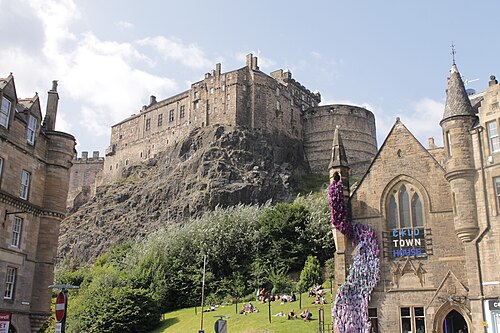 Edinburgh CastleRestored · prime 1520
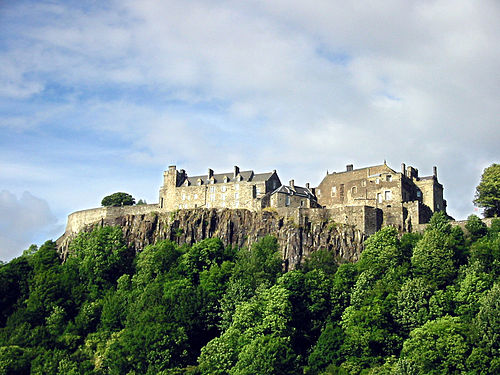 Stirling CastleRestored · prime 1542
 Glamis CastleStill standing · prime 1900
All castles in Scotland → · Strongest castles in Scotland → · Castles of Europe
Play As Your Clan
Hold a real castle against whatever you choose to send at it, take a ship out in her own service years, or stand at the shoulder of someone the record remembers. The chronicler sets the scene; the deeds are yours.
Notable bearers of the Robertson name
- Alexander Robertson of Struan (c.1670–1749), poet, chief of Clan Donnachaidh, Jacobite of the '15 and '45