Clan MacGregor
also McGregor, Gregor
The persecuted clan, proscribed but never broken.
- Origin
- Perthshire, Scotland
- Motto
- 'S rioghal mo dhream
- Famous bearer
- Rob Roy MacGregor
- Register
- Scottish clan
Ranked of all time
The 10 Oldest Clans in Scotland
The MacGregor arms, crest badge, tartan and country

Crest badgeClan member crest badge - Clan GregorCeltus · CC BY-SA 3.0 
TartanMacGregor Green tartanCeltus · CC BY-SA 3.0 
TartanMacgregor Rob Roy tartanMicheletb · CC BY-SA 4.0 
Coat of armsCoat of arms of the Chief of clan GregorThe chief's own arms, borne by the head of the name alone; “of that Ilk” is the designation that says so.Czar Brodie~commonswiki · CC BY-SA 4.0 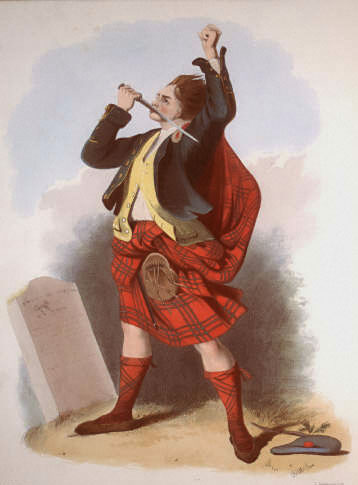
Clan plateMacGregor (R. R. McIan)Robert Ronald McIan (1803-1856). · Public domain


.jpg)
- Crest badge: The chief's crest inside a belt and buckle: the badge a clansman wears to show whose following he is in.
- Tartan: The checked cloth the family is known by.
- Coat of arms: Granted to an individual and inherited down that one documented line. These are the arms of particular families of the name, not of everyone who shares the surname.
- Clan plate: Period portrait art of the clan, from the great 19th-century illustrated surveys.
What is the MacGregor clan tartan?
Two MacGregor setts are shown above. They are not rival claims to be picked between; they are different records, and different weaves, of the same family cloth. A sett is the block of coloured bands the cloth is built from, repeated in both directions; the whole plaid is that one square enlarged.
Almost no clan tartan is medieval. Highland dress was proscribed from 1746 until 1782, and when it returned it returned as ceremony rather than everyday cloth, so the surname-to-sett map was fixed after the break, by the Bannockburn weavers’ pattern books, the royal visit to Edinburgh in 1822, and the Vestiarium Scoticum of 1842. The MacGregors wore tartan long before any of that. What the registers fixed was which one. Nobody polices any of it. Wearing the MacGregor sett declares allegiance to the name, not descent from any particular line of it.
The seat of Clan MacGregor
Seat vacantChief
No one leads the Clan MacGregor community yet. When the movement opens, you can stand for its leadership, or help elect whoever does.
Current mission
No shared goal set yet. Once Clan MacGregor has leadership, it sets the public focus: a restoration, a gathering, a real-world project that helps its own.
The MacGregor clan is being rebuilt. Join the waiting list for the movement today, and you help decide who leads it and what it does.
Help rebuild the MacGregor clan →Motto
'S rioghal mo dhream
“Royal is my race”
What does the MacGregor name mean?
Son of Gregor, from Gaelic, claimed by tradition to descend from a son of Kenneth MacAlpin, first King of Scots.
The history of Clan MacGregor
Mac Griogair, and the claim behind the motto
The surname is Gaelic Mac Griogair, son of Gregor, formed as Highland surnames were: mac for a man, nic for a woman (from nighean mhic, daughter of the son of), so a MacGregor daughter was properly NicGriogair. What the clan made of that plain form was not plain at all. Clan Gregor counted itself among the Siol Alpin, the kindreds claiming descent from Alpin, father of the Kenneth MacAlpin who united the Scottish kingdom in 843, and it put the claim in its slogan: 'S rioghail mo dhream, royal is my race.
Iain Moncreiffe traced the descent from an ancient Celtic royal family through the Abbots of Glendochart; another tradition made Gregor a brother of Kenneth MacAlpin, which the historian William Skene supported though there is little evidence behind it. Documented descent is later and plainer. Most modern historians take the first chief of Clan Gregor to be Gregor of the golden bridles, whose son Iain Camm, One-eye, succeeded as second chief some time before 1390. The clan held Glen Orchy, Glenlochy and Glenstrae, with a presence in Glen Lyon.
Land you live on, land you have papers for
Highland clanship ran on two ideas of heritage at once. Duthchas was a clan's collective right to settle territory its chiefs customarily protected, held by the chief as trustee for his people. Oighreachd was the estate defined by a crown charter, owned by the chief in his own right. Duthchas held precedence in the Middle Ages; by the early modern period oighreachd was what counted in court. Clan Gregor lived in the first world and lost in the second.
The barony of Loch Awe, which took in much of the MacGregor country, was granted by Robert the Bruce to the chief of Clan Campbell. The Campbells had already built Kilchurn Castle, controlling the gateway to the western Highlands, and from there they harried the MacGregors, who retired deeper into their own glens until they were restricted to Glenstrae. The same pattern ran through Glen Lyon. The evidence points to Clan Gregor as the original builders and owners of Meggernie Castle, the tower halfway up the glen beside the river Lyon: five storeys, walls around five feet thick, windows little more than slits. As the MacGregors were driven off, the barony of Glenlyon passed to the Campbells, and the Register of the Great Seal records James VI granting them the land to form it.
Gregor Roy and the Children of the Mist
Iain of Glenstrae, the second of his house to be called the Black, died in 1519 with no direct heirs. The Campbells supported the succession of Eian, who married a daughter of Sir Colin Campbell of Glenorchy; Eian's son Alistair fought the English at Pinkie Cleugh in 1547 and died shortly after. When Gregor Roy MacGregor claimed the estates, Colin Campbell refused to recognise the claim, and Gregor Roy answered with ten years of war, an outlaw lifting cattle and sheltering in the high glens. He was captured in 1570 and murdered by them.
His son Alistair claimed the chiefship and could not stem the persecution of his kinsmen. The losses were heavy enough to give the clan the name it has carried since: the Children of the Mist. John Drummond, the king's forester, hanged a number of MacGregors for poaching and was killed for it; the chief took responsibility for the killing, and the Privy Council condemned it.
Glen Fruin, 1603
In response to the execution of two MacGregor clansmen in 1603, Alasdair MacGregor marched into Colquhoun territory at the head of more than 400 men. The chief of Clan Colquhoun held a royal commission to suppress the MacGregors, and came out with 500 foot and 300 cavalry, advancing to Glen Fruin to hunt the Highland raiders down.
It was the MacGregors who did the hunting. Alasdair split his force: while the main body engaged the Colquhouns in front, the second came in on their rear. The Colquhouns were driven into the Moss of Auchingaich, where their cavalry was useless, and over 200 were killed. The victory was complete, and it was the ruin of them. At the end of the eighteenth century, in an act of good will, the chiefs of the two clans met and shook hands on the site of the slaughter.
Altogidder abolisheed: the year the name became a capital offence
In April 1603 James VI issued an edict proclaiming the name of MacGregor 'altogidder abolisheed'. Anyone who bore it had to renounce it or suffer death. In 1604 the chief and eleven of his chieftains were hanged at the Mercat Cross in Edinburgh. Robert Birrel, an Edinburgh burgess keeping a diary, recorded that MacGregor was conveyed to Berwick under guard to satisfy the Earl's promise to put him out of Scottish ground, and that the guard was never directed to part with him but to fetch him back again. He came again to Edinburgh on the 18th of January; on the 20th he was hanged at the Cross with eleven of his friends and name, himself, being chief, hanged his own height above the rest.
The clan was scattered. MacGregors took other names, Murray and Grant among them, and were hunted like animals, flushed out of the heather by bloodhounds. An act of the Scottish Parliament in 1617 turned the screw again: the whole persons of that clan were to renounce the name and take some other, and any of their children or posterity who at any time afterwards assumed the name Gregor or MacGregor would incur the pain of death, to be executed upon them without favour.
Not everyone obeyed. Clan Lamont defied the edict and gave aid and refuge to fleeing MacGregors on their lands in Cowal. Clan Chattan protected MacGregors in Badenoch from the MacDonalds of Keppoch. A surname could be abolished on paper; the people carrying it were harder to abolish. The Clan Gregor Society still keeps separate lists of the names its people sheltered under: those documented from the proscription, those held by family tradition, and the names of other clans MacGregors are known to have used.
Fighting for the crown that had outlawed them
Despite the savage treatment, the MacGregors fought for the king in the Scottish civil war. Some 200 men of Clan Gregor turned out for the Earl of Glencairn in his rising against the Commonwealth, and Charles II answered by repealing the ban outright: the Clan Gregor Act 1661. In law, MacGregors were MacGregors again.
It did not hold. After Charles's brother James VII was deposed, William of Orange reimposed the proscription in 1693, and the clan went back under borrowed names. (The sources give the final repeal as 1774 in two places and as 1784 in a third.) Something else belongs to these years: Clan Gregor was among the first families in Scotland to begin playing the bagpipes, in the early seventeenth century.
Rob Roy, the drover who carried the name back
Robert Roy MacGregor was born at Glengyle at the head of Loch Katrine on the seventh of March 1671, fifth son of Lieutenant-Colonel Donald MacGregor of Glengyle and Margaret Campbell of Glenfalloch. Roy is Gaelic ruadh, red, for his auburn hair. He was born into the proscribed clan, his family living legally under his mother's borrowed surname of Campbell. He fought in his twentieth year at Killiecrankie in 1689 in Lochiel's Cameron regiment, then built the leading drove-cattle business in the central Highlands, taking black cattle south each autumn over the Trossachs passes and the Endrick crossings to the great trysts at Crieff and Falkirk. By 1707 he was the principal cattle dealer of the Loch Lomond and Trossachs country, with his own herd at Inversnaid and the chiefship of the MacGregors of Glengyle.
In 1712 a herdsman absconded with a thousand pounds of working capital Rob had borrowed from James Graham, first Duke of Montrose, against an autumn drove. Montrose declared him a defaulting debtor, his lands at Craigrostan were forfeited, his cattle seized, and the Court of Session outlawed him. From then on he ran the central Highlands as a private power: an armed company of some thirty MacGregor and Stewart kinsmen, a base at Inversnaid above Loch Lomond, raids in retaliation on Montrose's lands at Buchanan, black-mail levied on Lowland farmers as the price of being left alone, and protection for a great many small Trossachs tenants against the improvers and their factors.
He fought at Sheriffmuir in November 1715 in the Earl of Mar's Jacobite army and afterwards set out plundering at will; one raid on Dumbarton panicked the town and the castle opened fire with its cannon. He led Clan Gregor at Glen Shiel in 1719. Montrose's men took him at Balquhidder in 1717 and he escaped twice on the road south, the second time by leaping from his horse and swimming the Forth at Stirling in spate. He outlasted the redcoat garrisons Field-Marshal Wade posted at Inversnaid through the 1720s, came in under a pardon from George I, and died in his bed at Inverlochlarig on the twenty-eighth of December 1734, in his sixty-fourth year. His grave in Balquhidder kirkyard is marked by a plain slab cut with a Highland sword and the words Dum Spiro Spero: while I breathe, I hope.
Colours flying past Finlarig, and 826 signatures
Some of Clan Gregor fought at Prestonpans in 1745 under the Duke of Perth. Others were with the Jacobite force beaten at Littleferry in Sutherland in 1746 and so missed Culloden the next day, too far off to arrive in time. The road home says more about the clan than either battle: no one ventured to interfere with the MacGregors as they strode across Atholl with their colours flying, past Finlarig Castle where, by one account, the Campbell militia durst not move more than pussies, defying in broad daylight the outposts Lord Campbell of Glenorchy had set in the passes. The persecution did not end until 1774, when the laws against the name were repealed.
Restoring the chiefship came next. Eight hundred and twenty six MacGregors subscribed to a petition declaring General John Murray of Lanrick the true chief; Murray was in fact a MacGregor, descended from Duncan MacGregor of Ardchoille, who died in 1552. His son Sir Evan took a part in the visit of George IV to Scotland in 1822, where he and his clansmen were given the honour of guarding the Honours of Scotland, the oldest crown jewels in the British Isles. The name travelled in print too: Defoe's partly fictional Highland Rogue appeared in 1723, and Walter Scott's Rob Roy in 1817 put a MacGregor at the centre of how the English-speaking world imagined the Highlands.
The chiefship runs still, in Sir Malcolm Gregor Charles MacGregor of MacGregor, 7th Baronet of Lanrick and Balquhidder and 24th Chief of Clan Gregor, whose Gaelic designation is An t-Ailpeanach, testimony to the traditional descent from Siol Alpin. The crest is a lion's head crowned with an antique crown; the plant badge is Scots pine. Descendants of Rob Roy settled around McGregor, Iowa, where in 1849 the original clan seal and signet was reported in the hands of Alex McGregor: a bloodstone from Loch Lomond, sketched by William Williams, inscribed Triogal Ma Dh'ream, Een dhn bait spair nocht, read as I am of royal descent, slay and spare not. Carrying the name was a capital offence from 1603, and again from 1693 until 1774. It is still here.
Champions of the MacGregor name
The bearers whose lives are inseparable from this surname. Each has their own page, biography, achievements, geography, connection to the family.
Historic Places, Rebuilt
Explore the streets and seats the MacGregor name knew, rebuilt with AI as they stood in history.
Historic Places, Rebuilt · New
The Campbells of Glenorchy's stronghold on its island in Loch Awe, garrisoned under Ben Cruachan.
Historic Places, Rebuilt · New
The holy isle at its medieval height, the abbey, the high crosses and the kings' graves, under the Lordship of the Isles.
Castles the MacGregor held
Strongholds this name held for a decade or more, look one up, or rebuild it to explore.
- Meggernie Castle
Evidence points to Clan Gregor as Meggernie's original builders and owners, before the MacGregors were driven from their Glen Lyon lands.
The castles of the homeland
The great strongholds of the homeland, look one up, see what it looked like in its prime, and recreate it to explore.
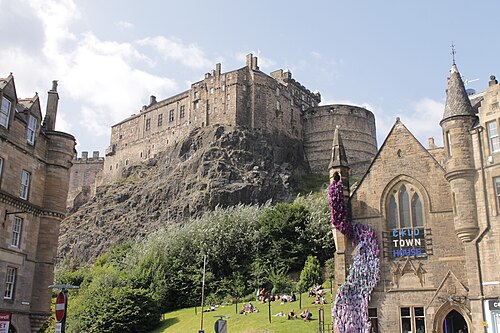 Edinburgh CastleRestored · prime 1520
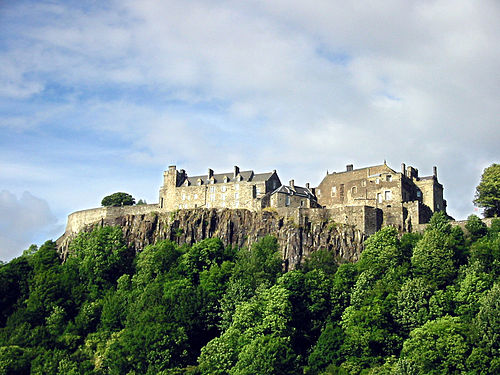 Stirling CastleRestored · prime 1542
 Glamis CastleStill standing · prime 1900
All castles in Scotland → · Strongest castles in Scotland → · Castles of Europe
Play As Your Clan
Hold a real castle against whatever you choose to send at it, take a ship out in her own service years, or stand at the shoulder of someone the record remembers. The chronicler sets the scene; the deeds are yours.
Notable bearers of the MacGregor name
- Rob Roy MacGregor
Stories of Clan MacGregor
The Battle of Glen Fruin
1603In February 1603, days before James VI of Scotland departed Edinburgh to take the English throne, Alasdair MacGregor of Glenstrae led four hundred clansmen down Glen Fruin onto the lands of the Colquhouns of Luss, in a long-running cattle feud over Loch Lomond pasture. By the day's end roughly one hundred and forty Colquhouns lay dead. The widows of Luss rode to Stirling and presented the bloodied shirts of their men to the king. James, on the eve of inheriting an English crown and intent on showing the southern court a settled north, signed a Letter of Fire and Sword. The very name MacGregor was abolished. The proscription would stand for one hundred and seventy-one years.
Read the story →
Rob Roy MacGregor
1671–1734Robert Roy MacGregor, born 1671 at Glengyle on Loch Katrine, was the third son of a clan that was not legally allowed to bear its own name. He worked as a cattle dealer and grew rich on the protection trade. In 1712 a sum of one thousand pounds advanced to him by James Graham, Duke of Montrose, vanished with one of his drovers; Montrose called the loan, seized Rob Roy's house at Inversnaid and evicted his wife and children. Rob Roy declared open war on the duke. For more than two decades he raided Montrose's lands, stole his rents, and lived as an outlaw under the protection of the rival Duke of Argyll. He died at Balquhidder in 1734, aged sixty-three, having sat up on his deathbed to refuse a death he had not yet finished arranging.
Read the story →