Griffiths
also Gruffydd, ap Gruffydd, Griffith
Son of the strong lord, the patronymic of Llywelyn the Last.
- Origin
- Deheubarth, Wales
- Famous bearer
- Ann Griffiths (1776–1805), Welsh hymn-writer of Dolwar Fach
- Register
- Welsh family
The Griffiths arms and country

Coat of armsArms of GriffithsS Burden · CC BY-SA 4.0

- Coat of arms: Granted to an individual and inherited down that one documented line. These are the arms of particular families of the name, not of everyone who shares the surname.
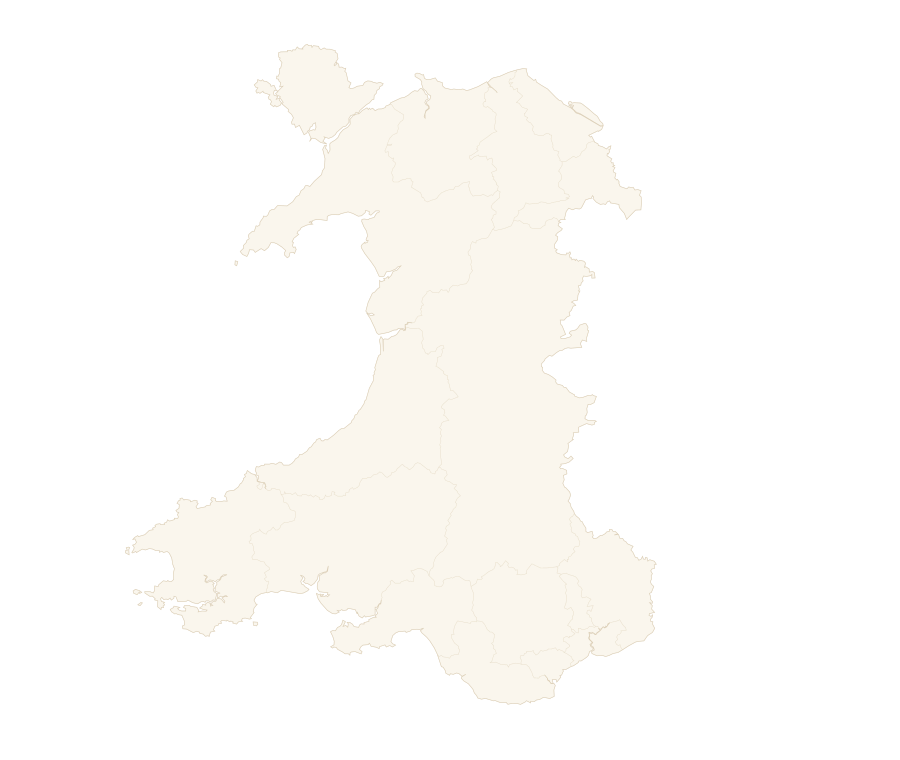
CoreHistoric reach
The seat of Griffiths
Seat vacantChief
No one leads the Griffiths community yet. When the movement opens, you can stand for its leadership, or help elect whoever does.
Current mission
No shared goal set yet. Once Griffiths has leadership, it sets the public focus: a restoration, a gathering, a real-world project that helps its own.
The Griffiths clan is being rebuilt. Join the waiting list for the movement today, and you help decide who leads it and what it does.
Help rebuild the Griffiths clan →What does the Griffiths name mean?
From ap Gruffydd, son of Gruffydd, the personal name borne by Llywelyn the Last (Llywelyn ap Gruffydd, the last sovereign Prince of Wales) and by the family of Owain Glyndŵr. The genitive 's' of Tudor surname compression turned ap Gruffydd into Griffiths and the southern variant Griffith. The personal name itself derives from Old Welsh Gruffudd ('strong lord'), one of the most resonant princely names of mediaeval Wales.
The history of Griffiths
The name three princes carried
Gruffudd is Old Welsh for strong lord, and it was a name the ruling houses of Wales reached for first. Gruffydd ap Cynan (1055–1137) and Gruffydd ap Llywelyn ap Iorwerth, who died in 1244, were sovereign princes of Gwynedd, and the last sovereign Prince of Wales, who fell at Cilmeri in 1282, was Llywelyn ap Gruffydd: a man identified, in the ordinary Welsh way, as the son of a Gruffydd. The name ran in the family of Owain Glyndŵr as well. It was among the most prestigious personal names in Welsh use, carried especially in Gwynedd and along the Welsh borderlands.
That prestige is why the surname exists in quantity: a patronymic can only be as common as the given name behind it. What Griffiths records is not descent from a prince. It records a father, one man in one parish called Gruffydd, at the moment the naming system stopped turning over.
1292, Henry VIII, and the century the name stopped moving
Before surnames, a Welshman's name was a sentence about his descent, his baptismal name linked by ap or ab (son of) to his father's, and the chain could run back seven generations: a genealogical history of the male line, kept because Welsh law made it essential to know how a person descended from an ancestor. In 1292, 48 per cent of Welsh names were patronymics, in some parishes over 70 per cent.
Those laws decayed in the later Middle Ages, and fixed surnames came in from the 15th century onwards. In the reign of Henry VIII (1509–1547) surnames became hereditary among the Welsh gentry and spread slowly among commoners, and the same king ordered that marital births be recorded under the surname of the father. Town families, the wealthy and the districts nearest England had given up patronymics earlier; in remote country the old system ran on into the early 19th century.
A freezing patronymic could go three ways: keep the ap in reduced form at the front, as in Powell (ap Hywel), Price (ap Rhys) and Bowen (ab Owen); drop the ap; or take the English genitive s that produced Jones, Roberts and Edwards. Gruffydd left no P-name in general use. It took the other two routes at once, giving the bare Griffith and the s-form Griffiths, two clerks' answers to the same question rather than two families.
Two Griffiths in one parish, and the counties the name holds
Welsh surnames are patronymics drawn from a small stock of first names, so Welsh communities hold families of the same surname who are not related, and it cannot be assumed that two people of one name in one village share an ancestor. Every household with a father called Gruffydd founded a Griffiths line of its own, in parishes that had no dealings with each other: hence two Welsh rugby union players named Dan Griffiths, a forward born in 1857 and a fly-half born in 1979, with no kinship recorded between them. The 19th century answered that sameness with the double surname, prefixing a house, a parish or the mother's family, as in Griffith-Jones. Philip Jones Griffiths (1936–2008), the Welsh photojournalist, carried that shape of name.
The surname sits heaviest in Pembrokeshire and Carmarthenshire and in Gwynedd, where the princely given name ran longest, with older weight in Denbighshire, Flintshire, Powys and Ceredigion.
Dolwar Fach, and the seventy-four hymns nobody wrote down
Ann Thomas was born in April 1776 at the farmhouse of Dolwar Fach, in the parish of Llanfihangel-yng-Ngwynfa in the high country of southern Montgomeryshire, fourth of the five children of John Evan Thomas and Jane Theodore, Anglicans of moderate Methodist sympathies and small means. She knew the Welsh Bible by heart in early adolescence and took over the household at eighteen when her mother died in 1794. At the Easter Communion at Llanfyllin in 1796 she came under the preaching of the Calvinistic Methodist itinerant Benjamin Jones, and in 1797 joined the society at Pontrobert under the seiat leader John Hughes. She took the surname in October 1804, on her marriage to Thomas Griffiths of Meifod.
From about 1802 she composed Welsh-language hymns at the hearth at Dolwar Fach, in the long evenings between the farm-work, at the spinning wheel and at the kitchen table. She did not write them down. She dictated them to the family servant Ruth Hughes of Dolwar Fach, who memorised them and could repeat them word-perfect on demand. For three years the whole body of work existed in one woman's head.
Ann Griffiths died at Dolwar Fach in August 1805, in her thirtieth year. On John Hughes's instruction, Ruth Hughes dictated the seventy-four surviving hymns to the Welsh-language Methodist press at Bala, and they were printed in 1806 in the second edition of Mary Jones of Llandinam's Hymnau a gyfansoddwyd ar amrywiol achosion. It ran to over a hundred editions in the next forty years, and twenty-six of the seventy-four are in continuous use still. Wele'n sefyll rhwng y myrtwydd is the central single hymn of the Welsh Methodist tradition.
Chapel country
The tradition Ann Griffiths wrote into was no minority interest. Welsh nonconformism and Methodism were strong enough to carry the Sunday Closing (Wales) Act 1881 through Parliament, the first legislation issued specifically for Wales since the Middle Ages.
The 1979 final, and the name in the Welsh game
Terry Griffiths (1947–2024) of Llanelli won the World Snooker Championship in 1979, only the second qualifier ever to take the title.
In rugby the name runs from Dan Griffiths (1857–1936), a forward, and Rowland Griffiths (1886–1914), a Wales international, to Mike Griffiths (born 1962) and Bryn Griffiths (born 1982). In football it runs from Llewelyn Griffiths (1877–1943) through Stan Griffiths (1911–2003) and Estyn Griffiths (1927–2017) to Rhys Griffiths (born 1980), player and manager; Leigh Griffiths (born 1990) carried it into the Scottish game. On the track, Cecil Griffiths (1901–1945) ran as a Welsh sprinter and middle-distance runner.
Print, stage and the writing life
The name reaches the book trade with Ralph Griffiths (c. 1720–1803), the English editor and publisher. Two centuries later Trevor Griffiths (1935–2024), the Manchester-born dramatist of Welsh and Lancastrian descent, wrote Comedians and the screenplay for Reds. The novelists Elly Griffiths (born 1963) and Niall Griffiths (born 1966) and the Welsh poet Bryn Griffiths (1933–2025) carry the name in fiction and poetry.
Gwenny Griffiths (1867–1953) was a Welsh painter; Richard Griffiths (1947–2013) and Derek Griffiths (born 1946) made their careers as British actors; Jemma Griffiths (born 1975) is the Welsh singer-songwriter known as Jem.
The name overseas
Griffiths went with them. Eliezer Griffiths (1827–1920) served as a Welsh Congregationalist minister in Australia; Jennie Scott Griffiths (1875–1951) worked as a journalist and women's rights activist in America, Fiji and Australia; Bede Griffiths (1906–1993) was a British-born monk and missionary in India. Andy Griffiths (born 1961), whose Treehouse books are read across the English-speaking world, descends from a south Wales Griffiths line that settled in Melbourne in the gold rush of the 1850s.
Champions of the Griffiths name
The bearers whose lives are inseparable from this surname. Each has their own page, biography, achievements, geography, connection to the family.
Historic Places, Rebuilt
Explore the streets and seats the Griffiths name knew, rebuilt with AI as they stood in history.
Historic Places, Rebuilt · New
Edward I's walled bastide and mighty castle in North Wales, a generation after the conquest, the banded towers still rising.
Historic Places, Rebuilt · New
Owain Glyndŵr's mountain fortress and court at the high tide of Welsh independence, the English siege lines gathering below.
The castles of the homeland
The great strongholds of the homeland, look one up, see what it looked like in its prime, and recreate it to explore.
 Caernarfon CastleRestored · prime 1330
 Conwy CastleRuin · prime 1287
 Pembroke CastleRestored · prime 1280
All castles in Wales → · Strongest castles in Wales → · Castles of Europe
Play As Your Clan
Hold a real castle against whatever you choose to send at it, take a ship out in her own service years, or stand at the shoulder of someone the record remembers. The chronicler sets the scene; the deeds are yours.
Notable bearers of the Griffiths name
- Ann Griffiths (1776–1805), Welsh hymn-writer of Dolwar Fach
- Trevor Griffiths (b. 1935), playwright (Comedians; the Reds screenplay)
- Terry Griffiths (b. 1947), World Snooker Champion 1979
- Andy Griffiths (b. 1961), Australian children's author (the Treehouse series)
Stories of Griffiths
Frequently asked
What does the surname Griffiths mean?
Where does the Griffiths family come from?
Where did the Griffiths family historically hold territory?
Is Griffiths Welsh or English?
How old is the Griffiths surname?
What is the Griffiths family known for?
Is there a Griffiths family crest or coat of arms?
Who is the most famous Griffiths?
Who are some famous Griffithses?
What stories are told about the Griffiths family?
What is the story of Ann Griffiths and the hymns of Dolwar Fach?
Is Gruffydd the same family as Griffiths?
Is ap Gruffydd the same family as Griffiths?
Is Griffith the same family as Griffiths?
Where is the Griffiths surname found today?
What does the Clan Rising page for the Griffiths family cover?
Who is the head of the Griffiths family today?
Neighbouring clans
- JonesSon of John, and roughly one in twenty Welsh-descended people in the world.
- WilliamsSon of William, second only to Jones in Welsh density, and first in the north.
- DaviesSon of David, born of the patron saint's name and densest in his own corner of Wales.
- ThomasThe fifth Welsh surname, son of Thomas, on the same Tudor-era road as Jones and Williams.