Grosvenor
also le Grosvenor
Dukes of Westminster, the wealthiest landowners in Britain.
- Origin
- North West, England
- Motto
- Nobilitatis virtus non stemma character
- Famous bearer
- Sir Thomas Grosvenor, 3rd Baronet (1655-1700), through whose marriage the family acquired the Manor of Ebury (modern Mayfair and Belgravia)
- Register
- English family
Ranked of all time
The 15 Most Powerful English Houses of All Time
The Grosvenor arms and country

Coat of armsArms of Grosvenor, Baronet of EatonBorne by the Eaton line, one branch of the name rather than all of it.MostEpic · CC BY-SA 4.0 
Coat of armsCoat of Arms of the Duke of Westminster without Order of GarterBorne by the Duke of Westminster: the ennobled line of the name, not the name at large.Thunderstorm008, based on Sodacan 's work. · CC BY-SA 4.0


- Coat of arms: Granted to an individual and inherited down that one documented line. These are the arms of particular families of the name, not of everyone who shares the surname.
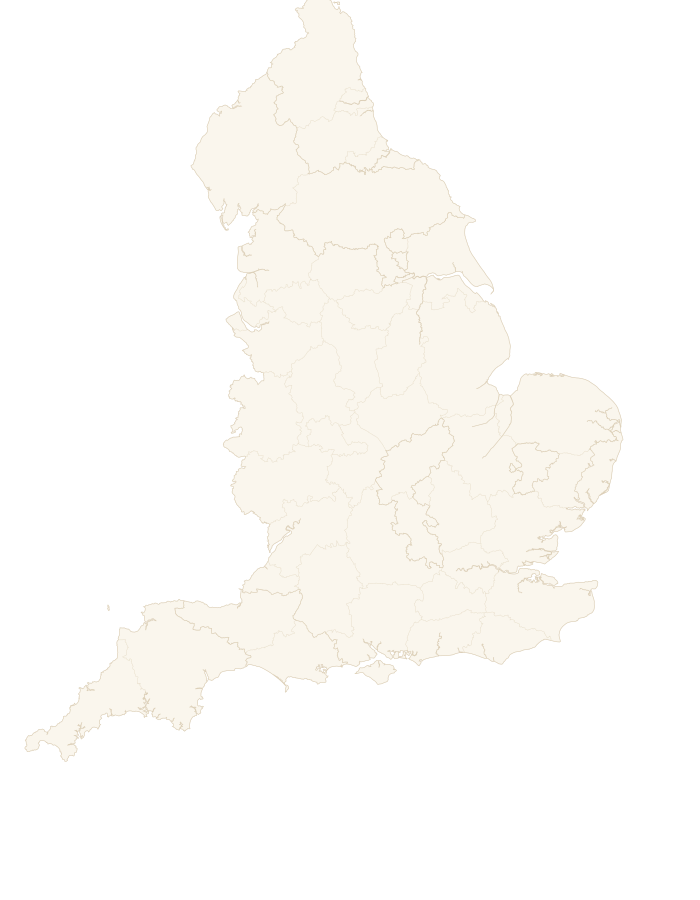
The seat of Grosvenor
Seat vacantChief
No one leads the Grosvenor community yet. When the movement opens, you can stand for its leadership, or help elect whoever does.
Current mission
No shared goal set yet. Once Grosvenor has leadership, it sets the public focus: a restoration, a gathering, a real-world project that helps its own.
The Grosvenor clan is being rebuilt. Join the waiting list for the movement today, and you help decide who leads it and what it does.
Help rebuild the Grosvenor clan →Motto
Nobilitatis virtus non stemma character
“Virtue, not pedigree, is the mark of nobility”
What does the Grosvenor name mean?
Norman territorial surname meaning 'the great huntsman' (from Old French 'gros veneur'), originally the title of the master huntsman to a great Norman lord. The English Grosvenor family traces its descent to Gilbert le Grosvenor, who came to England with William the Conqueror in 1066 and settled in Cheshire. The senior line has held its core Cheshire estates continuously since the 11th century.
The history of Grosvenor
Gilbert le Grosveneur and the huntsman's name
Grosvenor is not a place but a post. In Norman French, le gros veneur is the great huntsman, or less flatteringly the fat huntsman, and it was the working title of the master of the hunt in a great lord's household rather than the label of a village anyone came from. The Cheshire family that carried it into the English peerage traces itself to Gilbert le Grosveneur, who by the family's own account was a relative both of William the Conqueror and of Hugh d'Avranches, Earl of Chester, and who settled in Cheshire after the Norman Conquest. The office is fossilised in the spelling: a man identified by the animals he brought down for somebody else.
Cheshire was no accident of settlement. In early 1070, having driven Edgar the Aetheling back into Scotland and wintered his army through the devastation of Northumbria, William returned to Mercia and based himself at Chester, crushing what remained of resistance in the region before turning south again. The year before, rebel forces from Cheshire and Shropshire had joined Eadric the Wild and his Welsh allies in an attack on the castle at Shrewsbury. The county was a frontier command, and the men William installed there held it as a military tenancy.
What followed was the near-total replacement of one landowning class by another. The Domesday survey of 1086 records the scale of it: only about five per cent of land in England south of the Tees remained in English hands, and after 1075 every earldom was held by a Norman. That survey is also the conventional starting point for hereditary English family names, which were taken up first among the feudal nobility and gentry and spread downward from there. Many of the incoming Normans marked themselves with a de and the name of their French village, a territorial surname born of feudal landholding. Grosvenor belongs to the other kind, the kind that records what a man did at his lord's stirrup.
Veneur, cadge and the king's deer
The Conquest brought the forest laws with it, and with them the setting aside of large tracts of England as royal forest. Across most of medieval Europe the upper class secured for itself the sole right to hunt within defined areas of a feudal territory. Game in those areas was a source of food and furs, generally supplied by professional huntsmen, but it was also expected to furnish recreation for the aristocracy who owned it. The proprietary force of that arrangement survives in the Robin Hood legends, where the standing charge against the outlaws is that they hunt the King's deer.
Norman practice was precise about its pleasures. Medieval Normans distinguished falconry, pursued on horseback, from hawking, pursued on foot, and both were central to Norman cultural identity; an immediate consequence of the Conquest was a Norman appetite for falconry so strong that commoners were barred from hunting particular lands so that the nobility could enjoy both sports undisturbed. The birds travelled on a frame called a cadge. The chase itself carried a martial justification: dangerous hunting after boar or lion, done from horseback or a chariot, served a purpose close to that of the tournament, and hunting ranked as an honourable and competitive pastime by which the aristocracy kept the skills of war sharp in peacetime. Johannes Scotus Eriugena counted hunting among the seven mechanical arts.
Two things emerged once hunting stopped being a matter of subsistence: the sport of an upper class, and the specialist hunter with his own training and equipment to serve it. That specialist is the man the surname names. The Book of Saint Albans, first printed in 1486 and usually attributed to Dame Juliana Berners, set out how rigidly the whole business was graded, allotting the gyrfalcon to a king, the peregrine to an earl, the goshawk to a yeoman, the sparrowhawk to a priest and the kestrel to a knave or servant. The veteran British falconer Phillip Glasier dismissed the list as merely a formalised and rather fanciful listing of birds, and it was wrong on several counts, but it captures the point exactly: the hunt was a ladder of rank, and a veneur was the officer who kept it running.
Baronets of Eaton, and a title that went sideways
The family's first hereditary honour came in January 1622, when Richard Grosvenor was created Baronet of Eaton. Sir Richard Grosvenor, 1st Baronet (1584-1645), sat as a Member of Parliament, and the baronetcy passed on his death to his son, Sir Richard Grosvenor, 2nd Baronet (1604-1664). At that stage the Grosvenors were what their Cheshire neighbours were: county gentry with a seat, a shire voice and no particular reason to be remembered outside the county.
The line then took the first of several awkward turns. Roger Grosvenor, born about 1628, was the 2nd Baronet's son and should have succeeded him, but he died in 1661, three years before his father. The title therefore skipped a generation and went to Roger's son, Sir Thomas Grosvenor, 3rd Baronet (1655-1700), who inherited as a child and who would, through a single transaction, change what the surname meant.
After Sir Thomas the baronetcy travelled sideways rather than downward, moving through his three sons one after another. Sir Richard Grosvenor, 4th Baronet (1689-1732), the eldest, died without issue. Sir Thomas Grosvenor, 5th Baronet (1693-1733), the second son, died unmarried. It fell at last to the third and youngest, Sir Robert Grosvenor, 6th Baronet (1695-1755). Three brothers held the estate in succession across fifty-five years and none of the first two broke it up, so what Sir Thomas had acquired in 1677 reached the seventh baronet, Sir Richard Grosvenor (1731-1802), whole.
The contract to marry Mary Davies, aged twelve
In 1677 Sir Thomas Grosvenor took over the contract to marry Mary Davies, then aged twelve. She was heir to five hundred acres of swampy ground lying beyond the western boundary of London, the Manor of Ebury, a tract of marsh and meadow on the north bank of the Thames. The wording of the record is worth keeping: he took over the contract. This was not a courtship but the assumption of an existing bargain, and the property at the end of it was, at the moment of signing, waterlogged pasture of no obvious consequence to a Cheshire baronet.
Nothing in the Grosvenor story matters more than those acres. The marsh west of the City was drained, laid out and built over by Sir Thomas's descendants until it had become Mayfair, Belgravia, Pimlico and part of what is now Knightsbridge. By the time Hugh Lupus Grosvenor came into the inheritance in the nineteenth century the work of development had already been carried a long way by his father and grandfather, and the 1st Duke understood precisely where it had come from: his estate, as he described it, was the result of the 1677 marriage of his ancestor to the twelve-year-old heiress of Ebury.
The consequence was that a family whose name commemorated a servant's office at a Norman court became landlords of the ground on which the English governing class chose to live. The Cheshire vocabulary went south with them and stuck. Belgrave, a village in the county of Chester, supplied the viscountcy of 1784 and reappears in the London district; Eaton, the name of the Cheshire seat by the Dee, reappears in Eaton Square. The estate is in that sense a Cheshire colony planted west of the City.
Baron, Viscount Belgrave, Earl, Marquess
Sir Richard Grosvenor, 7th Baronet, was created Baron Grosvenor, of Eaton in the County of Chester, in 1761, taking the family out of the baronetage and into the Lords. In 1784, under George III, he was advanced again, becoming at a stroke both Viscount Belgrave, of Belgrave in the County of Chester, and Earl Grosvenor. Both of those creations, with the barony, belong to the Peerage of Great Britain, and both are named for Cheshire places rather than for the London ground that was paying for them.
The higher steps came with the Ebury rents. The title Marquess of Westminster was bestowed on Robert Grosvenor, 2nd Earl Grosvenor, at the coronation of William IV in 1831, and belongs to the Peerage of the United Kingdom. It is the first Grosvenor honour to be named not for a Cheshire village but for the London ground where Mary Davies's marsh had been. The courtesy title borne by the eldest son and heir remains Earl Grosvenor, so the 1784 creation is still worn by every Grosvenor heir in waiting.
Robert Grosvenor, as 1st Marquess, also gave the family its London address. In 1805 he bought Gloucester House at No. 33 Upper Grosvenor Street in Mayfair, the townhouse of Prince William Henry, Duke of Gloucester and Edinburgh, for twenty thousand pounds, and took up residence there in 1808. Renamed Grosvenor House, it was renovated and extended repeatedly through the nineteenth century, and by the time it belonged to the 1st Duke of Westminster it had become one of the largest private houses in London.
Halkyn: a sporting lodge in buff ashlar
The family that took its name from a huntsman built itself a hunting box in Wales. Halkyn Castle, in the village of Halkyn in Flintshire, was raised as a sporting lodge in the early 1800s: a castellated mansion designed by the architect John Buckler and built between 1824 and 1827 for Robert Grosvenor, then 2nd Earl Grosvenor and later 1st Marquess of Westminster, under the supervision of the Earl's own architect and surveyor, Benjamin Gummow. Battlements went up on a house that would never be asked to defend anything.
It was worked on again two generations later. In 1886 the Chester architects Douglas and Fordham added an Elizabethan-style extension for the 1st Duke of Westminster. The house is built in buff ashlar with mullioned and transomed windows, castellated walls, towers, turrets and a great many chimney stacks, and it stands in a small park with ornamental woodland, a small formal terraced garden and a walled garden - a sporting seat dressed as a fortress, which is a fair summary of nineteenth-century Grosvenor taste.
Halkyn did not stay in the family. After the Grosvenors disposed of the property it was bought by Charles Oxley, whose plan to run an independent school there was refused planning permission. Both the house and its stable block are now listed Grade II*, valued as an early and unusually well-preserved example of the castellated mansion, which is to say that the lodge outlived the sporting habit that produced it.
The last duke made outside the royal family
Hugh Lupus Grosvenor was born at Eaton Hall in Cheshire on the thirteenth of October 1825, the eldest son of Richard Grosvenor, 2nd Marquess of Westminster, and Lady Elizabeth Mary Leveson-Gower, daughter of the 1st Duke of Sutherland. He grew up between the two poles of the family's world: Eaton Hall, the great Cheshire seat above the river Dee, and Grosvenor House in London. He went to Eton from 1838 and entered Balliol College, Oxford, in October 1843, in his eighteenth year. He took no degree, which was the standard custom for heirs to senior English titles in the period.
His public career began in the Commons and stayed close to home. He sat as Liberal Member of Parliament for Chester from 1847 to 1869, the constituency in which the family seat at Eaton stood, served as a parliamentary private secretary in successive Whig and Liberal governments under Russell and Palmerston, and was a confidant of Gladstone through the long Liberal ascendancy of the 1860s and 1870s. He was raised to the peerage in his own right as Baron Grosvenor of Wotton Under Edge in 1857, and succeeded to the Marquessate on his father's death in 1869, at forty-four.
On the twenty-seventh of February 1874 the new Prime Minister, Benjamin Disraeli, created him Duke of Westminster, the honour conferred by Queen Victoria. It is the most recent dukedom given to anyone unrelated to the British royal family. He then spent the rest of his life administering what the title stood for, committing some thirty years after 1869 to the active stewardship of the inheritance.
That stewardship was architectural as much as financial. Through the 1870s and 1880s he completed the residential development of Belgravia and Pimlico under the estate architect Thomas Cundy III, and between 1870 and 1882 he rebuilt Eaton Hall on a vast scale to the design of Alfred Waterhouse - a house that was demolished in 1961. By supervising every aspect of the urban estate personally he established the working model of the modern English ground-rent landlord, and the Grosvenor Estate has run on that model for the century and a half since.
The NSPCC endowment, Westminster Cathedral and the Eaton stud
The 1st Duke's public offices were the conventional ones for a man of his rank, and he held them for a long time. He was Lord-Lieutenant of Cheshire from 1883 until his death, Master of the Horse from 1880 to 1885 and again from 1886 to 1892, and a Trustee of the British Museum, the National Gallery and the National Portrait Gallery. He was, by the reckoning of his own century, an exceptional Victorian philanthropist and public servant rather than merely a rich one.
The giving was substantial and specific. He paid the entire founding endowment of the National Society for the Prevention of Cruelty to Children in 1884. He funded the construction of St Mary's Hospital, Paddington. He financed Westminster Cathedral between 1895 and 1903, and he endowed the Grosvenor Chair of Modern History at Oxford. Four institutions of very different kinds - a children's charity, a hospital, a cathedral and a university chair - carry Grosvenor money in their foundations.
He also bred horses, and did it better than anyone else of his generation. At Eaton he raised the thoroughbred Doncaster, winner of the 1873 Derby, and Doncaster's great-grandson Ormonde, winner of the 1886 Triple Crown - between them the most successful single stud line in late-Victorian English racing. He died at Eaton Hall on the twenty-second of December 1899, in his seventy-fifth year, and was buried in the parish churchyard at Eccleston on the Eaton estate, the Old Churchyard beside St Mary's Church that remains the traditional burial place of the Dukes.
Park Lane, the Ministry of Food and the end of Grosvenor House
The 1st Duke outlived his heir. Victor, Earl Grosvenor, died in 1884, and in 1885 the Duke set aside one of the estate's own London houses, No. 35 Park Lane, for his widowed daughter-in-law Sibell, Countess Grosvenor. Twelve thousand pounds was spent on renovating it between 1885 and 1886, and in 1887 Sibell moved in with her three young children - Lady Constance Grosvenor, Lady Lettice Grosvenor and Hugh, Earl Grosvenor, the future 2nd Duke - and her second husband, George Wyndham. She lived there until her death in 1929, by which time the house had been renumbered 99 Park Lane.
Grosvenor House itself did not survive the century that followed. It passed on the 1st Duke's death in December 1899 to his grandson Hugh Grosvenor, 2nd Duke of Westminster, who kept it as his London residence until the outbreak of war in 1914. By December 1916 it had ceased to be a private house at all and had been requisitioned by the British government as offices for sections of the Ministry of Food. The 2nd Duke never moved back in. It was leased to the Dowager Lady Michelham in 1919, and in 1924 the lease was bought by William Lever, 1st Viscount Leverhulme, who intended to turn it into a National Art Gallery; his death in 1925 ended that plan. The house was demolished in 1927, and the Grosvenor House Hotel opened on the site in 1929.
The family's London life shrank into smaller quarters on its own ground. From 1917 the 2nd Duke lived at Bourdon House, on the corner of Davies Street and Bourdon Street in Mayfair, and it remained his London home until his death in 1953; his widowed fourth wife, Anne Grosvenor, Duchess of Westminster, stayed on there until 1957. Robert Grosvenor, 5th Duke of Westminster, kept an apartment at No. 100 Eaton Square from about 1970 until his death in 1979, and it was still serving as the London residence of his son Gerald, 6th Duke, as of 2015.
National Geographic, Ohio and the concert platform
The surname's most persistent American dynasty had nothing to do with land. Gilbert Hovey Grosvenor (1875-1966) was the first editor of National Geographic Magazine and president of the National Geographic Society. His son Melville Bell Grosvenor (1901-1982) held both posts after him, and Melville's son Gilbert Melville Grosvenor, born in 1931, edited the magazine in turn - three generations of one family in the same editor's chair. Melville's other son, Edwin S. Grosvenor, born in 1951, is the publisher of American Heritage and half-brother to Gilbert Melville.
Others of the name went into American politics in three states. Thomas Peabody Grosvenor (1744-1825) served as a United States Representative from New York. Charles Henry Grosvenor (1833-1917) was a Representative from Ohio. Ebenezer O. Grosvenor (1820-1910) was an American politician from Michigan.
In Britain the name turns up well away from Eaton. Benjamin Grosvenor, born in 1992, is a British classical pianist; Luther Grosvenor, born in 1946, a British rock musician; Bendor Grosvenor, born in 1977, a British art dealer and art historian; Catherine Grosvenor, born in 1978, a British playwright and translator; and Lady Edwina Louise Grosvenor, born in 1981, a British prison reformer. Gilbert and Sullivan borrowed it too: Archibald Grosvenor is one of the principal characters of Patience.
A dukedom with no heir
The Westminster succession has never run in a straight line for long. The 2nd, 3rd, 4th and 5th Dukes were each grandsons of the first, not sons, so the title moved down the family in jumps rather than steps. Hugh Grosvenor became 7th Duke on 9 August 2016, on the death of his father Gerald, and is a godfather of Prince George of Wales. The dukedom's seats remain Eaton Hall in Cheshire - the ground the family held before it held anything in London - and Abbeystead House in Lancashire.
As of 2026 there is no heir to the dukedom at all. The present Duke has no sons; his only child is a daughter, Lady Cosima Florence Grosvenor, born on 27 July 2025. The subsidiary honours would divide from the senior title if the male line failed, with the Earl of Wilton standing as heir presumptive to the Marquessate and due to succeed as the 10th Marquess. The last non-royal dukedom in Britain, created in 1874, may therefore prove to be the shortest-lived part of the family's honours, while the older Cheshire titles carry on beneath it.
The Grosvenor motto reads Nobilitatis virtus non stemma character - virtue, not pedigree, is the mark of nobility. It is an unexpected line for a house whose fortune came from a 1677 marriage contract and whose standing came from an unbroken pedigree back to a Norman huntsman, and the tension is the most honest thing about the family. The name records a servant's job; the estate records what a servant's descendants did with five hundred acres of marsh.
Champions of the Grosvenor name
The bearers whose lives are inseparable from this surname. Each has their own page, biography, achievements, geography, connection to the family.
Historic Places, Rebuilt
Explore the streets and seats the Grosvenor name knew, rebuilt with AI as they stood in history.
Castles the Grosvenor held
Strongholds this name held for a decade or more, look one up, or rebuild it to explore.
- Halkyn Castle
Built 1824–27 for Robert Grosvenor, 2nd Earl Grosvenor, and extended in 1886 for the 1st Duke of Westminster, before the family disposed of the property.
Landmarks the Grosvenor held
Palaces, houses and great buildings tied to this name, look one up, or rebuild it to explore.
- Belgrave Square
Laid out from 1826 on the Grosvenor family's Belgravia estate for the 2nd Earl Grosvenor; the Grosvenor Dukes of Westminster hold the square's garden to this day.
The castles of the homeland
The great strongholds of the homeland, look one up, see what it looked like in its prime, and recreate it to explore.
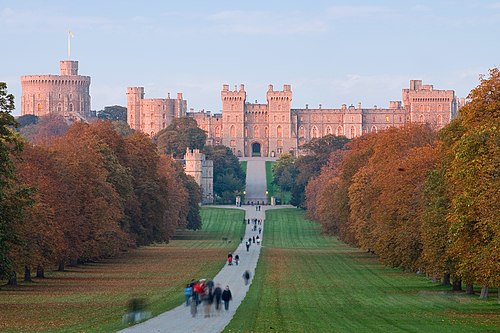 Windsor CastleRestored · prime 1820
 Tower of LondonRestored · prime 1285
 Bamburgh CastleRestored · prime 1904
All castles in England → · Strongest castles in England → · Castles of Europe
Play As Your Clan
Hold a real castle against whatever you choose to send at it, take a ship out in her own service years, or stand at the shoulder of someone the record remembers. The chronicler sets the scene; the deeds are yours.
Notable bearers of the Grosvenor name
- Sir Thomas Grosvenor, 3rd Baronet (1655-1700), through whose marriage the family acquired the Manor of Ebury (modern Mayfair and Belgravia)
- Hugh Lupus Grosvenor, 1st Duke of Westminster (1825-1899), first Duke and developer of central London
- Gerald Grosvenor, 6th Duke of Westminster (1951-2016), Territorial Army major-general and philanthropist
- Hugh Grosvenor, 7th Duke of Westminster (b.1991), current head of the Grosvenor line