Howells
also Howell, ap Hywel
Son of Hywel the Good, the surname of the great Welsh law-king.
- Origin
- Deheubarth, Wales
- Famous bearer
- Herbert Howells (1892–1983), composer (Hymnus Paradisi)
- Register
- Welsh family
Where the Howells name comes from
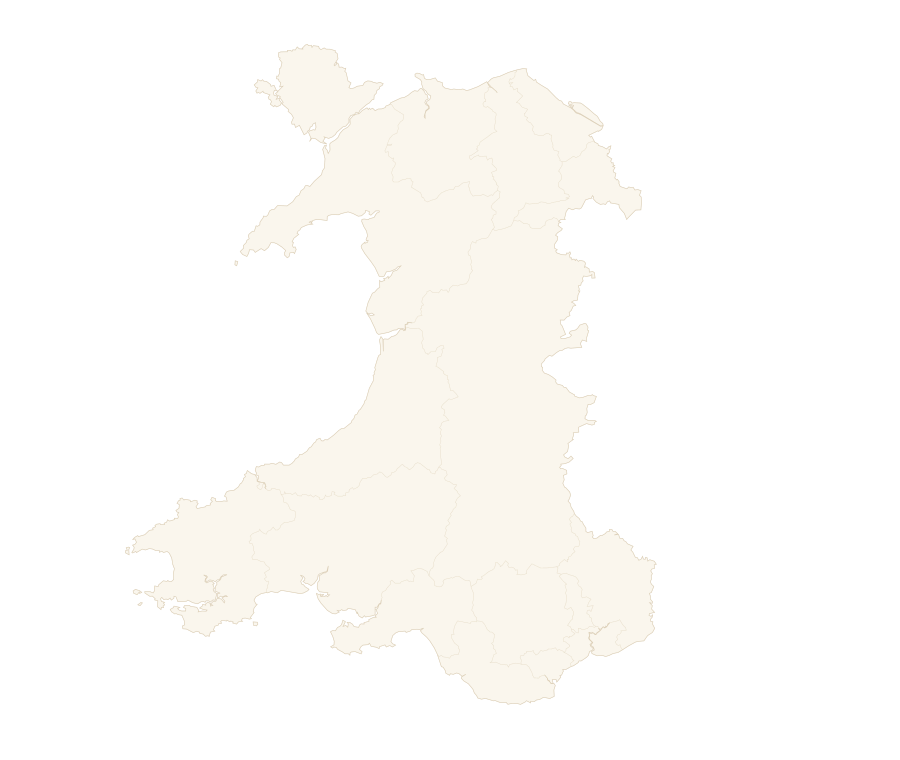
CoreHistoric reach
The seat of Howells
Seat vacantChief
No one leads the Howells community yet. When the movement opens, you can stand for its leadership, or help elect whoever does.
Current mission
No shared goal set yet. Once Howells has leadership, it sets the public focus: a restoration, a gathering, a real-world project that helps its own.
The Howells clan is being rebuilt. Join the waiting list for the movement today, and you help decide who leads it and what it does.
Help rebuild the Howells clan →What does the Howells name mean?
From ap Hywel, son of Hywel, the personal name of Hywel Dda ('Hywel the Good', c.880–950), king of Deheubarth and the Welsh prince traditionally credited with the codification of the Laws of Hywel Dda, the foundational law-code of mediaeval Wales. Hywel was carried as a personal name through every subsequent generation of the Welsh princely houses; the patronymic ap Hywel compressed into Howell and Howells under Tudor naming policy. The Welsh-form Hywel survived alongside the Anglicised Howell, especially in Cardiganshire and Pembrokeshire.
The history of Howells
The law-king whose given name went round a whole nation
Hywel comes from the Old Welsh Higuel, built from hy- ('good') and gwel ('sight') and understood as eminent or well-seen. Its first firm appearance in writing is in the Anglo-Saxon Chronicle for 926, where a Brittonic ruler is entered as Huwal of the West Welsh. Most scholars take that entry to be Hywel Dda, Hywel ap Cadell, king of Seisyllwg from about 910 and of all Deheubarth from 920, who by 950 was being given the title King of the Britons.
What made the name travel was the law. Cyfraith Hywel, the native Welsh law tradition attached to it, survived in three regional redactions and remained in force across much of native Wales until the Statute of Rhuddlan of 1284. Parents who called a boy Hywel were reaching for that. Under the old system the son of such a man was Owain ap Hywel, 'Owain son of Hywel': a description, not a possession.
1535, 1542, and the moment a moving name stopped moving
Wales did not drift into surnames; it was legislated into them. In 1292 some 48 per cent of recorded Welsh names were patronymics, and in some parishes above 70 per cent. A man's name changed every generation: Evan son of Thomas was Evan ap Thomas, Evan's son John was John ab Evan, John's son Rees was Rees ap John. The chain could run back to perhaps the seventh generation, so a name like Llewelyn ap Dafydd ab Ieuan ap Gruffudd ap Meredydd was a spoken genealogy of the male line.
Those laws decayed through the later Middle Ages, and under Henry VIII fixed surnames became hereditary among the Welsh gentry before spreading slowly to commoners. The Laws in Wales Acts of 1535 and 1542 brought Wales into the Kingdom of England, and Henry VIII ordered that marital births be recorded under the father's surname. Once a name was written into a register it stopped moving. In rural parishes the patronymic hung on into the early nineteenth century.
The old prefix survived two ways. Sometimes ap was welded on to the front, which is why Wales has Powell (ap Hywel), Price (ap Rhys), Pugh (ap Hugh) and Bowen (ab Owen). Sometimes it was dropped and an English genitive -s added instead. Howells belongs to that second group, with Jones, Roberts and Edwards. The Welsh Hywel and the anglicised Howell went on side by side, especially in Cardiganshire and Pembrokeshire.
Two Howells families in one parish are usually two families
The surnames came from a small pool of baptismal names, and that pool shrank further after the Protestant Reformation, so a thin stock of family names ended up covering an enormous number of people: Evans, Jones, Williams, Davies and Thomas were all in the top ten surnames recorded for England and Wales in 2000. It cannot be assumed that two people called Howells in one village inherited the name from a common ancestor. They may have had two different fathers named Hywel.
Many Howells families claim descent from Hywel Dda; what the record preserves is the given name, carried by thousands of unconnected men. Around 200,000 people now bear Howell worldwide, and a study of Welsh surname geography commissioned by the Welsh Government found 718,000 people in Wales, close to 35 per cent of the population, carrying a name of Welsh origin, against 4.7 per cent in New Zealand, 4.1 per cent in Australia and 3.8 per cent in the United States.
Across the border counties and out of the coalfield
The English conquest of Wales in the thirteenth century and the union legislation of the sixteenth pushed Welsh families eastward, and Howell became common in the western English counties along the border, where settlers anglicised Hywel to Howell as they went. In the eastern counties the same sound arrived by another road: Breton settlers after the Norman Conquest brought the forms Houuel, Huwel, Huwal and Howael.
The nineteenth century redrew Wales around the coalfield. The population doubled from 587,000 in 1801 to 1,163,000 in 1851 and reached 2,421,000 by 1911, and most of that growth landed in the mining districts: Glamorganshire went from 71,000 in 1801 to 232,000 in 1851 and 1,122,000 in 1911. Over the same decades Welsh emigration ran to the United States, Pennsylvania above all, to Canada, and to Y Wladfa in Patagonia, and Jackson County in Ohio was known as Little Wales.
James Howells and 152 years on St Mary Street
Michael Howells, 1935, and the score that stayed in a drawer
Herbert Norman Howells was born at Lydney in west Gloucestershire on 17 October 1892, sixth child of Oliver Howells, a Lydney plumber, painter and amateur organist, and Elizabeth Burgham. His father's organ-playing at the parish church made a musical household out of a modest one. At fourteen he was articled to Sir Herbert Brewer, organist of Gloucester Cathedral, and in October 1912 he took the open scholarship to the Royal College of Music, studying under Charles Villiers Stanford and Hubert Parry.
On 9 September 1935 his nine-year-old son Michael died of bulbar polio. Between 1936 and 1938, working privately at his house in Barnes, Howells wrote Hymnus Paradisi, a setting for soprano, tenor, chorus, semi-chorus and orchestra binding Latin texts of the Requiem to Psalms 23 and 121 in the King James version, the Salisbury Diurnal antiphon 'I Heard a Voice from Heaven' and the Pre-Sanctus 'Holy is the True Light'. He showed the score to no one and would not let it be performed; only the persistent persuasion of his Royal College colleague Ralph Vaughan Williams moved him. He released it in 1950 and conducted it that September at the Three Choirs Festival in Gloucester Cathedral, where its reception re-established him as one of the leading composers writing in English.
He took the teaching of composition at the Royal College in 1920 on Stanford's recommendation and held a post there for sixty-three years, the longest tenure in the College's history, teaching Lennox Berkeley, Malcolm Arnold, Richard Rodney Bennett, the early Britten, the early Imogen Holst, the early John Tavener and the future conductor John Eliot Gardiner. In 1936 he succeeded Gustav Holst as Director of Music at St Paul's Girls' School, holding the post until 1962.
The four services that put the name into every cathedral
The work that carries the name furthest is liturgical. The four Anglican service settings are Collegium Regale of 1944, the Gloucester Service in 1947, the St Paul's Service in 1951 and the Westminster Service in 1957, with a corpus of canticles and anthems that has sat at the centre of the cathedral repertoire without interruption since the 1940s.
He was appointed a Companion of the Order of the British Empire in 1953 and a Companion of Honour in 1972, and died at his Barnes home on 23 February 1983 in his ninety-first year. A surname that began as a claim about a father is now sung by cathedral choirs who know it chiefly as the name on the Gloucester Service.
Stage, page and lecture room: Howells elsewhere
Ursula Howells (1922-2005), the actress, was the composer's daughter, and hers is the one Howells-to-Howells descent on this page the record actually establishes. The others stand on their own. Anne Howells (1941-2022) was a British operatic mezzo-soprano; Callum Scott Howells, born in 1999, is a Welsh actor; Sarah Howells is a British singer-songwriter and trance vocalist; Glenn Howells, born in 1961, is a British architect.
The name went overseas early. William Dean Howells (1837-1920) was an American realist author and literary critic; John Mead Howells (1868-1959) an American architect; William W. Howells (1908-2005) professor of anthropology at Harvard; Adele C. Howells (1886-1951) president of the Mormon children's organisation; Philip Arthur Howells (1855-1921) a musical entrepreneur in South Australia. None need be kin to any other, and that is the point of a Welsh patronymic surname.
Champions of the Howells name
The bearers whose lives are inseparable from this surname. Each has their own page, biography, achievements, geography, connection to the family.
The castles of the homeland
The great strongholds of the homeland, look one up, see what it looked like in its prime, and recreate it to explore.
 Caernarfon CastleRestored · prime 1330
 Conwy CastleRuin · prime 1287
 Pembroke CastleRestored · prime 1280
All castles in Wales → · Strongest castles in Wales → · Castles of Europe
Play As Your Clan
Hold a real castle against whatever you choose to send at it, take a ship out in her own service years, or stand at the shoulder of someone the record remembers. The chronicler sets the scene; the deeds are yours.
Notable bearers of the Howells name
- Herbert Howells (1892–1983), composer (Hymnus Paradisi)
- James Howells (1814–1892), Cardiff draper, founder of Howells department store
- Ursula Howells (1922–2005), actress
Stories of Howells
Frequently asked
What does the surname Howells mean?
Where does the Howells family come from?
Where did the Howells family historically hold territory?
Is Howells Welsh or English?
How old is the Howells surname?
What is the Howells family known for?
Is there a Howells family crest or coat of arms?
Who is the most famous Howells?
Who are some famous Howellses?
What stories are told about the Howells family?
What is the story of Howells and Hymnus Paradisi?
Is Howell the same family as Howells?
Is ap Hywel the same family as Howells?
Where is the Howells surname found today?
What does the Clan Rising page for the Howells family cover?
Who is the head of the Howells family today?
Neighbouring clans
- JonesSon of John, and roughly one in twenty Welsh-descended people in the world.
- DaviesSon of David, born of the patron saint's name and densest in his own corner of Wales.
- EvansSon of John, by the Welsh road, the cousin name of Jones.
- ThomasThe fifth Welsh surname, son of Thomas, on the same Tudor-era road as Jones and Williams.