Clan Kerr
also Carr, Ker, Clan Kerr
Late but in earnest, riding clan of the Roxburgh marches.
- Origin
- The Borders, Scotland
- Motto
- Sero sed serio
- Famous bearer
- Sir John Kerr (1914–1991), Australian Governor-General; the 1975 dismissal of the Whitlam government
- Register
- Scottish clan
The Kerr crest badge, tartan and country

Crest badgeClan member crest badge - Clan KerrCeltus · CC BY-SA 3.0 
TartanKerr tartanMicheletb · CC BY-SA 4.0 
TartanKerr Hunting tartanThe hunting sett: the same pattern in muted browns and greens, worn in the field where the brighter colours would show.Micheletb · CC BY-SA 4.0


- Crest badge: The chief's crest inside a belt and buckle: the badge a clansman wears to show whose following he is in.
- Tartan: The checked cloth the family is known by.
What is the Kerr clan tartan?
Two Kerr setts are shown above, one of them the hunting sett, in muted browns and greens. They are not rival claims to be picked between; they are different records, and different weaves, of the same family cloth. A sett is the block of coloured bands the cloth is built from, repeated in both directions; the whole plaid is that one square enlarged.
Border families did not wear Highland dress, and no proscription touched them. What was worn on the Kerr ground was the shepherd’s check: the two-colour Border plaid, older than any clan sett and belonging to a district rather than a surname. The Kerr tartan is a later thing: a Highland-style pattern attached to a Border name in the 19th century, when tartan stopped being Highland and became Scottish. Nobody polices any of it. Wearing the Kerr sett declares allegiance to the name, not descent from any particular line of it.
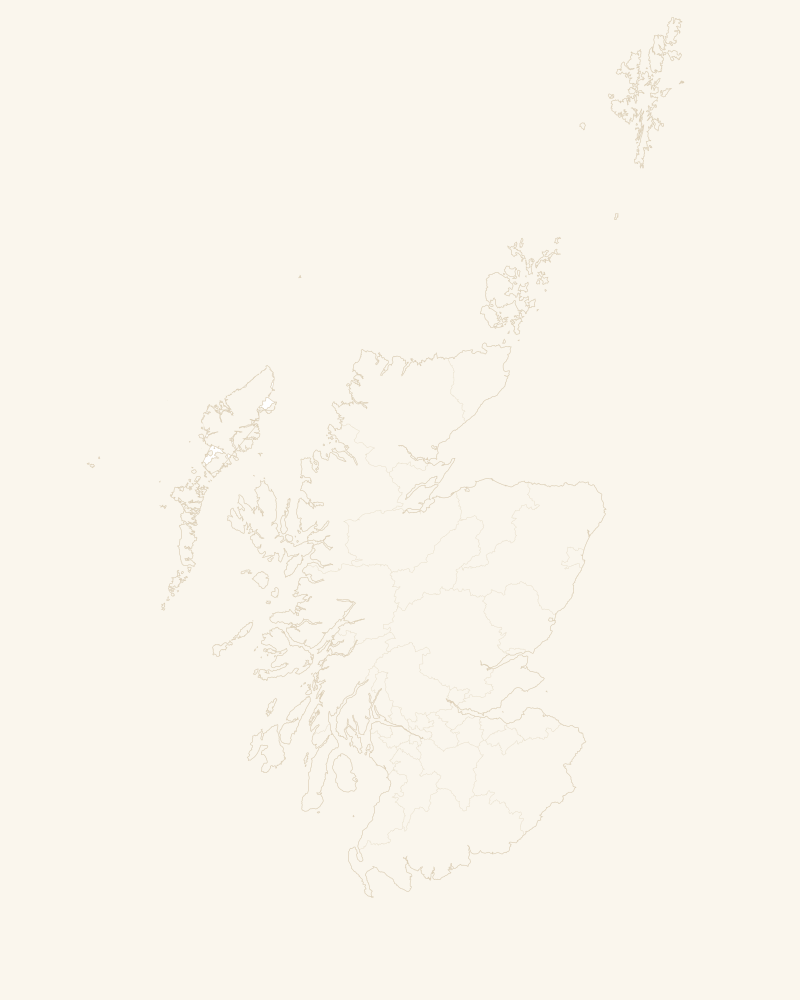
CoreHistoric reach
The seat of Clan Kerr
Seat vacantChief
No one leads the Clan Kerr community yet. When the movement opens, you can stand for its leadership, or help elect whoever does.
Current mission
No shared goal set yet. Once Clan Kerr has leadership, it sets the public focus: a restoration, a gathering, a real-world project that helps its own.
The Kerr clan is being rebuilt. Join the waiting list for the movement today, and you help decide who leads it and what it does.
Help rebuild the Kerr clan →Motto
Sero sed serio
“Late but in earnest”
What does the Kerr name mean?
From Old Norse kjarr, brushwood, marshland, and through it from a Norman family of De Carre or De Ker who came to the Anglo-Scottish Borders in the 12th century. Two branches founded the principal Scottish line: the Kerrs of Cessford (whose senior branch became Marquesses of Lothian) and the Kerrs of Ferniehirst (Earls of Ancram). The Kerrs of the Borders were among the principal 'riding clans', Border families whose effective government was a code of cattle-raiding (reiving) and feud across the Anglo-Scottish boundary, lasting from the 14th century to the Union of the Crowns in 1603.
The history of Clan Kerr
Brushwood, fortress, and the ker-handed
The name refuses to settle on one meaning, and the Borders kept all of them. The oldest reading is Middle English kerr, brushwood and low-lying grassland, marsh or fen, and behind it Old Norse kjarr; a second traces the surname to the Brittonic caer, fortress or stronghold, which fits because Cumbric was still spoken in the Lowland districts where the name first surfaces in Scotland. On the Isle of Arran a separate strand runs from Scottish ciar, dusky, and Irish cearr, left-handed. In Scotland a left-hander is still called Kerr-handed or corrie-fisted, so the language either produced the family's reputation or was rewritten by it.
The documented line begins in Ayrshire rather than the Borders. In the reign of David I (1082-1153), Hugh de Morville, Lord High Constable of Scotland, granted lands in the bailiery of Cunninghame to the Norman family of William de Ker, and the estate became Kersland; de Morville held the nearby port of Irvine as his military headquarters. Family tradition takes the Roxburghshire chiefs from two brothers, Ralph and Robert, also called John, who came to Roxburgh out of Lancashire. Ferniehirst claimed descent from Ralph and Cessford from John, and which brother was the elder was never settled, which is a fair summary of everything that followed. A William Ker of Kersland is said to have joined William Wallace in 1296, to have been one of only two of Wallace's men to survive Elcho, and to have been the one man with him at Robroyston in 1305, killed in the scuffle when both were taken asleep.
Two towers between Jedburgh and Kelso
Cessford Castle was built around 1450 by Andrew Ker, ancestor of Robert Ker, 1st Earl of Roxburghe. A massive L-plan work ringed by a curtain wall with a second wall and ditch beyond it, standing midway between Jedburgh and Kelso, it was the caput of the Barony of Cessford and the principal stronghold of the family. Ferniehirst followed around 1470, on the east bank of the Jed Water a mile and a half south of Jedburgh. Andrew Kerr of Ferniehirst was made Warden of the Middle Marches in 1502; Andrew Kerr of Cessford took the same office after Flodden in 1513, a battle he fought and survived.
Andrew Ker of Ferniehirst (1471-1545), known as Dand, built the Jed Water castle up into a formidable stronghold. Both he and his paternal grandfather, Andrew of Cessford, are held to have been left-handed swordsmen, and men who rode under the Ferniehirst and Cessford banners were encouraged to fight ker-handed, a left-handed fighter commanding a higher fee for his service. The original entrance at Ferniehirst leads to the turnpike known as the Left-Handed Staircase, spiralling counter-clockwise to put a right-handed attacker at a disadvantage; the story attaches it to Sir Andrew Kerr training his followers to use their weapons left-handed after Flodden. An article in the British Medical Journal around 1972 reported left-handedness in about 30% of those surnamed Kerr against 11% of the population at large, though a study in 1993 found no statistically significant excess.
The English tested both houses. Cessford was attacked in 1519 and besieged four years later by the Earl of Surrey, who reckoned it the third strongest fortress in Scotland and remarked that it 'might never have been taken had the assailed been able to go on defending'. It was torched in 1543 and sacked the year after. Ferniehirst fell in the same year, taken by Lord Dacre with 700 men and artillery after a protracted defence, some of the Liddesdale clans having placed themselves under Ferniehirst's protection after Flodden.
Wardens of a border that ran on raiding
Many Kerrs served as Warden of the Middle March, which meant policing cattle-raiding while their own surname stood among the notorious reiving names of the frontier. Reiving was not a failure of order on the Anglo-Scottish line but the working order itself: raid, feud, ransom and shifting allegiance, an economy that ran from the fourteenth century to the Union of the Crowns in 1603, and the Kerrs of Cessford and Ferniehirst were among the families who administered it and lived off it at once.
Officialdom of the day drew no line between a Border family and a Highland clan. An Act of the Scottish Parliament of 1587 addresses the 'cheiffis and chiftanes of all clannis, alsweill on the hielandis as on the bordouris' and then lists the Lowland reiving names (Maxwells, Johnstones, Carruthers, Turnbulls) in the same breath as the rest. The same act speaks of the 'principals of the branches of the said clans', of pledges relieved by others of the same clan or branch, and of young men 'sprung up in their race and clan', and of followers depending on chiefs by pretence of blood or place of dwelling. That is the Kerr shape exactly: one surname, two branches, separate pledges, and a following that was never only blood. The notion that Highlanders formed clans while Lowlanders formed families is a nineteenth-century convention, not a legal or historical one.
Late but in earnest: Ancrum Moor, February 1545
The motto is a battle report. At Ancrum Moor in February 1545, fought during the Rough Wooing about ten kilometres from Ferniehirst, the Kerrs, accomplished mounted troops, opened the day on the English side. Four centuries of cross-border invasion had made survival a matter of shifting allegiance, and it shifted here: as the balance tipped towards the Scots the Kerr horse turned on the English, who had a low winter sun in their eyes, and drove them from the field. Late, but in earnest. Sero sed serio.
The sun runs through the heraldry as well. The family crest sets the Latin motto around an image of the sun at its centre, and the chief's arms are quartered, first and fourth azure the sun in his splendour Or for the peerage of Lothian, second and third gules, on a chevron argent three mullets of the field for Kerr. Three tartans are recognised (Kerr Modern, Kerr Hunting and Kerr Muted), and the chief today is Ralph William Francis Joseph Kerr, 14th Marquess of Lothian.
The reckoning on Edinburgh High Street
The bitterest of the Kerr feuds was with the Scotts. It opened on 25 July 1526, when Sir Walter Scott of Buccleuch attacked at Melrose to rescue the young James V, who was being held by the Douglas Earl of Angus at Darnick just west of the town. Buccleuch did not free the king, and in the fighting Kerr of Cessford was killed.
The Kerrs took their time. In 1552 they set upon Sir Walter Scott on Edinburgh's High Street and killed him; Sir Walter Kerr of Cessford was banished to France for his part in the murder of Scott of Branxholme and Buccleuch. The quarrel closed the way Border quarrels usually closed, at an altar: Sir Thomas Kerr of Ferniehirst married Janet Scott, sister of the tenth Scott Laird of Buccleuch. The two Kerr branches, meanwhile, went on feuding with each other, and with the Pringles and the Rutherfords.
Ferniehirst, the French, and the queen they could not free
Ferniehirst changed hands twice in 1549. In February the clansmen of Sir John Ker, with the Earl of Huntly and French auxiliaries under Captain Pierre Longue, dislodged the English garrison, whose leader was executed. In June the Duke of Rutland recaptured the place as the war neared its end.
In 1570 the castle was damaged in a raid while Sir Thomas Kerr of Ferniehirst, protector of Mary, Queen of Scots, was working to have her released from imprisonment. In 1593 James VI came against the castle himself, in answer to the help the Kerrs had given Francis Stewart, 5th Earl of Bothwell, whom the king had accused of witchcraft and treason.
The house survived all of it: an L-plan fortalice with conically-capped corner turrets and Renaissance decoration around its windows and doors. The Scottish Youth Hostel Association leased it from 1934 to 1984, apart from the Second World War when it served as an army billet, and it was restored for residential use in the late twentieth century by Peter Kerr, 12th Marquess of Lothian, whose second son Lord Ralph Kerr uses it now. It is said to be haunted by a Green Lady and opens to the public in July.
Newbattle, Roxburghe, and the marriage that ended the quarrel
The Reformation turned abbey land into Kerr land. Newbattle, a mile south-west of Dalkeith in Midlothian, went to the Kerrs of Ferniehirst; Mark Kerr had Newbattle and Prestongrange erected into a barony by charter in 1591 and was created Earl of Lothian in 1606, a title that failed when his son died without male issue in 1624. Sir Andrew Kerr of Ferniehirst was made Lord Jedburgh in 1621. The earldom of Ancram went to Sir Robert Kerr, descended from a younger son of Ferniehirst; his son Sir William Kerr received a new earldom of Lothian in 1631, and William's son Robert was advanced to marquess and succeeded to Ancram on his uncle's death.
On the Cessford side, Sir Robert Ker (spelling the surname with a single r by then) was created Earl of Roxburghe in 1616. The branch feud that had run since the fifteenth century ended at a wedding in 1631, when William Kerr of Ferniehirst married Ann Kerr of Cessford. The Lothian line was raised to marquess in 1701 and the Roxburghe line to duke in 1704, and the Duke still takes subsidiary titles from the ruin his ancestors left, as Baron Ker of Cessford and Marquess of Bowmont and Cessford.
Cessford Castle was abandoned around 1650 and its stone carted off to build Floors. The lands of Floors had belonged to the monks of Kelso Abbey until the Reformation, when James VI handed them to Robert Ker of Cessford; the present house was raised in the 1720s by the architect William Adam for John Ker, 1st Duke of Roxburghe, who had played a part in securing the Union of 1707 and was rewarded with the dukedom. Around 1837 James Innes-Ker, 6th Duke, commissioned William Henry Playfair to remodel the plain Georgian mansion, and it is Playfair's turrets and battlements that give Floors its castle silhouette above the Tweed. In 1903 Henry Innes-Ker, 8th Duke, married the American heiress Mary Goelet.
Redcastle, Edinburgh Castle, and the spontoon at Culloden
In the Scottish Civil War, Colonel Kerr supported the Covenanter commander General David Leslie, Lord Newark, took the Clan Mackenzie's Redcastle, demolished it and hanged the garrison. A generation later Lord Mark Kerr, son of Robert Kerr, 1st Marquis of Lothian, made a professional soldier's career out of a high sense of personal honour and a quick temper, fighting several duels, rising to general, and taking the governorship of Edinburgh Castle in 1745.
In the rising of that year the Kerrs stood with the British government. At Culloden in 1746, Lord Mark's great-nephew Lord Robert Kerr, son of William Kerr, 3rd Marquis of Lothian, was captain of the grenadiers in Barrell's regiment; he received the first charging Cameron on the point of his spontoon, and a second cut him through from head to chin. He holds the dubious distinction of being the only person of high rank killed on the government side. His eldest brother Mark, Lord Kerr, afterwards 4th Marquess of Lothian, commanded three squadrons of government cavalry in the same battle and survived to serve under the Duke of Cumberland in France in 1758.
The Carrs of Etal, and land bought south of the line
The English spelling of the name took castles of its own. Sir William Heron had a licence to crenellate Ford in 1338 and his family held it until 1549, when the marriage of Elizabeth Heron to Thomas Carr of Etal carried the castle to the Carrs. The Herons disputed the ownership and seized Ford back for a time in March 1557; that August it was attacked by Lord James and Robert Stewart, sons of James V, and by Lord Home, who brought artillery and burnt farmhouses through the 'ten towns of Glendale'. Castle and lands passed by marriage to Sir Francis Blake of Cogges in the 1660s.
Barmoor, held by the Muschamps since the Conquest and licensed for crenellation by Edward III on 17 May 1341, was repaired and improved in 1584 but sold after George Muschamp's death in 1649 to William Carr of Etal to satisfy creditors. North of the line the family was buying too. Sir Alexander Nisbet of that Ilk (c. 1580-1660) overextended his finances supporting Charles I and was forced to sell Nisbet in the Merse to John Ker in 1652; George Carre, Lord Nisbet, son of John Ker by his second wife, was born in the house around 1700, and a square tower in the classical style of William Adam was added to its west end in 1774. Ker descendants held Nisbet, latterly in the person of Lord Sinclair, until the estate was sold to Lord Brocket in the 1950s.
Deborah Kerr, and the surname past the Jed Water
Deborah Jane Trimmer was born at 1 Pittville Road in the Hillhead district of Glasgow on 30 September 1921, only daughter of Captain Arthur Trimmer of the Royal Navy and Kathleen Smale Kerr. The family moved to Helensburgh on the Firth of Clyde while she was small; her father died when she was fourteen and her mother took her to Weston-super-Mare in Somerset, where she was schooled at Rossholme. She trained from 1937 at the Sadler's Wells Ballet School in London, took her stage name from the Scottish maternal line, and first appeared in the corps de ballet of the Sadler's Wells production of Prometheus at the Aldwych Theatre in October 1938.
Film work began in 1940. Major Barbara (1941) and The Life and Death of Colonel Blimp (1943) were made for the Powell and Pressburger Archers, and her Sister Clodagh in Black Narcissus (1947) brought her to Hollywood, where Metro-Goldwyn-Mayer signed her on seven years. From Here to Eternity (1953) cast her as Karen Holmes opposite Burt Lancaster and won her the New York Film Critics' Circle Award for Best Actress; The King and I (1956) cast her as Anna Leonowens opposite Yul Brynner, her singing dubbed by Marni Nixon, and took the Academy Award for Best Picture. Tea and Sympathy (1956), An Affair to Remember (1957) with Cary Grant, Heaven Knows, Mr. Allison (1957) and Separate Tables (1958) carried the run to six Best Actress nominations in nine years without a competitive win, then the record for a film actress.
She named The Innocents (1961), Jack Clayton's version of Henry James's The Turn of the Screw, as the performance she was proudest of; she married the screenwriter Peter Viertel in 1960, retired from film in the late 1960s and lived at Klosters and Marbella, took the Honorary Academy Award in March 1994 and a CBE in the New Year Honours of 1998, and died at Botesdale in Suffolk on 16 October 2007. Other bearers carried the name well past the Jed Water: Philip Kerr, 11th Marquess of Lothian (1882-1940), politician, diplomat and newspaper editor, who gave Newbattle to the nation as the adult education college it remains; Ralph Kerr (1891-1941), Royal Navy captain of HMS Hood; Clark Kerr (1911-2003), first Chancellor of the University of California, Berkeley; and the Australian footballing family of Roger, Daniel and Samantha Kerr.
Champions of the Kerr name
The bearers whose lives are inseparable from this surname. Each has their own page, biography, achievements, geography, connection to the family.
Castles the Kerr held
Strongholds this name held for a decade or more, look one up, or rebuild it to explore.
- Floors Castle
The Ker Earls and Dukes of Roxburghe have held lands in Roxburghshire since the 12th century; Floors was granted to Robert Ker of Cessford by James VI and remains the family seat.
- Ferniehirst Castle
Ancient seat of Clan Kerr, built by the Ker family around 1470 and restored by Peter Kerr, 12th Marquess of Lothian, in the late 20th century.
- Ford Castle
Carried to the Carrs of Etal by marriage in 1549.
- Cessford Castle
Built c. 1450 by Andrew Ker; the principal stronghold of the Kerrs until its abandonment in 1650.
- Nisbet House
John Ker bought Nisbet in 1652, and his descendants, latterly Lord Sinclair, kept the house until the estate was sold to Lord Brocket in the 1950s.
- Barmoor Castle
Bought by William Carr of Etal in 1649; the estate changed hands after 1702.
The castles of the homeland
The great strongholds of the homeland, look one up, see what it looked like in its prime, and recreate it to explore.
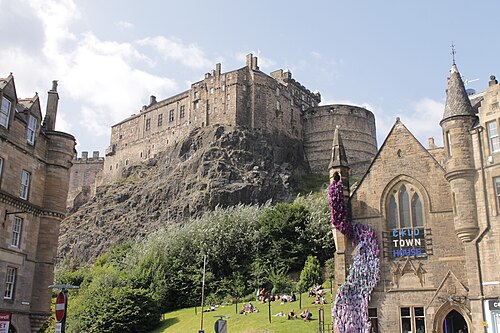 Edinburgh CastleRestored · prime 1520
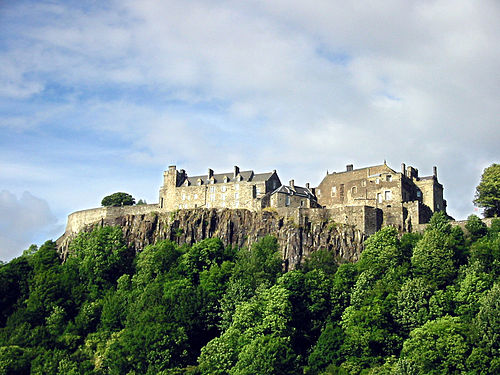 Stirling CastleRestored · prime 1542
 Glamis CastleStill standing · prime 1900
All castles in Scotland → · Strongest castles in Scotland → · Castles of Europe
Play As Your Clan
Hold a real castle against whatever you choose to send at it, take a ship out in her own service years, or stand at the shoulder of someone the record remembers. The chronicler sets the scene; the deeds are yours.
Notable bearers of the Kerr name
- Sir John Kerr (1914–1991), Australian Governor-General; the 1975 dismissal of the Whitlam government
- Deborah Kerr (1921–2007), actress, six-time Oscar nominee
- Roy Kerr (b. 1934), mathematician, discoverer of the Kerr metric (rotating black holes)