Clan Paterson
also Patterson
Son of Patrick, the Lowland patronymic of Scotland.
- Origin
- Lothian & Edinburgh, Scotland
- Motto
- Pro rege
- Famous bearer
- William Paterson (1658–1719), founder of the Bank of England, the Darien Scheme
- Register
- Scottish clan
Where the Paterson name comes from
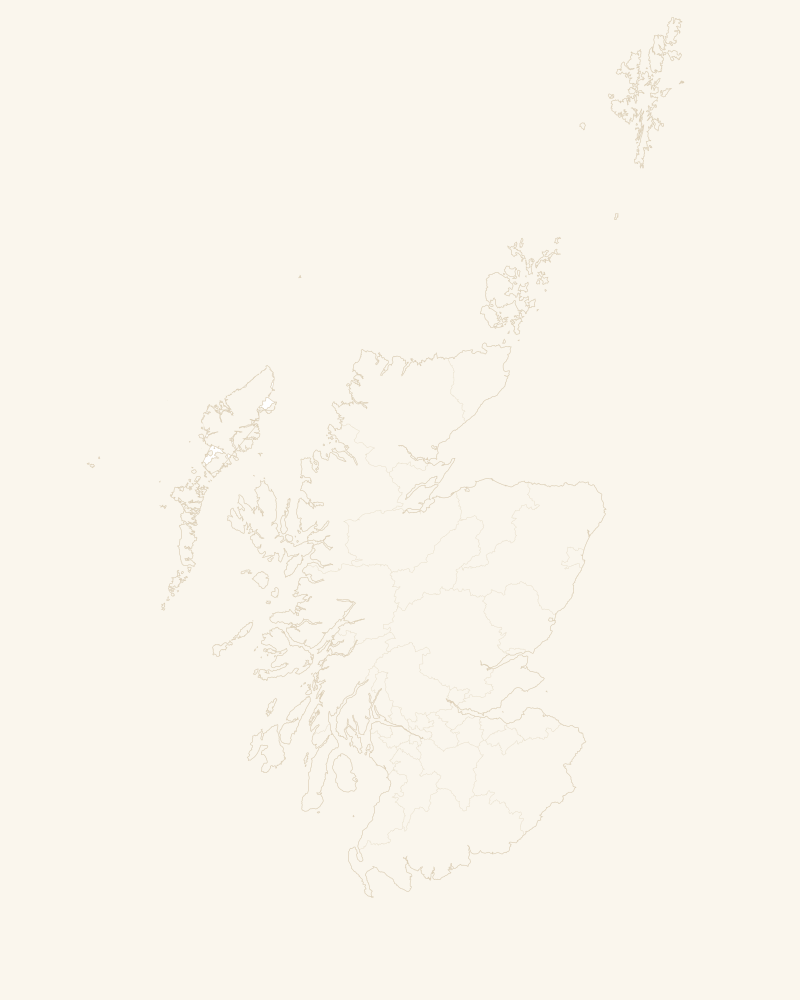
CoreHistoric reach
The seat of Clan Paterson
Seat vacantChief
No one leads the Clan Paterson community yet. When the movement opens, you can stand for its leadership, or help elect whoever does.
Current mission
No shared goal set yet. Once Clan Paterson has leadership, it sets the public focus: a restoration, a gathering, a real-world project that helps its own.
The Paterson clan is being rebuilt. Join the waiting list for the movement today, and you help decide who leads it and what it does.
Help rebuild the Paterson clan →Motto
Pro rege
“For the king”
What does the Paterson name mean?
Patronymic, son of Patrick (the Latin Patricius, 'noble'). Patrick was a common mediaeval Scottish first name on account of Saint Patrick, himself a Roman Briton, possibly born in modern Strathclyde, and through Norman influence as well. The patronymic Paterson is densely Scottish-Lowland in modern distribution; the spelling Patterson (double-t) is commoner among Scottish-Irish-American families. The Patersons descend from multiple distinct lines and never formed a single clan.
The history of Clan Paterson
Son of Patrick, and the devotee of the saint
In Scottish Gaelic the name is MacPhadraig, son of Patrick, and it may be a shortened form of MacGille Phadraig, son of the devotee of Saint Patrick. That second reading points at the church rather than at a father: an ancestor who was a churchman (the Celtic church allowed its priests to marry) or a layman attached to the ecclesiastical hierarchy. Patrick himself was a Roman Briton, possibly born in what is now Strathclyde, and his name came back into Scotland through his cult and through Norman fashion, which made Patricius, the Latin for noble, one of the most-used given names of mediaeval Scotland.
The consequence is that Paterson is not one family. Wherever a man called Patrick had sons in a Scots-speaking burgh, the byname could form on its own, and it did, repeatedly. The Patersons descend from multiple distinct lines and never formed a single clan, and the motto that came to sit above the name, Pro rege, For the king, is a declaration of loyalty rather than a claim of lineage. What follows is not a pedigree but a record of what people of the name did.
Loch Fyne, an Aberdeen charter and the provost of Inverness
The earliest settlement the record fixes is on the shores of Loch Fyne, where Patersons had settled by about the end of the thirteenth century. In 1446 a gentleman named William Paterson witnessed a charter in Aberdeen: the name was already what a burgh clerk expected to write down. In 1563 James Paterson was sheriff-depute of Inverness, deep in the Highlands, and afterwards became Provost of the town: one bearer holding first the crown's local judicial office and then the burgh's highest civic one.
The weight of the name went the other way, into the Lowlands, and stayed. Paterson sits among the twenty most common surnames of the Scottish Lowlands and among the top twenty-five of Scotland as a whole, densest in Edinburgh, Fife, the Lothians and Lanarkshire. That is the pre-industrial Lowland heartland of Scottish surname distribution exactly.
The Court of the Lord Lyon recognises Clan Paterson officially, but there is no chief at present, so it is an armigerous clan, one of those without a chief. Paterson is also carried on the sept lists of Clan MacLaren and Clan Farquharson, both Highland. Those lists deserve care: most date from the nineteenth century, when clan societies and tartan manufacturers linked as many surnames as possible to a clan whether or not any historical connection existed. Miller was made a sept of MacFarlane and Taylor of Cameron by the same commercial logic.
The Tinwald man who built the Bank of England
William Paterson (1658-1719) was born at Tinwald in Dumfriesshire and became the principal founder of the Bank of England in 1694. He is better remembered at home for the other scheme: the Darien venture, the Scottish attempt of the 1690s to plant a colony on the isthmus in Central America, of which he was the moving force and the architect.
Darien's collapse led directly to the Acts of Union of 1707. One Dumfriesshire financier thus stands behind both the founding of the Bank of England and the venture whose failure ended Scotland's separate parliament.
Bannockburn House, January 1746
The most celebrated Paterson episode belongs to the last Jacobite rising. Sir Hugh Paterson, 2nd Baronet of Bannockburn, entertained Prince Charles Edward Stuart at his house in January 1746. Bannockburn House still stands today as it was when Bonnie Prince Charlie was under its roof.
The visit ran past hospitality. Sir Hugh's niece Clementina became the prince's mistress and bore him a daughter, Charlotte Stuart, Duchess of Albany.
Castle Huntly, bought with East India money
Castle Huntly was built around 1452 by Lord Gray of Fowlis, under licence from James II, on a rocky outcrop in the Carse of Gowrie near the shore of the Firth of Tay, seven miles west of Dundee. The land around it was marshy wilderness then, and the rock looks to have been picked for the defence it gave. In 1614 the Earl of Strathmore acquired the place and renamed it Castle Lyon.
In the 1770s the widow of the 7th Earl of Strathmore sold it to George Paterson of the East India Company, and the Patersons held it from then until 1946, when, after the death of Colonel Adrian Gordon Paterson, his wife sold the castle to the government. It is now HMP Castle Huntly, still plainly visible from the main road between Dundee and Perth.
Ulster, Pennsylvania and the second t
The surname went into Plantation Ulster in heavy numbers and out of Ulster again into the eighteenth-century migration to Pennsylvania and Virginia. The Pittsburgh Patterson line and the Patterson cousins of Andrew Jackson were Ulster-Scots Patersons before the spelling shifted. The double-t Patterson is now the commoner form among Scottish-Irish-American families, while the single-t Paterson has stayed densely Scottish and Lowland, so the extra letter is a rough map of who crossed the Atlantic.
Patterson is at home in Ireland and northern England on its own account too, with Pattison and Pattinson as further variants. In Connacht and Ulster the name also does duty as an anglicised form of the Irish surname Ó Casáin, which means an Irish Patterson may be carrying a Gaelic name with no Patrick in it whatsoever.
The Banjo, and the ballad written in one week at Dagworth
Andrew Barton Paterson was born at Narambla, three miles north of Orange in the central west of New South Wales, on 17 February 1864, eldest of seven. His father, Andrew Bogan Paterson, was a Lanarkshire-born squatter who had emigrated to the colony in 1850; his mother, Rose Barton, was sister to Australia's first Prime Minister, Sir Edmund Barton. The family selection at Buckinbah Station on the Bogan River was lost in the drought of the 1860s and his father went to manage Illalong in the Yass district, where the boy was raised in the saddle. He was at Sydney Grammar School from 1874 and articled at sixteen to the Sydney solicitors Spain and Salway.
He was admitted as a solicitor in 1886 and practised in Sydney for sixteen years, latterly in partnership as Street and Paterson. The law was the quiet half of his week; the other half went to The Bulletin, the Sydney weekly that had set itself the job of inventing an Australian literary voice and paid two pounds a poem for it. His first verse went in during October 1885 under the pen name The Banjo, taken from his father's racehorse, and he kept that name for the next half-century. Clancy of the Overflow appeared in 1889; The Man from Snowy River, title poem of the 1895 collection, sold seven thousand copies in six months and ten thousand in twelve, and made him the most popular poet in Australian history.
In August or September 1895, staying at Dagworth Station in the Winton district of central-west Queensland, with Christina Macpherson playing the Scottish air Craigielee on a zither beside him, he wrote a ballad about a swagman, a billabong and a jumbuck. It was first performed that night at the North Gregory Hotel in Winton. Waltzing Matilda became the unofficial national song of Australia within a generation, and it is the only popular ballad in the world whose origin can be dated to a single station house in a single week.
He covered the Second Boer War for Reuters and the Sydney Morning Herald, the Boxer Rebellion in China in 1900, and the politics of the new Commonwealth under his uncle Edmund Barton from 1901, all the while running the long Bulletin argument with Henry Lawson about whether the bush was paradise or hell, taking the romantic side against Lawson's realism. He served with the Australian Remount Service in Egypt through the First World War, ending as a major and quartermaster of the light horse remount depot at Moascar, then worked his last twenty-five years as a Sydney journalist. He died at Killara in Sydney on 5 February 1941. His portrait is on the Australian ten-dollar note, and the romantic view of the bush he defended in the Bulletin is the one Australia kept.
The name in the last hundred years
Bill Paterson (b. 1945), the Glasgow-born actor of Comfort and Joy, Local Hero and Outlander, is a leading contemporary Scottish stage and screen actor. Alongside him the name keeps a strong Scottish bench: Don Paterson (b. 1963), poet and musician; Aileen Paterson (1934-2018), children's writer; Viola Paterson (1899-1981), painter and colour woodcut artist; Iain Paterson (b. 1973), baritone; and Chris Paterson (b. 1978), rugby union player.
Further out it reaches into reform, science and letters: Emma Paterson (1848-1886), the English feminist and trade unionist; Sir Alexander Paterson (1884-1947), the British prison reformer; Stan Paterson (1924-2013), the British glaciologist; Tim Paterson (b. 1956), the American programmer who wrote MS-DOS; Katherine Paterson (b. 1932), the American children's writer; Isabel Paterson (1886-1961), the Canadian libertarian writer; and Helen Allingham (1848-1926), the British painter born Helen Paterson.
A byname that formed by itself in separate Scottish burghs has ended up attached to the Bank of England, a Queensland billabong and a tower house in the Carse of Gowrie. For a patronymic with no chief and no single ancestor, that is a good deal of ground held.
Champions of the Paterson name
The bearers whose lives are inseparable from this surname. Each has their own page, biography, achievements, geography, connection to the family.
Historic Places, Rebuilt
Explore the streets and seats the Paterson name knew, rebuilt with AI as they stood in history.
Historic Places, Rebuilt · New
The castle on its crag, St Giles' crown spire, and the closes tumbling to the Cowgate.
Historic Places, Rebuilt · New
Scotland's ecclesiastical capital at its peak, the great cathedral, the bishop's castle on the sea, and the new university.
Castles the Paterson held
Strongholds this name held for a decade or more, look one up, or rebuild it to explore.
- Castle Huntly
Held by the Patersons from the 1770s, when George Paterson of the East India Company bought it, until 1946.
The castles of the homeland
The great strongholds of the homeland, look one up, see what it looked like in its prime, and recreate it to explore.
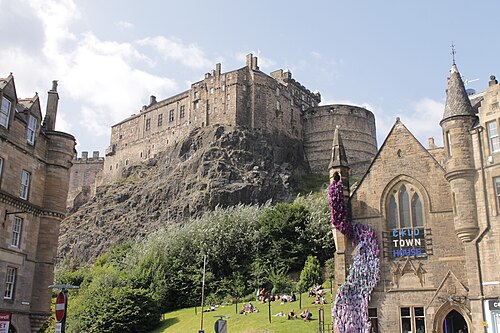 Edinburgh CastleRestored · prime 1520
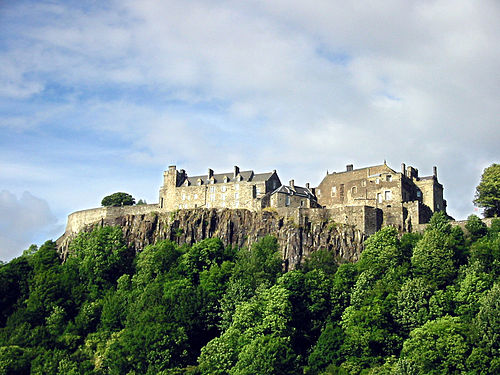 Stirling CastleRestored · prime 1542
 Glamis CastleStill standing · prime 1900
All castles in Scotland → · Strongest castles in Scotland → · Castles of Europe
Play As Your Clan
Hold a real castle against whatever you choose to send at it, take a ship out in her own service years, or stand at the shoulder of someone the record remembers. The chronicler sets the scene; the deeds are yours.
Notable bearers of the Paterson name
- William Paterson (1658–1719), founder of the Bank of England, the Darien Scheme
- Banjo Paterson (1864–1941), Australian poet ('Waltzing Matilda', 'The Man from Snowy River')
- Bill Paterson (b. 1945), Scottish actor