Percy
also de Percy
Earls and Dukes of Northumberland, seven hundred years at Alnwick Castle.
- Origin
- North East, England
- Motto
- Esperance en Dieu
- Famous bearer
- Sir Henry Percy 'Hotspur' (1364-1403), warrior of the Anglo-Scottish border
- Register
- English family
Ranked of all time
The 15 Most Powerful English Houses of All Time
The Percy arms and country

Coat of armsPercy armsWikimandia · CC BY-SA 4.0 
Coat of armsModern arms of PercyWikimandia · CC BY-SA 4.0


- Coat of arms: Granted to an individual and inherited down that one documented line. These are the arms of particular families of the name, not of everyone who shares the surname.
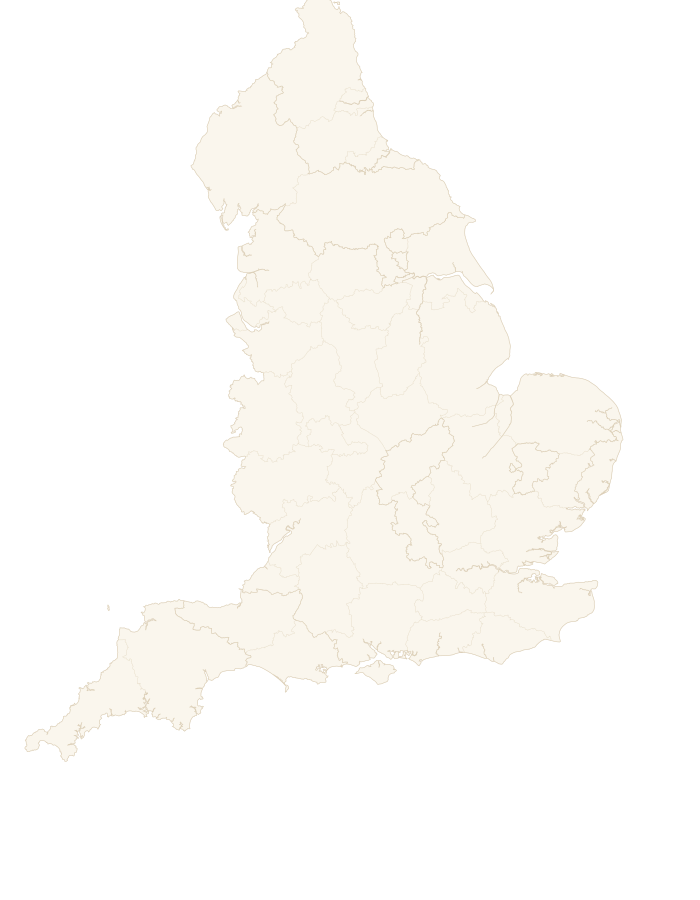
CoreHistoric reach
The seat of Percy
Seat vacantChief
No one leads the Percy community yet. When the movement opens, you can stand for its leadership, or help elect whoever does.
Current mission
No shared goal set yet. Once Percy has leadership, it sets the public focus: a restoration, a gathering, a real-world project that helps its own.
The Percy clan is being rebuilt. Join the waiting list for the movement today, and you help decide who leads it and what it does.
Help rebuild the Percy clan →Motto
Esperance en Dieu
“Hope in God”
What does the Percy name mean?
Norman territorial surname from the village of Percy-en-Auge in Normandy, the seat of William de Percy who came to England with William the Conqueror in 1066. The family established itself in Yorkshire and the northern Marches and by the 14th century was the dominant noble house of the English-Scottish border country.
The history of Percy
A village in the Auge, a barony in Yorkshire
Percy is a territorial surname, taken from Percy-en-Auge in Normandy, the family's home at the time of the Norman Conquest. That naming habit was itself a Norman import: the incoming nobility distinguished themselves by fixing 'de' (of, from) before the name of their village or estate in France, and in England the introduction of family names is generally credited to the preparation of the Domesday Book in 1086. Surnames were adopted first among the feudal nobility and gentry and spread outward from there, so a name like de Percy is close to the beginning of the whole English practice rather than a later addition to it.
The man who brought it was William de Percy, who died in 1096 and who carried the byname Aux Gernons, 'with moustaches'. The traditional account puts his arrival in 1066 with the Conqueror; the fuller account has him crossing to England after William in early December 1067, and reaching the north after the Harrying of the North of 1069 to 1070, when the Norman army had systematically devastated Northumbria and the old English landholding class was being stripped out wholesale. By 1086 only about five per cent of land in England south of the Tees remained in English hands, and after 1075 every earldom was held by a Norman.
William de Percy was given modest estates in Yorkshire by Hugh d'Avranches and was rebuilding York Castle in 1070. Domesday in 1086 records him holding Topcliffe, at the junction of the River Swale and Cod Beck in North Yorkshire, and it served as the caput of his feudal barony: the Percy family's most ancient English seat. A motte and bailey had been thrown up there around 1071. From that one Yorkshire manor everything else follows, and 'modest' is the word the record uses. Nothing about the grant announced that its holders would end up running the English border with Scotland.
The heiress, the Brabanter, and a surname that refused to die
The Percy name has twice run out in the male line and twice been picked up again by the husband or the son of a Percy heiress, which is the single most unusual thing about it. The first failure came in the twelfth century. Alan de Percy was the second feudal baron of Topcliffe, and William II de Percy, the third, died in 1174 or 1175 leaving two daughters, Maud and Agnes, as co-heiresses. By the reign of Henry II the family was represented by an heiress alone.
Agnes de Percy, born in 1134, held Topcliffe in her dowry, and that manor was valuable enough to attract royal attention. Adeliza of Louvain, the widowed and remarried second wife of Henry I, arranged Agnes's marriage to her own young half-brother, Joscelin of Louvain, a son of Godfrey I, Count of Louvain. Joscelin came from the Duchy of Brabant inside the Holy Roman Empire, settled in England, and took the surname Percy. His descendants were the men later created Earls of Northumberland, so the great northern house is Norman in name and Brabantine in male blood, and it advertised the fact: the old Percy arms, azure with five gold fusils in fess, were set aside in favour of the Brabant lion, or a lion rampant azure, and both are quartered by the Duke of Northumberland to this day.
Joscelin acquired Petworth in Sussex, and his younger son Richard took the name de Percy, inherited Petworth and half the barony of Topcliffe, and was among the signatories of Magna Carta. Richard died childless in 1244 and his estates went to his nephew William de Percy, who lived from 1197 to 1245 and had already inherited the other half of Topcliffe from his great-aunt Maud, so both moieties and Petworth came together in one pair of hands. The name Henry recurs in the family from the seventh feudal baron of Topcliffe onward, borne by his ten immediate successors, the 1st Earl and Hotspur among them.
1309: the year the Percys bought Alnwick
Alnwick Castle was not built by Percys. Ivo de Vesci, a Norman from Vassy in Calvados, raised the first parts of it around 1096 to guard a road crossing of the River Aln. When David I of Scotland took it in 1136 it was already described as 'very strong'; William the Lion besieged it in 1172 and again in 1174, and was captured outside its walls at the Battle of Alnwick. Eustace de Vesci was accused of plotting against King John in 1212 and John ordered the place demolished. When John de Vesci succeeded in 1253 he was under age, and Henry III put the wardship of his estates in the hands of a foreign kinsman, to the family's great offence. The de Vesci property eventually came into the guardianship of Antony Bek, Bishop of Durham.
In 1309 Bek sold it. Henry de Percy, 1st Baron Percy of Alnwick, who lived from 1273 to 1314 and was the first of the line summoned to Parliament by writ, bought the barony of Alnwick and with it a fortress on the eastern march. The Yorkshire lands and titles stayed in the family, but from that purchase the Percy fortunes were tied permanently to Alnwick and its castle, and they have held it ever since. In the early fourteenth century a Henry de Percy took out a licence to crenellate a manor house at Spofforth, building the fortified hall whose hall-tower still stands.
His son Henry de Percy, 2nd Baron Percy, turned the purchase into a power base. Edward II granted him the Northumberland lands of Patrick IV, Earl of March, in 1316, and he set about enlarging Alnwick and strengthening its defences. Edward III put him on the royal council in 1327, gave him the manor and castle of Skipton, and in 1328 granted him the castle and barony of Warkworth, although the Percys did not take possession there until 1345, after the death of John de Clavering and then of Clavering's widow. He was at the siege of Dunbar and at Halidon Hill, was made constable of Berwick-upon-Tweed, and in 1346 commanded the right wing of the English army that beat a larger Scottish force at Neville's Cross near Durham. His son, the 3rd Baron Percy, who lived from 1320 to 1368, married Mary of Lancaster, an aunt of John of Gaunt's wife.
Earls of Northumberland and wardens of the March
In 1377, after the coronation of Richard II, the next Henry Percy was created Earl of Northumberland. He lived from 1341 to 1408, and the earldom formalised what the family had already become. For the next two centuries the Percys ran the English border country with what amounted to palatinate authority, raising and commanding the northern levies for the crown in every major Scottish and continental campaign. Nearly every Percy served as a Warden of the Marches, and the consequence was that Scottish affairs were often of more concern to the family than English ones.
Marriage kept adding to the map. The Lucy inheritance brought Cockermouth Castle in Cumbria, at the meeting of the Cocker and the Derwent, and Langley, the H-shaped tower house of four storeys with a tower at each corner that Sir Thomas de Lucy finished in 1364 after David Bruce destroyed the older manor house in 1346. Cockermouth came to the 1st Earl and his heirs male on one condition: that they quarter the Lucy arms, gules with three silver lucies, with their own. Prudhoe Castle above the Tyne, held by the Umfravilles since the Conquest and garrisoned in 1316 by forty men-at-arms and eighty light horsemen at the king's charge, passed to the Percys in 1398, and they built a new Great Hall against its curtain wall.
They built as hard as they married. The 1st Earl raised the great keep at Warkworth overlooking the village in the late fourteenth century, and its designer, John Lewyn, is the likely architect of Wressle Castle in Yorkshire as well. Wressle went up in the 1390s for Thomas Percy, who had been granted the manor in 1364, on land the family had held since the early fourteenth century: four ranges around a central courtyard, a tower at each corner, and a five-storey gatehouse facing the village. It was a palace-fortress rather than a border keep, and the Percys, one of four great landowning dynasties in later medieval Yorkshire, built it to say so.
Hotspur, the knight of the eastern march
Henry Percy was born at Alnwick on 20 May 1364, eldest son of the 1st Earl of Northumberland and Margaret Neville, and raised in the fortress that commanded the eastern Anglo-Scottish border. Through his teens he rode at his father's side on the Border campaigns that were the central work of the Percy interest, and he picked up in his youth the cognomen Hotspur, from his impetuous courage and the rapidity of his charges in the Border affrays. He has been known by it ever since.
He was made Warden of the East March in 1384, at twenty, in succession to his father, and served in the great army Richard II led into Scotland in 1385. In August 1388 he fought the most celebrated single Border engagement of the century at Otterburn in Redesdale against James, 2nd Earl of Douglas. He was taken in the action and ransomed at three thousand marks, the largest single Border ransom of the period, and the fight passed into the ballad tradition of both kingdoms as Chevy Chase, the most recited ballad of the late medieval frontier. Through the 1390s he was the central English commander on the Scottish line, and he served in Richard II's wars in Ireland in 1394 and at Calais, and was made Justiciar of North Wales in 1399 and Justiciar of Chester.
On 14 September 1402 he commanded the English army that defeated the Scots at Homildon Hill, the decisive Border victory of the period, taking the Earl of Douglas and three more Scottish earls captive. It was the high point of a career that had begun on the marches at twenty. In 1403 he and his uncle the Earl of Worcester rose against Henry IV, whom they had helped to the throne in 1399, marched south to join Owain Glyndwr in the Welsh Marches, and met the royal army outside Shrewsbury on 21 July. It was the first major English battle in which both sides used the longbow, and Hotspur, leading the Percy household cavalry in the central charge of the day, was killed on the field. Shakespeare's Henry IV, Parts 1 and 2, printed in 1597 and 1598, put him into the central canon of English literature as the embodiment of chivalric honour, and Hotspur of Alnwick is still the image the Percy name summons.
Attainder, restoration, and the feud with the Nevilles
The 1st Earl, who had rebelled against Henry IV alongside his son, was attainted and his estates forfeited to the crown in 1405, Prudhoe among them. Wressle had already been confiscated after Thomas Percy was executed for rebelling against Henry IV, and Langley was severely damaged by fire in 1405 and lay ruined for five centuries. It was the sharpest reverse the family ever took, and it did not hold. Henry V restored Hotspur's son, who lived from 1394 to 1455, to his family honours as 2nd Earl of Northumberland.
The family's other long quarrel was with the House of Neville, the other great power in fifteenth-century northern England. The Percy-Neville feud fed directly into the Wars of the Roses, and the crown spent much of the century trying to balance the Percys against the Nevilles and the Dacres on the northern marches. The Percys were staunch Lancastrians: the 2nd Earl was killed at the opening of the wars, the 3rd Earl, who lived from 1421 to 1461, fell at Towton, and three of his brothers also lost their lives in the cause. The earldom was forfeited in 1461 and Wressle stayed under royal control.
Restoration came in 1470, and in 1471 Wressle was handed back to Henry Percy, 4th Earl of Northumberland. He navigated the last Yorkist reigns of Edward IV and Richard III, remodelled the bailey buildings at Warkworth and began a collegiate church inside the castle, and was present but inactive at Bosworth Field in 1485. In 1489 he was pulled from his horse and killed at the old Percy caput of Topcliffe, in a rising against higher taxation. The castle there had already been abandoned during the fourteenth century, and the site of the first Percy barony in England survives today only as earthwork mounds, also known as Maiden's Bower.
Tudor magnates, a rising, and the Wizard Earl
Henry Algernon Percy, 5th Earl of Northumberland, who lived from 1478 to 1527, was a Tudor magnate on the grand scale. He refurbished Wressle and its gardens to the standard of royal properties, and the family bought Egremont Castle in Cumbria from Robert Radclyffe, 1st Earl of Sussex, in 1529. Leconfield in Yorkshire was another of the houses. The 6th Earl, Henry Percy, who lived from 1502 to 1537, was the accepted suitor of Anne Boleyn before Henry VIII married her, and married Mary Talbot, daughter of the 4th Earl of Shrewsbury. He died without a son and his nephew Thomas became the seventh Earl.
Thomas Percy, 7th Earl of Northumberland, born in 1528, led the Rising of the North and was attainted in 1571 and restored the following year; he is honoured as Blessed Thomas Percy. In 1551 the crown had granted the family full ownership of Langley. Another Thomas Percy, who died in 1537, had joined the Pilgrimage of Grace, and a Thomas Percy who was a great-grandson of the 4th Earl was among the Gunpowder Plot conspirators in 1605. Successive Percys were caught up in the plots to free Mary, Queen of Scots, and the 8th and 9th Earls each spent long years in the Tower of London as a result.
The 9th Earl, Henry Percy, who lived from 1564 to 1632, was imprisoned after the Gunpowder Plot and was known as the Wizard Earl for his intellectual pursuits. In 1594 he acquired Syon House at Isleworth in Middlesex, the former Syon Monastery, which is still the family's London seat. His generation produced other kinds of Percy as well: William Percy, born about 1570, poet and playwright, and George Percy, who lived from 1580 to 1632, explorer, author and an early governor of Virginia. Earlier centuries had put Percys into the church, among them Thomas Percy, Bishop of Norwich, who died in 1369, and William Percy, Bishop of Carlisle, who died in 1462.
The name revived by act of Parliament
Algernon Percy, 10th Earl of Northumberland, who lived from 1602 to 1668, was Lord High Admiral of England and then a Parliamentarian in the Civil War, while Henry Percy, Baron Percy of Alnwick, who died in 1659, held to the royalist side. Warkworth was damaged in the fighting; Wressle, built for show and never besieged, was held by Parliament and partly pulled down between 1646 and 1650, leaving the south range standing; Spofforth was ruined. The male line of the Percy-Louvain house ended with Joceline Percy, 11th Earl of Northumberland, who lived from 1644 to 1670, the last man of direct Percy blood to inherit the earldom.
His only surviving child, Elizabeth Percy, who lived from 1667 to 1722, married Charles Seymour, 6th Duke of Somerset, and carried the vast Percy estates into that house. The revival was then engineered deliberately. In 1749 George II created her son Algernon Seymour, 7th Duke of Somerset, Earl of Northumberland and Baron Warkworth, with special remainder to his son-in-law Sir Hugh Smithson, a Yorkshire baronet who had married Algernon's daughter Elizabeth in 1740. Smithson inherited the earldom in 1750 and, by Hugh Earl of Northumberland's Name and Arms Act 1749, took the surname Percy for himself and his descendants. In 1766 he was created Duke of Northumberland and Earl Percy. It was the second time the name had been rescued by an heiress, and English law allowed for exactly this: a family's surname added as a condition of inheritance.
The dukedom has run unbroken since. Hugh Percy, 2nd Duke, was a lieutenant-general in the American Revolutionary War. The 3rd Duke was Lord-Lieutenant of Ireland from 1829 to 1830, and his wife Charlotte, Duchess of Northumberland, was governess to the future Queen Victoria. Algernon Percy, 4th Duke, who lived from 1792 to 1865, had been created Baron Prudhoe of Prudhoe Castle in 1814, rose to admiral in the Royal Navy and served as First Lord of the Admiralty in 1852. The 6th Duke was Lord Privy Seal from 1879 to 1880. Lord Eustace Percy, seventh son of the 7th Duke, went into politics and was made Baron Percy of Newcastle in 1953, and Henry Percy, 9th Duke, was killed during the retreat to Dunkirk in 1940.
Alnwick now, and the name that became a Christian name
Ralph George Algernon Percy, 12th Duke of Northumberland, born in 1956, succeeded in 1995 and lives at Alnwick, with Syon House in west London as the southern seat. The castle is Grade I listed and the second largest inhabited castle in England after Windsor; with the adjacent Alnwick Garden it drew more than 600,000 visitors a year by 2016. Northumberland Estates manages 100,000 acres, of which 4,000 are woodland and 20,000 farmed directly, with about a hundred tenant farmers working the rest. Jane Percy, Duchess of Northumberland, has been Lord-Lieutenant of Northumberland since 2009. The family's traditional burial place is the Northumberland Vault in Westminster Abbey, the Percys being the last family to keep such a privilege; the vault is nearly full and a new private graveyard has been made in Hulne Park near Alnwick.
The Percy castles are now largely public. Warkworth passed into the custody of the Office of Works in 1922, after Anthony Salvin had restored the keep for the dukes in the late nineteenth century, and English Heritage has looked after it since 1984. Spofforth was given to the Office of Works in 1924, and in 1985 the people of Spofforth bought Castle Field for the lasting benefit of their village. Langley, ruined for five hundred years, was restored by the historian Cadwallader Bates and his wife Josephine by 1914 and is now a hotel; its south-west tower still holds twelve garderobes, four to a floor, among the most remarkable survivals of their kind in Europe. Wressle's shell has been secured with grant money and opens a few days a year. Prudhoe's twelfth-century keep, its walls ten feet thick, still stands above the Tyne, and Cockermouth is that rare thing, a castle both ruined and lived in.
Bearers of the surname made their own marks well away from the border. Samuel Percy, who lived from 1750 to 1820, was an Irish-born wax modeller of portraits; Pierre-Francois Percy, 1754 to 1825, was a French surgeon; Walker Percy, 1916 to 1990, was an American author. The name also travelled in an entirely different way. English parents took to using the surnames of great houses as given names, originally to signal political support or patronage, and Percy is one of the handful that stuck, alongside Cecil, Howard and Stanley. That is how the border earls' name came to be carried by the poet Percy Bysshe Shelley, the composer and pianist Percy Grainger, the physicist and Nobel laureate Percy Williams Bridgman, the inventor Percy Shaw, the soldier and explorer Percy Fawcett, and the Irish songwriter and painter Percy French. Many of those names have since become ordinary choices, picked because parents liked the sound of them, the political sense long gone; but Percy came into the font from the family at Alnwick.
Champions of the Percy name
The bearers whose lives are inseparable from this surname. Each has their own page, biography, achievements, geography, connection to the family.
Castles the Percy held
Strongholds this name held for a decade or more, look one up, or rebuild it to explore.
- Warkworth Castle
The 2nd Baron Percy of Alnwick took control in 1345; possession descended through the Percys and the Percy Dukes of Northumberland until custody passed to the Office of Works in 1922.
- Prudhoe Castle
Passed to the Percys in 1398; forfeited to the Crown in 1405 after the 1st Earl of Northumberland's attainder.
- Wressle Castle
Held the manor of Wressle from the early 14th century; the castle was built for Thomas Percy in the 1390s and returned to the family in 1471.
- Cockermouth Castle
Held by the Percy Earls of Northumberland from the 15th to the 17th century.
- Langley Castle
Inherited by Maud de Lucy and her husband Henry Percy, Earl of Northumberland; full ownership regranted to Thomas Percy, sixth Earl, in 1551.
- Topcliffe Castle
The Percy family held Topcliffe; Henry Percy, 4th Earl of Northumberland, was slain on the castle site by a mob in 1489.
- Spofforth Castle
Built by Henry de Percy in the early 14th century under licence to crenellate; later returned to the family, whose steward lived there until 1604.
- Alnwick Castle
The Percys bought Alnwick from Antony Bek, guardian of the de Vesci estates, and have held it as earls and later dukes of Northumberland ever since; the 12th Duke lives there today.
Landmarks the Percy held
Palaces, houses and great buildings tied to this name, look one up, or rebuild it to explore.
- Petworth House
Held by the Percy Earls of Northumberland from the 12th century until the line's heiress carried it to the Seymours in 1682.
The castles of the homeland
The great strongholds of the homeland, look one up, see what it looked like in its prime, and recreate it to explore.
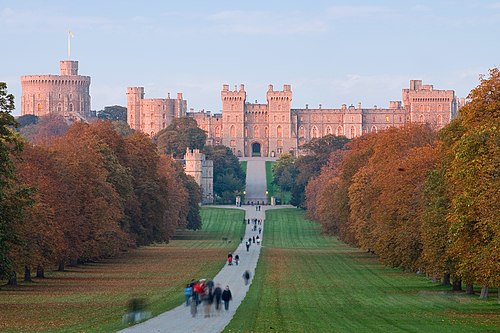 Windsor CastleRestored · prime 1820
 Tower of LondonRestored · prime 1285
 Bamburgh CastleRestored · prime 1904
All castles in England → · Strongest castles in England → · Castles of Europe
Play As Your Clan
Hold a real castle against whatever you choose to send at it, take a ship out in her own service years, or stand at the shoulder of someone the record remembers. The chronicler sets the scene; the deeds are yours.
Notable bearers of the Percy name
- Sir Henry Percy 'Hotspur' (1364-1403), warrior of the Anglo-Scottish border
- Henry Algernon Percy, 5th Earl of Northumberland (1478-1527), Tudor magnate
- Algernon Percy, 4th Duke of Northumberland (1792-1865), First Lord of the Admiralty
- Ralph Percy, 12th Duke of Northumberland (b.1956), current head of the Percy line