Quayle
also Quaile, MacPhail
Son of Paul, contracted Manx-style, the island's signature surname.
- Origin
- Isle of Man, Islands & Dependencies
- Famous bearer
- Dan Quayle (b. 1947), 44th Vice-President of the United States
- Register
- Manx family
Where the Quayle name comes from
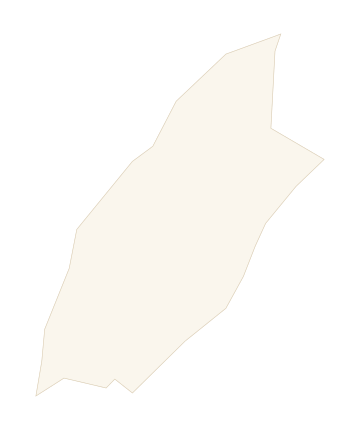
The seat of Quayle
Seat vacantChief
No one leads the Quayle community yet. When the movement opens, you can stand for its leadership, or help elect whoever does.
Current mission
No shared goal set yet. Once Quayle has leadership, it sets the public focus: a restoration, a gathering, a real-world project that helps its own.
The Quayle clan is being rebuilt. Join the waiting list for the movement today, and you help decide who leads it and what it does.
Help rebuild the Quayle clan →What does the Quayle name mean?
A contraction of the Gaelic Mac Pháil, 'son of Paul'. The reduction of Mac- to a single hard initial, here Qu-, is the signature pattern of Manx surnames, and Quayle is among the most characteristic of them all.
The history of Quayle
Mac worn down to its last letter
Quayle is Mac Phail, son of Paul, and the Scottish cognate of the same patronymic is still written out in full as MacPhail. The difference between the two spellings is not a difference of family. It is a difference of speech, and the Manx form is what happens when a language stops giving the prefix any weight at all.
Mac carried no stress in Manx. Spoken unstressed, it was reduced in the mouth to a bare hard consonant, and that consonant came to be heard not as the tail of the prefix but as the head of the word behind it. Once the ear had made that shift the prefix had nothing left to do. In the early sixteenth century Mac was almost universally used on the island; by the seventeenth it had almost completely disappeared, leaving its final sound welded to the front of the father's personal name. That is why so many Manx surnames now open with C, K or Q. Cubbon, Kelly and Quayle are three of them, each one carrying a single letter of a prefix that no longer exists.
None of that is a statement about descent. Two Manx families of the Q names need share no ancestor; what they share is a habit of pronunciation, and the letter at the front of Quayle records the stress pattern of a spoken phrase. Nor was the change confined to Man, though Man is where it went furthest. At the north end of the Irish Sea, in Ulster, on the island, in Galloway and as far north as Argyll, Mac was frequently truncated in speech to a plain k sound, and the anglicised spellings that came of it usually begin with C, K or Q: Qualtrough for the son of Walter, alongside Quayle for the son of Paul. Ireland ran the same process to a different result, Mac Aonghusa becoming Guinness and the O names surfacing in H, as Ua h-Iarfhlatha became Hurley. The Irish O never took root among Manx names at all, so the island had only the one prefix to lose, and lost it thoroughly.
Indianapolis, Paradise Valley, Huntington North
James Danforth Quayle was born in Indianapolis on 4 February 1947, to Martha, born Pulliam, and James Cline Quayle (1921-2000), the oldest of four children with two brothers, Christopher and Michael, and a sister, Martha. The name reached the family from the Isle of Man, where his great-grandfather was born. The household moved to Arizona while he was small, and in 1955 James C. Quayle moved it there for good to run a branch of the family's publishing business, settling at Paradise Valley outside Phoenix, where his son started playing golf at eight at the country club.
He went back to Indiana to finish school, graduating from Huntington North High School in 1965, and took a BA in political science at DePauw University in 1969, where he captained the university golf team. He joined the Indiana National Guard on graduating and served from 1969 to 1975, reaching sergeant. In 1970, still serving, he enrolled at the Indiana University Robert H. McKinney School of Law and took his Juris Doctor in 1974. It was in night classes there in 1972, on a project about revising Indiana's death penalty laws, that he met Marilyn Tucker; they married within weeks, in November 1972, and had three children, Tucker, Corinne and Benjamin.
The Pulliam papers on the mother's side
The newspapers in this story are Pulliam papers, and the name belongs to Dan Quayle's mother's family rather than his father's. Eugene Collins Pulliam (1889-1975), his maternal grandfather, was a publisher for sixty-three years and acquired forty-six newspapers in that time, founding the holding company Central Newspapers, Inc. and serving as its president. On 25 April 1944 Central Newspapers bought The Indianapolis Star out of Shaffer's estate. The Star had been trailing the evening Indianapolis News; by 1948 it was the largest newspaper in Indiana.
Pulliam bought the News itself that same year and combined the two papers' business, mechanical, advertising and circulation operations, moving the News into the Star's building in 1950 while leaving the newsrooms separate. In Arizona he bought The Arizona Republic and the two Gazettes and ran all three until his death in 1975 at eighty-six, imprinting the Republic with his own conservative politics and his drive for civic leadership; he is counted among the business leaders who made the modern Phoenix area.
The house carried on after him without becoming a Quayle concern. Eugene S. Pulliam (1914-1999), Dan Quayle's uncle, took over as publisher of the Star and the News in 1975 and held the post until his own death. Myrta Pulliam, born 1947, a journalist on the Star, worked on a 1974 series that uncovered local police corruption and dilatory law enforcement and forced a cleanup of both the police department and the county prosecutor's office; it won the 1975 Pulitzer Prize for Local Investigative Specialized Reporting. The Phoenix Gazette closed in 1997 and the Indianapolis News ceased publication in 1999, leaving the Star as the only major daily in the city.
Unseating Roush in Indiana's fourth
Quayle's first work was in state government: investigator in the Consumer Protection Division of the Indiana attorney general's office from July 1971, then administrative assistant to Governor Edgar Whitcomb, and from 1973 to 1974 director of the Inheritance Tax Division of the Indiana Department of Revenue. After law school he went to the family's paper at Huntington, the Herald-Press, as associate publisher and then general manager.
In 1976, from that desk, he ran for Indiana's fourth congressional district against the Democratic incumbent J. Edward Roush, arguing that Roush's long career was itself part of the case for congressional reform. He was expected to lose to a popular sitting member. He beat Roush by 19,401 votes, and was the only challenger in Indiana that year to unseat an incumbent representative, crediting the win to his newspaper connections and well placed advertising.
In 1978 he faced the Democrat John D. Walda. His aides advised him not to debate; he debated anyway, saying he thought it mattered to be open, and took nearly twice Walda's vote. That November, Congressman Leo Ryan of California invited him onto a delegation going to investigate conditions at the Jonestown settlement in Guyana. Quayle could not go. Ryan and his party were murdered at the airstrip as they tried to leave.
The youngest senator Indiana had ever elected
Rather than seek a third House term, Quayle announced for the Senate in 1980. He went up against Birch Bayh, a three-term Democratic incumbent first elected in 1962, chairman of the Senate Intelligence Committee and the architect of the 25th and 26th Amendments. Quayle won with 54 percent, better than 160,000 votes clear, in one of the key races of that year and part of the pattern that came to be called Reagan's coattails. At thirty-three he was the youngest person Indiana had ever sent to the Senate.
He was returned in 1986 against Jill Long with the largest margin achieved to that date by any candidate in a statewide Indiana race. In the Senate he worked on Armed Services and on Labor and Human Resources, pressing defence strengthening, the Strategic Defense Initiative and job creation, and his principal piece of legislation was the Job Training Partnership Act of 1982, which he co-authored and which overhauled the federal job training programmes. He also chaired the special committee examining the Senate's own committee system, known while it sat as the Quayle Committee. He resigned the seat after the 1988 election, and Representative Dan Coats was appointed to fill it.
Forty-one years old, sworn in by Sandra Day O'Connor
On 16 August 1988, at the Republican convention in New Orleans, George H. W. Bush chose Quayle as his running mate. Bush had been trailing by as much as fifteen points before the convention; in August the ticket took the lead and did not give it up again, carrying forty states and 426 electoral votes in November against Michael Dukakis and Lloyd Bentsen.
He was sworn in at noon on 20 January 1989 by Justice Sandra Day O'Connor, the first vice president to take the oath from a woman of the Supreme Court, and at forty-one the third youngest to hold the office, after Richard Nixon and John C. Breckinridge. Across a full term as president of the Senate he cast no tie-breaking vote at all, only the second vice president after Charles W. Fairbanks to serve a complete term without one.
Bush made him the first chairman of the National Space Council and head of the Council on Competitiveness. At the Space Council he argued for greater effort to protect the Earth against asteroid impacts, and after a briefing from Lieutenant General Daniel O. Graham, Max Hunter and Jerry Pournelle he sponsored an experimental single stage to orbit programme, which produced the McDonnell Douglas DC-X. He travelled more than any vice president before him, visiting forty-seven countries: Venezuela and El Salvador on his first solo mission, Chile and Brazil in 1990, south-western Saudi Arabia in early 1991 to see American pilots and sailors in the Gulf, and Nigeria, Liberia and Malawi in October 1991 on an African tour that was his sixteenth foreign trip.
The 1992 ticket lost to Bill Clinton and Al Gore, 168 electoral votes to 370. Quayle spent his last months on the constitutional side of the job, and on 6 January 1993 he presided over the certification of the election he had just lost, confirming the victory of the men about to replace him.
Standing Firm, Cerberus, and a church in Huntington
Quayle left office on 20 January 1993 and became a trustee of the Hudson Institute that year, sitting on the board of Central Newspapers until 1999. His memoir Standing Firm appeared in 1994 and was a bestseller; The American Family: Discovering the Values That Make Us Strong, written with Diane Medved, followed in 1996, and Worth Fighting For in 1999. He joined the private equity firm Cerberus Capital Management in 1999 and became chair of its Global Investments division. He ran for the Republican nomination in 2000, launching on 14 April 1999 in the gymnasium of Huntington North High School, the school he had left in 1965, and ended the candidacy that September in Phoenix for want of funds and support.
His son Benjamin Quayle, born 5 November 1976, won Arizona's third district in 2010 and served one term; his father was central to the campaign. According to Bob Woodward and Robert Costa's Peril, Quayle was also central in advising his fellow Indianan Mike Pence to certify the 2020 presidential election under the Senate's rules. The office he held is commemorated back in Indiana at 815 Warren Street in Huntington, in the Old Plat Historic District, where a renovated First Church of Christ, Scientist opened to the public on 17 June 1993. It began as the Dan Quayle Center and Museum and is now the Quayle Vice Presidential Learning Center, its ground floor given to the history of every vice president of the United States.
Play As Your Clan
Hold a real castle against whatever you choose to send at it, take a ship out in her own service years, or stand at the shoulder of someone the record remembers. The chronicler sets the scene; the deeds are yours.
Notable bearers of the Quayle name
- Dan Quayle (b. 1947), 44th Vice-President of the United States