House of Windsor
also House of Windsor, Saxe-Coburg and Gotha
Royal house of Britain, 1917 to today (and Saxe-Coburg and Gotha from 1901).
- Origin
- London, England
- Motto
- Dieu et mon droit
- Famous bearer
- George V (1865-1936), the king who adopted the Windsor name in 1917
- Register
- Princely house
Ranked of all time
The 15 Most Powerful English Houses of All Time
The Windsor arms and country

Coat of armsBadge of the House of WindsorThe arms of the house itself: the main line, not one of its cadet branches.Sodacan · Public domain 
Coat of armsCoat of Arms of the Duchy of Saxe-Coburg and GothaBorne by the Saxe-Coburg line, one branch of the name rather than all of it.Glasshouse using elements by Sodacan, Trondivers and katepanomegas · CC BY-SA 4.0


- Coat of arms: Granted to an individual and inherited down that one documented line. These are the arms of particular families of the name, not of everyone who shares the surname.
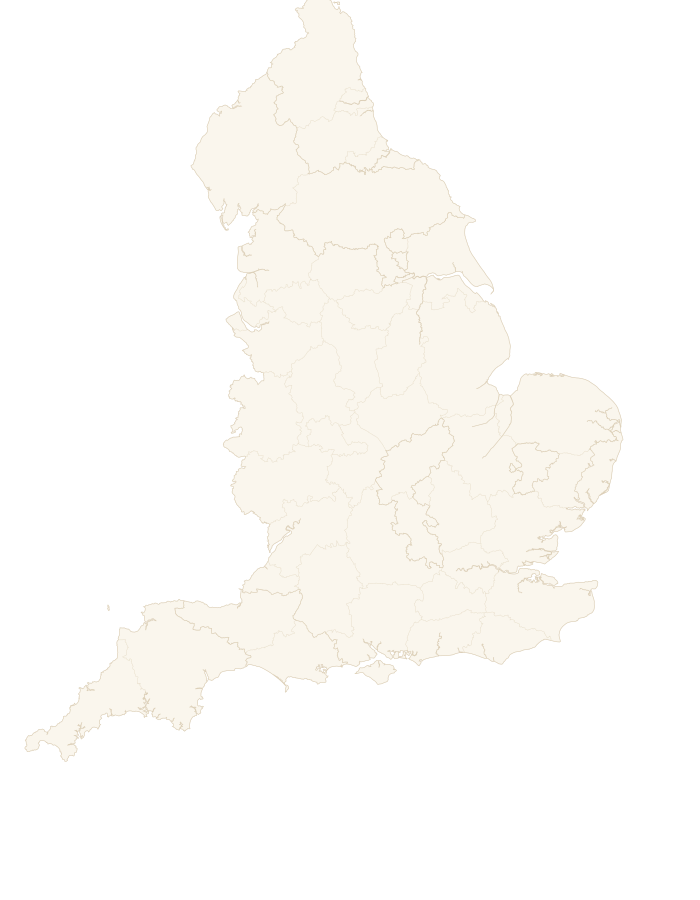
The seat of House of Windsor
Seat vacantChief
No one leads the House of Windsor community yet. When the movement opens, you can stand for its leadership, or help elect whoever does.
Current mission
No shared goal set yet. Once House of Windsor has leadership, it sets the public focus: a restoration, a gathering, a real-world project that helps its own.
The Windsor clan is being rebuilt. Join the waiting list for the movement today, and you help decide who leads it and what it does.
Help rebuild the Windsor clan →Motto
Dieu et mon droit
“God and my right”
What does the Windsor name mean?
From Windsor Castle in Berkshire, the principal royal residence outside London since the 11th century, originally built by William the Conqueror. The dynasty's adopted name was conferred by royal proclamation of George V on 17 July 1917, replacing the German house style of Saxe-Coburg and Gotha that the family had carried since Edward VII's accession in 1901.
The history of House of Windsor
The Berkshire castle that handed out a surname
Windsor Castle was raised by William the Conqueror, part of the programme by which the Normans built castles and fortifications in unprecedented numbers, initially on the motte-and-bailey pattern, to hold a kingdom taken at Hastings on 14 October 1066. The Great Survey that recorded the result, the Domesday Book, was completed by 1086. Windsor came out of that first Norman generation as the principal royal residence outside London, and it has been so since the eleventh century.
Windsor as a surname is habitational, one of the class of names taken from the inhabited place associated with the person who bore it: a homestead, a farm, an enclosure, a village, a stronghold. In England the introduction of family names is generally attributed to the preparation of the Domesday Book itself, and the evidence indicates that surnames were adopted first among the nobility. Anyone who held land at Windsor, served there, or simply came from the town on the Berkshire bank could be written down as of Windsor, and the descendants of clerks, tenants and household men carried the place-name into parishes that had never seen the castle.
Andrew Windsor, and the name inside the peerage
Long before any dynasty adopted it, Windsor was a working English noble surname. Andrew Windsor, 1st Baron Windsor (1467-1543), stands at the head of the barony that carried the name into the English peerage, and he belongs to the reign of the early Tudors, not to the twentieth century at all. The titles that grew from the same root, Baron Windsor, Viscount Windsor and Earl of Windsor, kept the name in circulation among landed families who would have found nothing royal about it.
The name came back the other way in 1936. Edward VIII reigned for less than a year and abdicated in December of that year, and was afterwards styled Duke of Windsor, with Wallis Simpson as Duchess of Windsor. The place-name had by then done both jobs: a family's own surname, inherited in the ordinary way, and a title conferred out of the crown. The 1917 proclamation that made it a dynasty's name is the most famous thing that ever happened to the word Windsor, but it is not the beginning of the word's history in England.
The Ernestine duchy that produced Prince Albert
The house that would take the Windsor name in 1917 began in Thuringia. When Ernest I, Duke of Saxe-Gotha, died in 1675, his seven sons divided the inheritance in the Gothaer Hauptrezess of 1680, and the youngest, John Ernest IV, received Saalfeld. A succession dispute over Saxe-Coburg that ran until 1735 sent most of that territory to John Ernest's line, forming the duchy of Saxe-Coburg-Saalfeld. His sons Christian Ernest and Francis Josias ruled it jointly until 1745; Francis Josias then governed alone and introduced primogeniture in 1747 precisely to stop the duchy being carved up again.
Ernest Anton (1784-1844) inherited that consolidated patrimony. He received the Principality of Lichtenberg in 1816 for military service against Napoleon and sold it to Prussia in 1834, unrest and distance having made it more trouble than it was worth. The territorial reorganisation of 1826 turned him into Ernest I, first Duke of Saxe-Coburg and Gotha, ruler of a house with two official residences and a court that moved twice a year, from Gotha to Coburg for the summer and back to Gotha for the winter. Two nearly identical court theatres were built in 1840, one in each capital, so the season did not stop when the household moved.
Ernest I's second son, Prince Albert (1819-1861), married his first cousin Queen Victoria in 1840; Victoria's mother was a sister of Ernest I. That marriage is the hinge. On 22 January 1901 Edward VII succeeded Victoria and inherited his father's house style, and the British crown passed from Hanover to Saxe-Coburg and Gotha. Genealogically the patriline was older still, a cadet branch of the Saxon House of Wettin, whichever name the branches chose to use.
Cousins on the thrones of Belgium, Portugal and Bulgaria
Albert's relations were placed across Europe with remarkable speed. Leopold, youngest son of Francis, Duke of Saxe-Coburg-Saalfeld, converted to Catholicism to take the newly created Belgian throne and became King of the Belgians in 1831; his descendants reign in Belgium still, through Leopold II, Albert I, Leopold III, Baudouin, Albert II and Philippe. Leopold's only daughter, Princess Charlotte of Belgium, was consort to Maximilian I of Mexico and was known in the 1860s as Empress Carlota of Mexico.
A Catholic cadet branch formed in 1826, when the family inherited the Hungarian princely estate of the Koharys and converted. Its marriages reached a queen regnant of Portugal, an imperial princess of Brazil, an archduchess of Austria and a French royal princess. Ferdinand the younger married Queen Maria II of the House of Braganza and became king of Portugal, a line that ran through Pedro V, Luis I, Carlos I and Manuel II until the Revolution of 1910. Another scion, Ferdinand, became ruling prince and then Tsar of Bulgaria from 1887, followed by Boris III and Simeon II, and the Bulgarian branch reigned until 1946.
The proclamation of 17 July 1917
Anti-German feeling across the British Empire reached its peak in March 1917. The Gotha G.IV, a heavy aircraft capable of crossing the English Channel, began bombing London directly, and the word Gotha became a household name in the worst possible way for a king whose house was styled Saxe-Coburg and Gotha. On 15 March 1917 George V's first cousin, Emperor Nicholas II of Russia, was forced to abdicate, raising the spectre that every monarchy in Europe might be swept away. The king and his family were persuaded to abandon all titles held under the German crown and to anglicise their German titles and house names.
The new name was suggested by Arthur Bigge, 1st Baron Stamfordham, and it carried a long association with monarchy in Britain through the town of Windsor in Berkshire and the castle above it. The royal proclamation of 17 July 1917 declared that from its date "Our House and Family shall be styled and known as the House and Family of Windsor", and that all descendants in the male line of Queen Victoria who were subjects of these realms, other than female descendants who married or had married, should bear the name of Windsor.
Wilhelm II, hearing that his cousin had renamed the British royal house, remarked that he planned to attend a performance of "The Merry Wives of Saxe-Coburg-Gotha". George V went further than the name: he restricted the use of British princely titles to his nearest relations, and in 1919 stripped three of his German relatives of their British titles and styles under the Titles Deprivation Act 1917. Belgium did the same arithmetic. In 1920 Albert I changed the family style to "of Belgium" and the Saxon arms were taken off the Belgian royal coat of arms, where they were not restored until 2019.
The second proclamation, and the name Mountbatten-Windsor
The name had to be defended once more, in peacetime. In 1947 Philip, born Prince Philip of Greece and Denmark and a member of the Glucksburg branch of the House of Oldenburg, gave up his princely titles a few months before his marriage and adopted the surname Mountbatten. It was his maternal uncle's name, taken by Prince Louis of Battenberg in 1917 as a literal translation of Battenberg, a small town in Hesse. He married Princess Elizabeth at Westminster Abbey on 20 November 1947.
Soon after her accession in 1952, Lord Mountbatten observed that since a wife customarily took her husband's surname, the House of Mountbatten now reigned. Queen Mary heard the remark and told Winston Churchill, who advised a proclamation. On 9 April 1952 the new queen declared it her "Will and Pleasure that I and My children shall be styled and known as the House and Family of Windsor, and that My descendants, other than female descendants who marry and their descendants, shall bear the name of Windsor." Philip's private verdict was famously blunt: "I am nothing but a bloody amoeba. I am the only man in the country not allowed to give his name to his own children."
The question returned in 1960 after months of correspondence between Prime Minister Harold Macmillan and the constitutional expert Edward Iwi, who argued that a royal child given its mother's maiden name rather than its father's would carry a stain on its legitimacy. On 8 February 1960 the Queen confirmed that she and her children would remain the House and Family of Windsor, and decreed that agnatic descendants without the style of Royal Highness and the title of prince or princess would bear the surname Mountbatten-Windsor. The child whose expected birth had forced the issue arrived eleven days later. Any future monarch may change the dynastic name by a similar proclamation, because the royal prerogative covers it.
Seventy years and two hundred and fourteen days
Elizabeth Alexandra Mary Windsor was born at 17 Bruton Street in Mayfair, London, on 21 April 1926, elder of the two daughters of Albert, Duke of York, and Lady Elizabeth Bowes-Lyon. She was raised at 145 Piccadilly and at the Royal Lodge in Windsor Great Park, and was tutored at home by her mother and by the constitutional historian Sir Henry Marten of Eton. The abdication of her uncle Edward VIII in December 1936 made her father George VI and made her, at ten, heir presumptive. In the closing months of the Second World War she trained as a Subaltern in the Auxiliary Territorial Service, the only British monarch in history to have served in the armed forces in uniform.
She acceded on 6 February 1952, on the death of her father at Sandringham, while she was at the Treetops Hotel in the Aberdare Forest of Kenya. She was crowned at Westminster Abbey on 2 June 1953 in the first televised coronation in British history, a BBC broadcast reaching an estimated two hundred and seventy-seven million viewers worldwide. She gave the first televised Christmas Message in 1957 and kept the tradition every year for sixty-five years, to 2021. The Royal Commonwealth Tour of 1953 to 1954, a seven-month circumnavigation, set the shape of modern Commonwealth ceremonial.
Her reign covered the ministries of fifteen British Prime Ministers from Winston Churchill to Liz Truss, seven Archbishops of Canterbury, six Roman Catholic Popes and fourteen United States Presidents. She paid state visits to a hundred and seventeen countries, the most-travelled sovereign in history, including the first state visit by a British monarch to the Republic of Ireland in May 2011. Her Silver, Golden, Diamond and Platinum Jubilees fell in 1977, 2002, 2012 and 2022. She died at Balmoral Castle on 8 September 2022; her state funeral at Westminster Abbey on 19 September was the most-watched single broadcast event in British history, and she was buried at the King George VI Memorial Chapel in St George's Chapel, Windsor Castle, beside her husband and her parents.
One crown, fifteen realms
When the House of Windsor was created in 1917 its head reigned over the British Empire. After the First World War the Dominions emerged as independent states, a shift recognised in the Balfour Declaration of 1926, the Royal and Parliamentary Titles Act 1927 and the Statute of Westminster 1931. The Windsors became the royal family of several separate countries rather than one, a number that moved as Dominions became republics and Crown colonies became realms or monarchies under a different sovereign. Since 1949 three Windsor monarchs, George VI, Elizabeth II and Charles III, have also been Head of the Commonwealth of Nations.
The monarch is today head of state of fifteen sovereign states: the United Kingdom, Antigua and Barbuda, Australia, the Bahamas, Belize, Canada, Grenada, Jamaica, New Zealand, Papua New Guinea, Saint Kitts and Nevis, Saint Lucia, Saint Vincent and the Grenadines, Solomon Islands and Tuvalu, alongside three Crown Dependencies and fourteen British Overseas Territories. Charles III succeeded on 8 September 2022 and was crowned at Westminster Abbey on 6 May 2023.
The Windsors who never went near a palace
The 1917 proclamation gave the surname Windsor to the male-line descendants of Queen Victoria who were British subjects, which is why the word now reads as royal. It did nothing to the far larger number of families who had carried it as an ordinary habitational name. Frank Windsor (1928-2020) was an English television actor and Robin Windsor (1979-2024) a British dancer; Harry Windsor-Fry (1862-1947) was a British painter and educator; Gerard Windsor, born in 1944, is an Australian author; Peter Windsor, born in 1952, is a British journalist and reporter.
The name is just as ordinary in sport and in working life. Bobby Windsor, born in 1948, played rugby union for Wales; Harley Windsor, born in 1996, is an Australian figure skater, and Annette Woodward, nee Windsor, born in 1947, an Australian pistol shooter. Walter Windsor (1884-1945) sat as a British Labour Party politician; Roger Windsor was a British labour union leader and former chief executive of the National Union of Mineworkers; and Cecil Stanley Windsor (1879-1926) was managing director of Windsor, a British automobile company.
Champions of the Windsor name
The bearers whose lives are inseparable from this surname. Each has their own page, biography, achievements, geography, connection to the family.
Historic Places, Rebuilt
Explore the streets and seats the Windsor name knew, rebuilt with AI as they stood in history.
Landmarks the Windsor held
Palaces, houses and great buildings tied to this name, look one up, or rebuild it to explore.
- Clarence House
Home of Queen Elizabeth The Queen Mother for nearly fifty years from 1953, and later the London residence of King Charles III.
- Royal Burial Ground
Consecrated in 1928 as the private burial ground of the House of Windsor; Edward VIII and Wallis, Duchess of Windsor, are among those buried there.
Castles that share the Windsor name
The same name on the map, look one up, see what it looked like in its prime, and recreate it to explore.
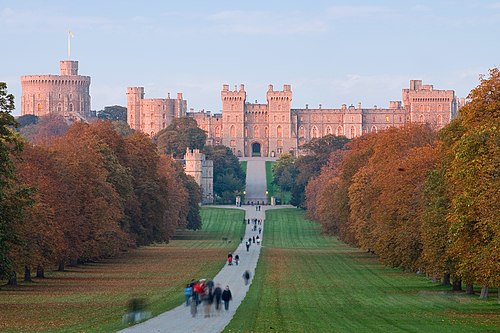
All castles in England → · Strongest castles in England → · Castles of Europe
Play As Your Clan
Hold a real castle against whatever you choose to send at it, take a ship out in her own service years, or stand at the shoulder of someone the record remembers. The chronicler sets the scene; the deeds are yours.
Notable bearers of the Windsor name
- George V (1865-1936), the king who adopted the Windsor name in 1917
- George VI (1895-1952), wartime king
- Elizabeth II (1926-2022), longest-reigning British monarch
- Charles III (b.1948), reigning king of the United Kingdom