Stadium · England · Still standing
Goldstone Ground & Brighton Community Stadium
Falmer Stadium (known commercially as the American Express Stadium and commonly the Amex) is a modern football stadium in Falmer, Brighton and Hove, England, serving as the home ground of Brighton & Hove Albion. It has continuous seating around a rectangular pitch with four named stands and facilities for corporate boxes, club hospitality and community use.
First raised
2008
Its prime
2017
Today
Still standing
As it stood in 2017
What Brighton Community Stadium looked like in its prime.
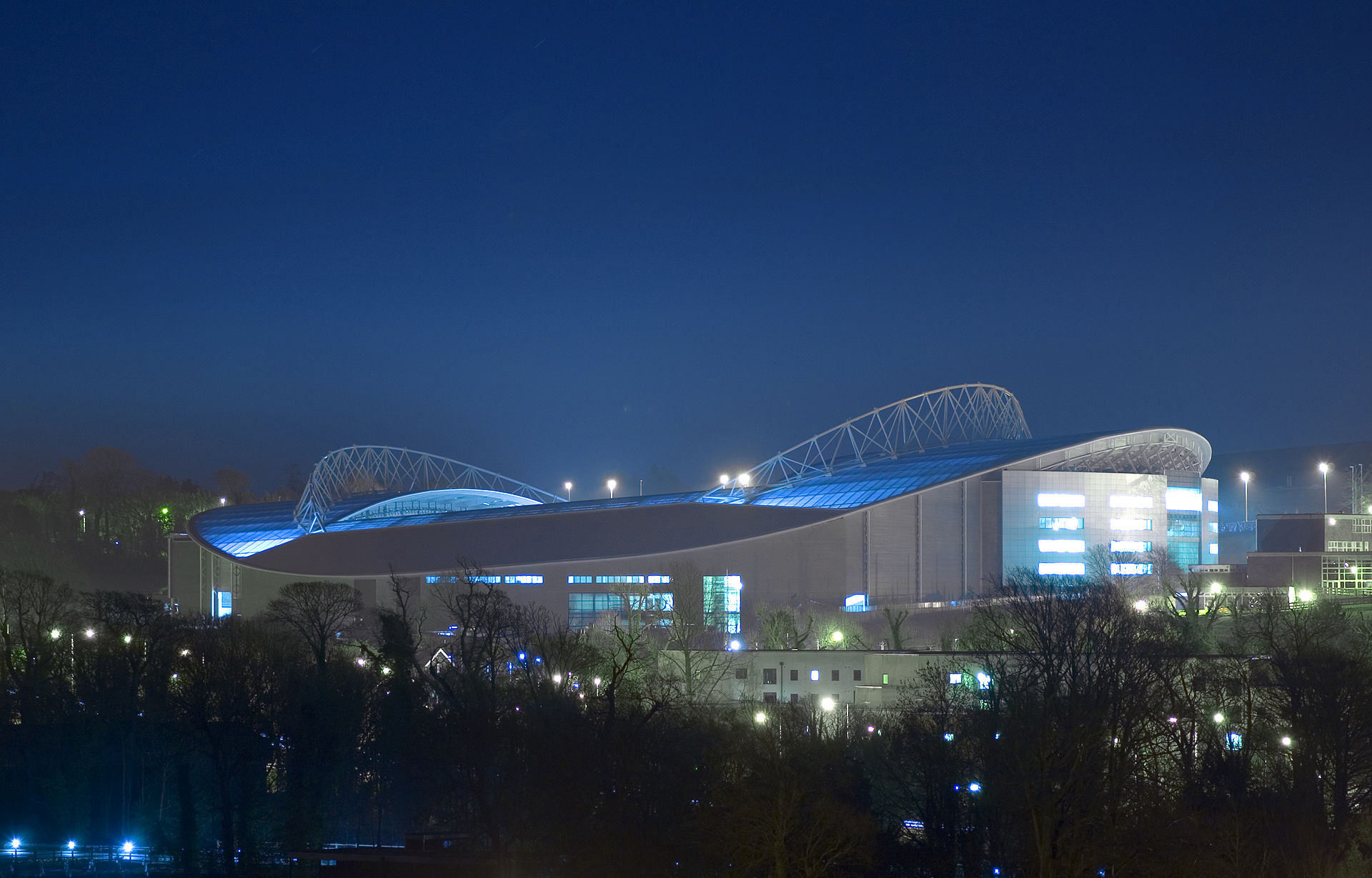
A low-set, bowl-shaped stadium sunk into the ground beneath undulating, white steel roof trusses that form two sweeping arches; the roofline curves over a full bowl of seating. Exterior walls are smooth pale concrete and metal cladding with glazed end-facades of stacked rectangular windows that glow when lit. Floodlights rim the roof, entry portals and corporate box levels break the long elevations, and the site sits beside trees, a rail line and a coach/parking area.
Its story
The story of Brighton Community Stadium.
Evicted from the Goldstone, 1995-2002
The plans for a stadium at Falmer were initiated by Brighton & Hove Albion after the club lost the ground it had. In 1995 the club's former board - Greg Stanley, Bill Archer and David Bellotti - sold the Goldstone Ground to developers with no new home arranged. The club was evicted at the end of the 1996-1997 season and spent two seasons groundsharing at Gillingham's Priestfield Stadium in Kent, 74 miles away by road.
Two years later Albion returned to Brighton as tenants of Withdean Stadium, which was upgraded to meet Football League capacity requirements and later expanded when the club reached Division One - now the EFL Championship - in 2002 after two successive promotions. The site at Falmer had been identified during the 1998-99 season, and the hope then was for a stadium ready in the early to mid-2000s.
Prescott's Withdrawn Approval and the Falmer Inquiry, 2002-2007
Brighton and Hove City Council granted planning permission in June 2002, with the intention that the stadium would be ready for the 2005-06 season. Neighbouring Lewes District Council and local residents opposed the plans. The stadium itself lies wholly within Brighton and Hove, but part of the north-east of the site - Bennett's Field - falls in Lewes; it was used for parking at first and has been disused since 2021. Both the vacant fields and the campus of the adjacent University of Sussex sat within the South Downs Area of Outstanding Natural Beauty, though outside the National Park, and the plans were made the subject of a separate planning inquiry by the Office of the Deputy Prime Minister.
John Prescott, then Deputy Prime Minister, approved the plans on 28 October 2005, and Lewes District Council immediately mounted a fresh legal challenge. In April 2006 Prescott admitted that he had given his approval under the misconception that only a small part of the site lay on the Lewes side, and he withdrew it. Hazel Blears, the Secretary of State responsible for planning, re-affirmed the approval on 25 July 2007, against the advice of planning inspectors. The three main opponents - Lewes District Council, Falmer Parish Council and the South Downs Joint Committee - announced shortly afterwards that they would not take the matter to the High Court, and on 4 September 2007 the deadline for appealing the new grant expired, leaving the club with full permission to proceed.
Buckingham Group, KSS and the American Express Deal, 2008-2011
Delays in gaining planning permission meant Albion had to wait until August 2011 to play home games at Falmer, more than a decade after the stadium was first proposed. The Buckingham Group signed the construction contract on 27 November 2008 and began preparation work on 17 December, the date construction proper is also dated from. The London architects KSS designed a stadium set three storeys down into the ground; 138,000 cubic metres of chalk came out during the dig and was placed on the field on the south side of Village Way, a decision estimated to have prevented 22,000 lorry trips to off-site landfill. The building was designed with scope for expansion from the outset. On 22 June 2010 the club announced a naming-rights deal with American Express Europe, Brighton and Hove's largest private-sector employer, under which the ground became the American Express Stadium, more commonly referred to as the Amex.
Construction finished in May 2011 and the developers handed the stadium over to the club on 31 May. The first competitive game came on 16 July 2011, when Brighton's development squad beat Eastbourne Borough 2-0 in the 2010-11 Sussex Senior Cup final, Gary Hart scoring the first goal on the ground. The official opening followed on 30 July 2011 with a friendly against Tottenham Hotspur, the old club of Brighton's then manager Gus Poyet, the home side losing 3-2. The first competitive first-team fixture was on 6 August 2011, Brighton coming from 1-0 down to beat Doncaster Rovers 2-1 - the same opponents as the last game played at the Goldstone Ground fourteen years earlier.
Expansion and the Record Crowds, 2011-2023
The ground began breaking its own attendance record almost at once. The first mark, 21,897, was set against Liverpool, who were also the first away side to win a competitive match there, taking a League Cup tie 2-1 in September 2011; the first league defeat at the stadium came when Crystal Palace came from behind to win 3-1. On 2 January 2012 the club applied to increase capacity by a further 8,000 seats and to add corporate boxes, new television facilities and a luxury suite, and the council's planning committee granted it unanimously on 25 April 2012. Capacity reached 27,250 by the start of the 2012-13 season, 27,750 by December 2012 and 30,750 by the end of that season, an extra seating tier having been installed above the East Stand.
A crowd of 26,684 saw a goalless draw with Nottingham Forest on 15 December 2012; 27,113 watched a 3-2 defeat by Arsenal in the FA Cup fourth round on 26 January 2013; 28,499 saw Brighton beat Crystal Palace 3-0 on 17 March 2013; 30,003 attended the last league game of the season against Wolverhampton Wanderers on 4 May 2013. Arsenal returned in the FA Cup fourth round on 25 January 2015 and won 3-2 again, before 30,278. Derby County's visit on 2 May 2016 drew 30,292, beaten weeks later by the second leg of the play-offs against Sheffield Wednesday, and again on 24 September 2017 when 30,468 watched a 1-0 win over Newcastle United. The record of 31,872, against Luton Town, was set on 12 August 2023, in a ground whose capacity stands at 31,876 - the second-largest in South East England and the thirtieth-largest in the United Kingdom.
Falmer Stadium staged Premier League football for the first time in August 2017, after Albion's promotion at the end of the 2016-17 season, and European football for the first time on 21 September 2023, when Brighton played AEK in the UEFA Europa League.
The Brighton Miracle and the Rugby World Cups, 2012-2025
The ground was designed to take other sports and events, and it did. England's under-21s played Austria's under-21s in a friendly there on 25 March 2013. In the final round of the 2015 Six Nations Under 20s Championship it hosted England U20s against France U20s as a trial run for the World Cup to come. Under the name Brighton Community Stadium it then took two Pool B matches of the 2015 Rugby World Cup: on 19 September 2015, before 29,290 spectators, Japan beat the twice champions South Africa 34-32, an upset counted among the biggest in Rugby World Cup history and the subject of a 2019 film, The Brighton Miracle. Samoa beat the United States 25-16 there before 29,178.
In December 2018 the stadium was named as one of the venues for the UEFA Women's Euro 2022, where it hosted Group A matches involving the hosts England and a quarter-final that also involved England. From the 2021-22 season it has served as an occasional home for Brighton & Hove Albion W.F.C. In August 2023 it was confirmed as one of eight host venues for the 2025 Women's Rugby World Cup, for which it was to be known as the Brighton and Hove Albion Stadium.
Brighton & Hove Albion own and operate the stadium. It won the New Venue Award at the Stadium Business Awards in May 2012. Its bar carries the name of the club's life president, Dick Knight, and its beer comes from Harvey's and Dark Star, two local breweries that backed the club's appeal for a new ground at Falmer.
Step inside
12 places to explore in 2017.
The record describes 12 distinct spots at Brighton Community Stadium, including 6 interiors: pitchside by the players' tunnel, view from the west stand upper tier, east stand family area and concourse and more. Create your own photoreal reconstruction and explore every one, more scenes means more photos, more angles and more of the immersive experience.
Build Your Own Castle
Recreate Goldstone Ground with AI to explore it.
Rebuilds stop at 1945, so the artist raises Goldstone Ground, the historic ground that came before it, as a photoreal reconstruction that belongs to you alone. Pay with coins, no subscription needed.
Recreate Stadium to Explore →Nearby