Belarus · Restored
Mir Castle Complex
Mir Castle Complex is a 16th-century fortified castle in Mir, Belarus, built in the late Brick Gothic style and later refitted with Renaissance residential wings. The complex centres on a square citadel with five towers and two inner residential ranges and is a UNESCO World Heritage Site.
Its prime
1580
Today
Restored
As it stood in 1580
What Mir Castle Complex looked like in its prime.
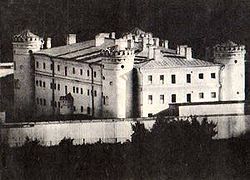
A compact square citadel of red brick with a rough fieldstone plinth, its 75-metre sides enclosing an inner courtyard and five towered corners. The outer curtain is punctuated by a central arched gate and tall brick towers with white plastered decorative panels and narrow slit windows. Two inner wings (northern and eastern) present three-storey plastered facades with limestone portals and mullioned windows. Steep pyramidal red-tiled roofs and metal weather vanes top the towers; the site stands on a low rise with lawns before the entrance.
Its story
The story of Mir Castle Complex.
Juryj Illinič's Castle, Early 16th Century
Duke Juryj Ivanavič Illinič built a stone castle at Mir in the Belarusian Gothic style in the early 16th century (perhaps from 1522, when he finally won a long-running legal dispute over the estate), and it was first recorded in the Lithuanian registers in 1527. Five towers rose around a citadel courtyard that formed a square 75 metres on each side, the castle walls up to three metres thick, the fifth tower (a storey taller than its four corner companions) carrying the main gate.
Mikalaj “the Orphan” Radziwiłł and the Wars, 1568–1794
When the Illinič line died out in 1568, the castle passed to Mikalaj Kryštafor “the Orphan” Radziwiłł, who refitted it with a two-winged, three-storey Renaissance residence along the eastern and northern inner walls, its plastered façades dressed with limestone portals, balconies and porches. It became the administrative centre of the Mir county and a princely country residence.
The castle was besieged and stormed more than once in the wars that began with the Muscovite–Commonwealth war of 1654–1667. It was damaged in 1665 and again in 1706 and restored in the early 18th century, then badly damaged once more in 1794; by the end of that century it had fallen into decay.
The Battle of Mir and the End of Radziwiłł Ownership, 1812–1895
The last of those wars reached Mir in 1812, when French cavalry and the rearguard of the Russian army fought beneath the castle walls in the Battle of Mir, in which the castle suffered severe damage. Its owner, Daminik Hieranim Radziwiłł, died of battle injuries in 1817, and Mir passed to his daughter Stefania, who married Ludwig zu Sayn-Wittgenstein-Berleburg.
The castle later passed to their daughter Maria, who married Prince Chlodwig Hohenlohe-Schillingsfürst; their son Maurice Hohenlohe-Schillingsfürst sold it in 1895 to Mikalaj Sviatapolk-Mirski of the Bialynia clan.
The Sviatapolk-Mirski Restoration and Soviet Occupation, 1895–1939
Mikalaj's son Michail began rebuilding the castle to designs by the architect Teodor Bursche. The Sviatapolk-Mirski family held Mir until 1939, when the Soviet Union occupied Western Belarus.
German Occupation, the Ghetto and World Heritage, 1941–2000
When German forces invaded the Soviet Union in 1941, they occupied the castle and converted it into a ghetto for the local Jewish population before their murder. Between 1944 and 1956 the castle served as a housing facility, damaging its interior. In December 2000 UNESCO listed the Mir Castle Complex as a World Heritage Site.
Step inside
8 places to explore in 1580.
The record describes 8 distinct spots at Mir Castle Complex, including 3 interiors: northern state rooms (interior), chapel and burial vault (sviatapolk-mirsky), battlement walk and tower-top view. Create your own photoreal reconstruction and explore every one, more scenes means more rooms, more angles, and more of the place to stand in.
Build Your Own Castle
Recreate Mir Castle Complex with AI to explore it.
The artist rebuilds it as it stood in 1580, a photoreal reconstruction that belongs to you alone. Pay with coins, no subscription needed.
Recreate this castle →Defend this castle →Whose castle
Clans who held Mir Castle Complex.
The families that held Mir Castle Complex for a decade or more across its history, follow a name to its clan.
Ilyinich
Duke Juryj Ivanavič Illinič began the castle after the turn of the 16th century; the family held Mir until the line died out in 1568.
Radziwill
Held by the Radziwiłłs from 1568, when Mikalaj Kryštafor 'the Orphan' Radziwiłł added the Renaissance residence, until Daminik Hieranim Radziwiłł's death in 1817.
Sayn-Wittgenstein
Passed in 1817 to Radziwiłł heiress Stefania, wife of Ludwig zu Sayn-Wittgenstein-Berleburg; the line held Mir until their son sold it in 1895.
Sviatapolk-Mirski
Bought by Mikalaj Sviatapolk-Mirski in 1895 and owned by the family until the Soviet occupation of Western Belarus in 1939.