Belarus · Partial ruin
Pischalauski Castle
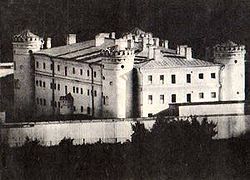
Pishchalauski Castle (commonly called Volodarka) is an early 19th-century purpose-built prison in Minsk, completed in 1824 and commissioned in 1825. The stone, castle-shaped structure consists of a three-storey rectangular main block flanked by four cylindrical corner towers and surrounded by a high perimeter wall; it has served as the city's central detention centre and execution site into the 21st century.
First raised
1825
Its prime
1825
Today
Partial ruin
As it stood in 1825
What Pischalauski Castle looked like in its prime.
The Pishchalauski Castle sits as a rectangular three-storey stone block with four cylindrical corner towers rising slightly above the roofline. Its façade is punctuated by regular rows of small rectangular windows and a central entrance set into a low projecting gate section; a continuous low-pitched roof with numerous short chimneys runs along the block. A white or pale stone perimeter wall encloses a narrow prison yard; the masonry appears smooth ashlar. At its prime the structure is complete, with all four towers intact.
Its story
The story of Pischalauski Castle.
Rudolf Pischallo's Prison Castle
The building on the Romanov hill in Minsk was raised as a gaol and was used as nothing else. Work began in 1822 for the landowner Rudolf Pischallo, who had won the contract to replace the decayed old prison; contrary to a widespread belief he was the general contractor rather than the architect, the design being the work of Kazimir Khrschonovich. The project was approved by Tsar Nicholas I. The stone building was finished by 1824 and commissioned in the spring of 1825: an early-classical block of three storeys with four corner towers, with an administrative range, a pharmacy, a hospital and a church alongside it.
The place took its name from Pischallo: in Belarusian, Pishchalauski Castle. Its popular name, Volodarka, was coined after the October Revolution, when the street outside was renamed for the revolutionary V. Volodarsky.
Prisoners of the Russian Empire, 1830–1911
Insurgents of the risings of 1830–31 and 1863–64 served sentences here, among them the Belarusian writer Vintsent Dunin-Martsinkyevich, held in 1864–65. Józef Piłsudski, the future Polish statesman, was kept here under investigation after his arrest in 1887, and Felix Dzerzhinsky, later head of the Soviet secret police, passed through repeatedly on transfer during his arrests for “revolutionary activity”. The Belarusian revival writers Karuś Kahaniec (1905–06 and 1910–11) and Alés Harun (1907) were prisoners, as was Jakub Kołas from 1908 to 1911. Ivan Pulikhov, who had attempted to assassinate the governor of Minsk, was hanged at the prison gates in 1906.
The NKVD in the Cellars, 1924–1940
After the First World War the prison was taken over by the Cheka-GPU. The Socialist Revolutionary Boris Savinkov, arrested after being lured back onto Soviet territory in the operation known as “Trust”, was held here in 1924. On the night of 29–30 October 1937, during the Great Terror, NKVD officers shot 36 representatives of Belarusian culture, science and art in the castle basement, killing them with shots to the head. About 100 people were executed in the castle during the repressions of 1937–1940, accused of anti-Soviet activity.
Occupation and War, 1939–1945
The Soviet invasion of Poland from 17 September 1939 brought large numbers of Polish prisoners into the castle, soldiers, police and civil servants. Ryszard Kaczorowski, later the last President of Poland-in-exile, was a prisoner in 1940–41.
After the German invasion of the Soviet Union the occupiers went on using the building as a prison. Arrested partisans and members of the underground were held in it, and some were executed or tortured there. Masha Bruskina, a Belarusian Jewish partisan, was hanged in public by the Germans on 26 October 1941. The fighting for Minsk destroyed the historic centre of the city; the castle came through almost untouched, one of the few buildings left standing. Kazimierz Świątek, later a cardinal of the Roman Catholic Church, was imprisoned here in 1944–45.
SIZO No. 1 and the End of Volodarka, 1953–2025
From 1953 the Minsk detention centre was the only institution in the Byelorussian SSR, and afterwards in independent Belarus, where death sentences were carried out; the executions took place inside the prison. Among those shot were Vasyl Meleshko and Hryhoriy Vasiura, both of whom had taken part in the Khatyn massacre, and the serial killer Gennady Mikhasevich. About 400 people were executed there from 1991 onwards. It was also a pre-trial detention centre for arrested political activists: those held after the contested 2020 presidential campaign included the politician Maria Kalesnikava, the blogger Ihar Losik, the lawyer Maxim Znak, charged with “conspiracy to seize state power in an unconstitutional manner” and with leading an extremist organisation, and the activist Roman Protasevich, arrested after his Ryanair flight was diverted to Minsk over a false bomb threat.
Part of one of the four towers collapsed on 20 April 2008, and in 2013 the castle was still in urgent need of major repairs. A decree of 2010 provided for a new detention centre near the village of Pashkovichi; completion slipped repeatedly from 2015, and the detention centre left the castle only on 29 April 2024. The building, an item on the state list of historical and cultural values of Belarus, passed to the Minsk city executive committee. A proposal to install the National Historical Museum in it was dropped, and the site is instead to become a multifunctional complex; five buildings of historical and cultural value, the castle among them, are to be rebuilt in their existing architectural form, and demolition of the rest began in January 2025.
Step inside
6 places to explore in 1825.
The record describes 6 distinct spots at Pischalauski Castle, including 1 interior: basement / cellars. Create your own photoreal reconstruction and explore every one, more scenes means more rooms, more angles, and more of the place to stand in.
Build Your Own Castle
Recreate Pischalauski Castle with AI to explore it.
The artist rebuilds it as it stood in 1825, a photoreal reconstruction that belongs to you alone. Pay with coins, no subscription needed.
Recreate this castle →Defend this castle →

