Belgium · Demolished
Citadel of Antwerp
The Citadel of Antwerp was a large pentagonal bastion fort built to dominate the city of Antwerp in the 16th century. Designed by Francesco Paciotto and completed in 1572, it comprised five angular bastions, curtain walls and a surrounding wet ditch; it was demolished in the late 19th century and the site was redeveloped.
First raised
1572
Its prime
1572
Today
Demolished
As it stood in 1572
What Citadel of Antwerp looked like in its prime.
A regular five-pointed (pentagonal) star fort with five angular bastions linked by low, thick curtain walls surrounding a wide, water-filled ditch. The fort sits on flat ground beside the river with a glacis beyond the ditch. Inside is a large open parade area with several long, narrow barrack ranges and small service buildings aligned to the walls; a compact central house or block stands near the middle. Walls appear as masonry faced earthworks in pale brown and grey tones.
Its story
The story of Citadel of Antwerp.
Alba's Pentagon Over Antwerp, 1567–1572
The Duke of Alba became governor of the Spanish Netherlands in 1567, after the departure of Margaret of Parma, charged with putting down the iconoclasm of the year before. On arrival he began looking for ground for a fortress meant above all to smother any rising by the people of Antwerp. The Italian engineer Francesco Paciotto drew the plans, which were altered after his departure by his compatriot Bartolomeo Campi.
The result, raised between 1567 and 1572 at the southern end of the town wall, was a pentagon of five hectares with a broken-flanked bastion at each angle, named Hernando, Toledo, Paciotto, d'Albe and Le Duc, the whole ringed by a ditch. Inside stood barracks, powder magazines, bomb-proof shelters and a chapel. It has been described as "doubtlesse the most matchlesse piece of modern Fortification in the World" and as "one of the most studied urban installations of the sixteenth century".
The Spanish Fury and the Castellans of Antwerp, 1576–1622
In the Eighty Years' War the citadel served as the base from which the sack of Antwerp of 1576, the Spanish Fury, was launched, under Sancho d'Ávila, then its commander. After the sack the citizens partly demolished the fortification. It was reconstructed following the fall of Antwerp in 1585. In Spanish the post of governor carried the title Castellano de Amberes, Castellan of Antwerp; Cristóbal de Mondragón held it from 1587 to 1596 and Íñigo de Borja from 1606 to 1622.
Liberty Trees, Bonapartists and the Wellington Barrier
After the French conquest of September 1792 the republican general Francisco de Miranda had a liberty tree planted in place of the statue of the Duke of Alba, and the five bastions renamed: Albe, Du Duc, Hernando, Toledo and Paciotto became Dumouriez, Pétion, Mirabeau, Rousseau and Helvétius. The citadel saw action again at the close of the Napoleonic Wars, held by determined Bonapartists; the siege of Antwerp of 1814 ran on for a month after Napoleon's abdication. Under the United Kingdom of the Netherlands the works were folded into the Wellington Barrier raised against France, and the citadel quartered the 15th afdeeling.
Chassé Holds Out, 1830–1832
During the Belgian Revolution the citadel was commanded by the Dutch general David Hendrik Chassé, who directed the 4th grand military command from it. When Belgian revolutionaries took the city on 27 October 1830 after heavy fighting, he withdrew into the fortress and, following a prolonged exchange of fire, agreed a ceasefire with the Belgian command which the Belgian volunteers did not observe. He then submitted to the orders of the Duke of Saxe-Weimar, who directed him to bombard the city from the citadel, the Tête de Flandre fort and the flotilla on the Scheldt under Jan Evert Lewe van Aduard. The bombardment started a major fire, wrecked 230 houses and cost 85 lives. The citadel did not surrender, and Dutch forces held it through the first Belgian victories and through the recognition of Belgian independence by the powers meeting at the London conference.
Two years later France, allied to the new kingdom, sent an expeditionary corps under General Étienne Maurice Gérard, which opened the siege on 30 November 1832. Chassé surrendered on 24 December 1832 after heavy artillery bombardment. The citadel was one of the last classic forts to be taken by the tested siege method of opening a decisive breach in the walls.
Demolition and the Zuid
Under the kingdom of Belgium the city was given a modern ring of fortifications between 1878 and 1885. The citadel had outlived its use, and its demolition was completed in 1881. The ground became a new quarter of the city, Het Zuid, in which the most prominent construction was the new building for the Royal Museum of Fine Arts Antwerp. The stones bearing the names of the five bastions were given by Belgium to the Netherlands and built into the monument raised at Ginneken in 1874 to the Dutch soldiers who died in the siege. Excavations in 2006 and 2012 uncovered foundations, wall bases and construction debris.
Step inside
7 places to explore in 1572.
The record describes 7 distinct spots at Citadel of Antwerp, including 3 interiors: central parade ground, inner curtain and barrack ranges, central block house / command building. Create your own photoreal reconstruction and explore every one, more scenes means more rooms, more angles, and more of the place to stand in.
Build Your Own Castle
Recreate Citadel of Antwerp with AI to explore it.
The artist rebuilds it as it stood in 1572, a photoreal reconstruction that belongs to you alone. Pay with coins, no subscription needed.
Recreate this castle →Defend this castle →From the archive
Citadel of Antwerp on paper: the measured plan and period views.
The survey plan and photographs below are the ground truth this page's reconstructions are checked against, drawn and photographed while the castle was still a working garrison. Every image is public-domain or openly licensed, with its source named.
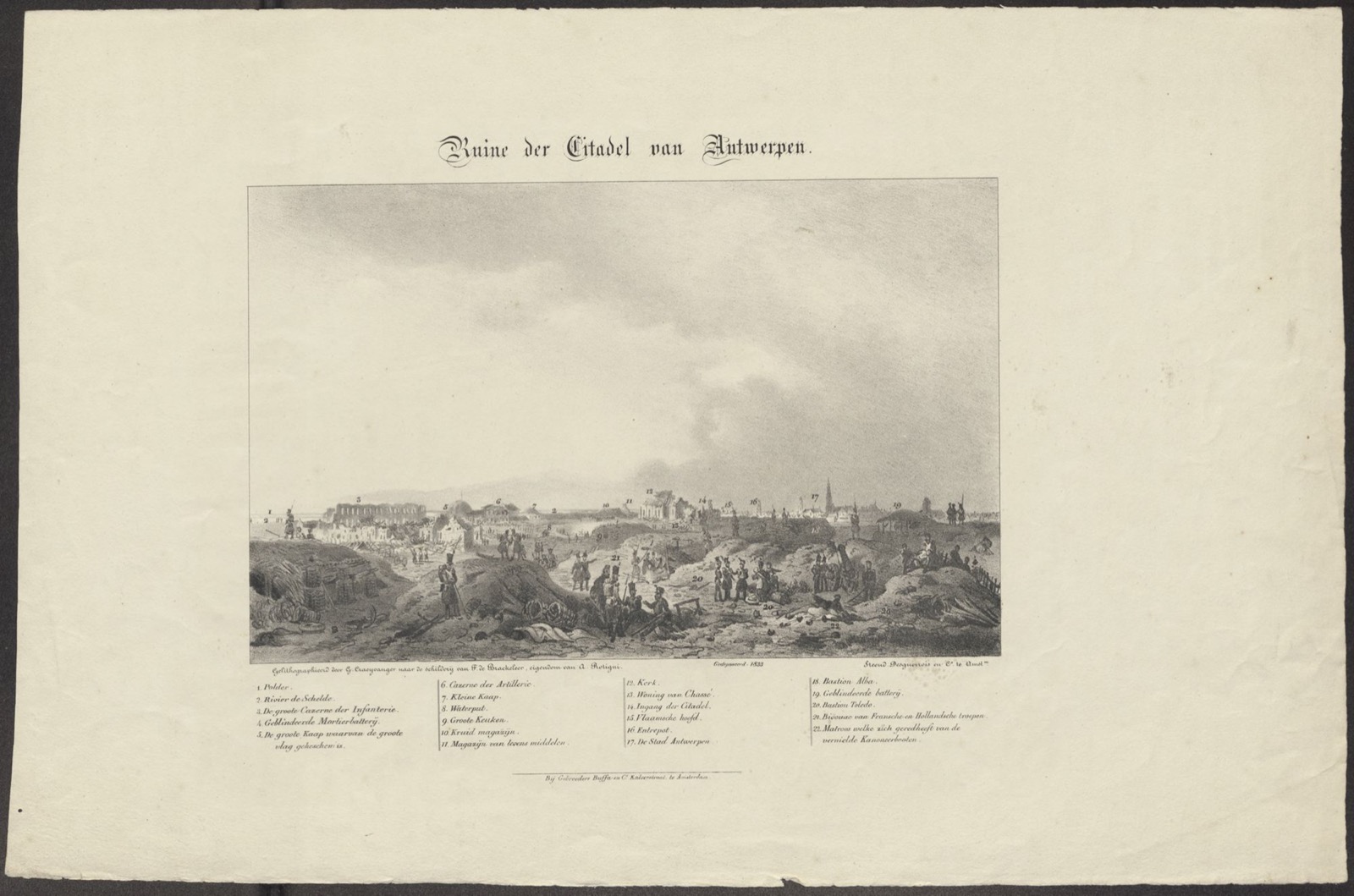
View of the remains of the Citadel of Antwerp
1833 · Leiden University Libraries (via Europeana)
Public domain
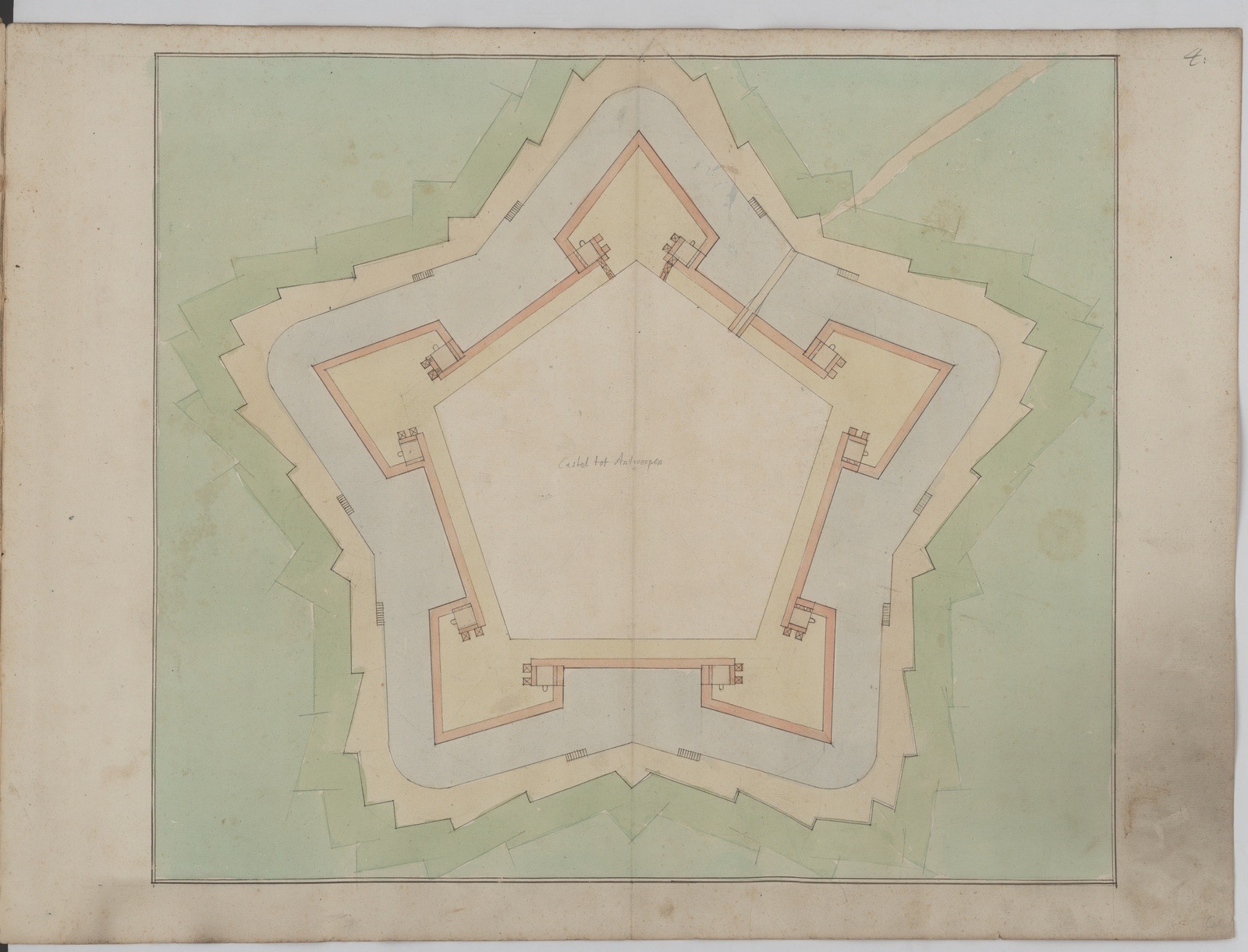
Citadel of Antwerp, hand drawing, before 1695
· Deutsche Fotothek (via Europeana)
CC BY-SA
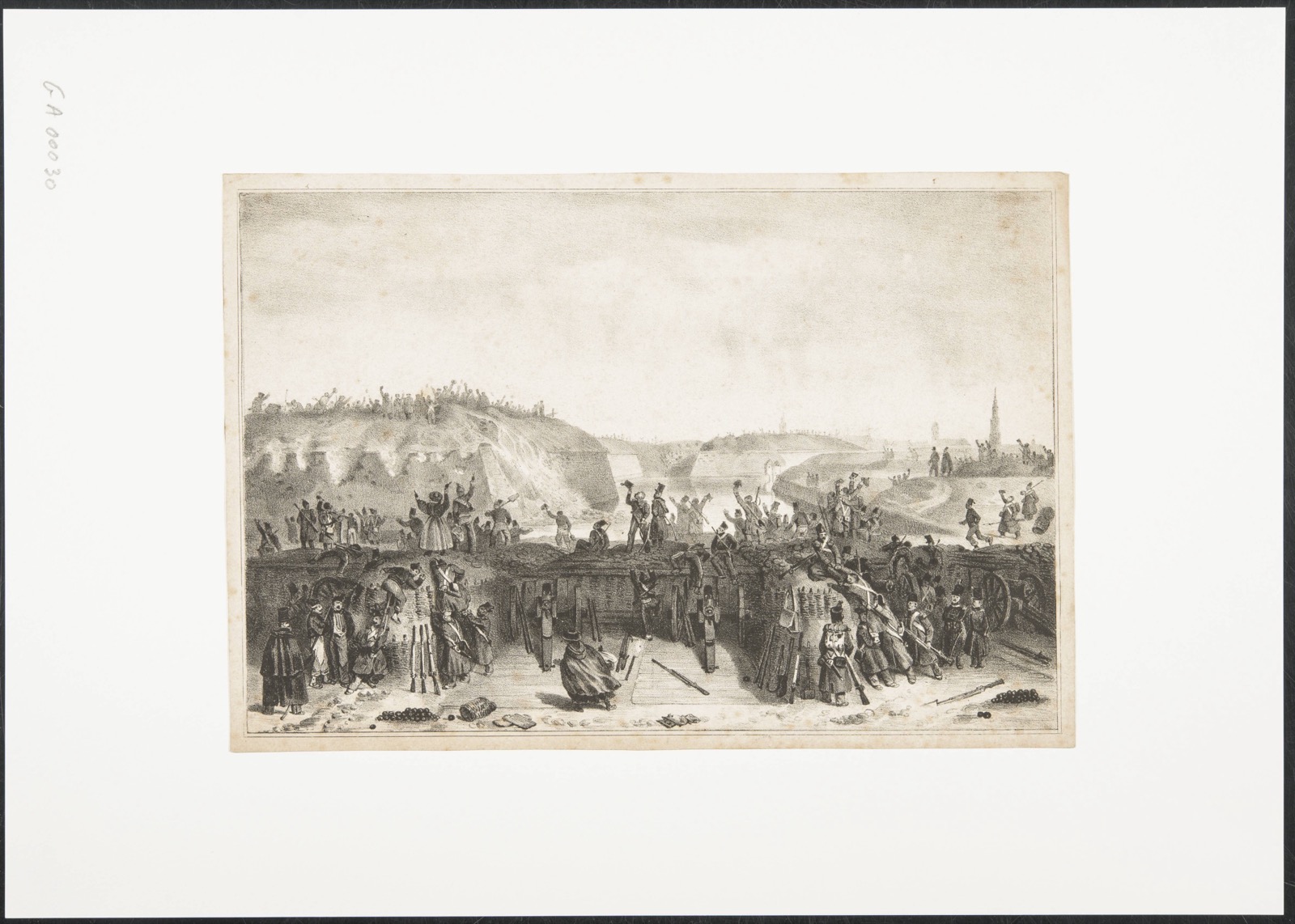
Inname van de Citadel van Antwerpen, 1832
· Catholic University of Leuven (via Europeana)
Public domain
Nearby
Landmarks within reach of Citadel of Antwerp.

Questions about Citadel of Antwerp
What is the history of Citadel of Antwerp?
What is inside Citadel of Antwerp / what can you see in it?
Why was Citadel of Antwerp built, and what was it used for?
Where is Citadel of Antwerp?
When was Citadel of Antwerp built?
Was Citadel of Antwerp ever attacked or besieged?
What did Citadel of Antwerp look like in its prime?
Is Citadel of Antwerp still standing / is it a ruin?
Who built Citadel of Antwerp?
More castles of Belgium


Explore the city