Belgium · Restored
Bouchout Castle
Bouchout Castle is a rectangular moated castle in Meise, Flemish Brabant, Belgium, with a prominent medieval donjon and corner towers. It received a major neo‑Gothic remodelling in 1832 and today sits within the Meise botanic garden and is used for events and exhibitions.
First raised
1150
Its prime
1832
Today
Restored
As it stood in 1832
What Bouchout Castle looked like in its prime.
A compact rectangular stone castle set directly on a broad surrounding pond, with pale, almost white masonry and a low, crenellated roofline. Cylindrical round towers (including the medieval Donjon) occupy at least one corner, and a large square keep rises at another; battlements and merlons top the towers. The main façade shows tall, vertically proportioned neo‑Gothic windows and a small projecting stone balcony above the central entrance. The estate is parkland with trees framing the water reflections.
Its story
The story of Bouchout Castle.
Godfrey III's Two Castles Against Grimbergen
The Berthout lords of Grimbergen held a strong castle and with it the trade road from Bruges to Cologne, and neither Godfrey I of Leuven nor his son Godfrey II could force them to submit to the young Duchy of Brabant. Godfrey III answered by planting two fortifications close to Berthout ground: Nedelaar, raised in 1148 across the Zenne, and a second on the swampy, beech-grown domain of Boc-holt, granted to Wouter van Craaynem. In 1159 Brabant troops, assisted by Flanders, ended some twenty years of Grimbergen warfare and burnt the Berthout castle.
Whether Wouter's stronghold was a castle or only a fortified house is unclear: Cantillon called it a strong castle already, yet his son Willem held barely 120 to 160 hectares in the 1160s.
Daniel van Bouchout at Worringen, 1288
Willem's grandson Daniel was the first of the line to bear the name Van Bouchout. On 5 June 1288 he fought at Worringen, where the independence of Brabant was at stake, helping to capture Reinald of Guelders in the stroke that won the day for Duke Jan I. He was afterwards made seneschal, one of the duchy's highest offices.
Doperé, Ubregts and others credit him with rebuilding the fortified house, around 1300, into a water-castle proper: a donjon some 20 metres high, five successive ditches and a timber bridge of ten metres. The Flemish heritage register dates the tower earlier still, to the twelfth century. It is believed to survive as the oldest fabric on the site.
Scheut, Baesweiler and the End of the Line
Daniel's grandson Jan van Bouchout (c. 1320-1391) came of age as Brabant's ducal succession fell into dispute. When Johanna succeeded her father Jan III in 1355, Louis of Male, Count of Flanders, pressed a rival claim through his marriage to her sister; the Brabant army was beaten at Scheut in 1356 and Bouchout was most likely taken with it. Jan became garrison commander of Brussels once peace returned, lost again to Guelders at Baesweiler in 1371, and recovered his standing in 1386 by leading a successful attack on Grave on the Meuse.
The legitimate line ran out with Margareta van Bouchout, who married Everhard van der Marck in the mid-fifteenth century. The humanist Maximilianus Transylvanus bought it from Everhard's brother Robrecht and renovated heavily before his death in the 1530s; after his son-in-law Gerard Veltwijck died in 1555 maintenance lapsed, and Spanish rule and the iconoclasm of 1566 likely left it worse still.
D'Assonleville's Barony and the Roose Château
Around 1590 Christoffel d'Assonleville bought the decayed castle from Joanna Transylvan and by about 1600 had restored Bocholdia Castrum to its medieval state, throwing the five ditches into a single pond. A loyal minister of the Spanish administration thought to have had a part in the attempt on William of Orange, he saw Bouchout raised to a barony in 1605 and took a seat among Brabant's governing councillors.
In the 1670s the estate went to Peter-Ferdinand Roose, who bought it from the debt-ridden Renom de France and turned the medieval fortress into a fashionable château ringed with French ornamental gardens; he died childless in 1700. During the French occupation after the Revolution, soldiers burnt the wooden bridge for warmth in the severe winter of 1795, filled in the front of the pond, destroyed the forward defences and looted the buildings.
Neo-Gothic 1832 and the Empress Charlotte
Count Amédée de Beauffort rebuilt Bouchout in the neo-Gothic taste from 1832 under the architect Tilman François Suys, in the young kingdom's medieval revival. The southern wing came down, large windows and a balcony were cut through the walls, battlements added to the towers and a door opened in the donjon's ground floor, undoing the closed defensive form.
In 1879 King Leopold II bought the domain for his sister Charlotte, dowager Empress of Mexico, whose husband Maximilian of Austria had been captured and shot by Mexican republicans in 1867. Charlotte's mind never recovered, and she kept a court at Bouchout but took no public engagements. Because she was Franz Joseph's sister-in-law the German occupiers left the domain alone in the First World War, and the people of Meise sheltered there. She died at the castle on 19 January 1927.
In 1938 the Belgian state bought the domain for the National Botanic Garden, since 2014 Meise Botanic Garden. Belgian troops looted the castle during the 1939 mobilisation, and German occupiers later ringed it with an earth rampart and four bunkers. A flying bomb fell on the west of the domain late in November 1944; neighbouring Meise Castle burnt out and was pulled down after the war. Bouchout was restored between 1987 and 1989 and has since hosted meetings, lectures and exhibitions.
Step inside
7 places to explore in 1832.
The record describes 7 distinct spots at Bouchout Castle, including 1 interior: main reception room / castle rooms (interior). Create your own photoreal reconstruction and explore every one, more scenes means more rooms, more angles, and more of the place to stand in.
Build Your Own Castle
Recreate Bouchout Castle with AI to explore it.
The artist rebuilds it as it stood in 1832, a photoreal reconstruction that belongs to you alone. Pay with coins, no subscription needed.
Recreate this castle →Defend this castle →Whose castle
Clans who held Bouchout Castle.
The families that held Bouchout Castle for a decade or more across its history, follow a name to its clan.
van Bouchout
Daniel van Bouchout, a knight at the Battle of Worringen, erected the donjon around 1300.
van der Marck
Owned Bouchout in the 15th and 16th centuries.
van Sevenbergen
Owned Bouchout in the 15th and 16th centuries.
Roose
Peter-Ferdinand Roose transformed the castle into a Renaissance château at the end of the 17th century.
de Beauffort
Restored by Count Amadeus de Beauffort in 1832, who gave the castle its neo-Gothic appearance.
From the archive
Bouchout Castle on paper: the measured plan and period views.
The survey plan and photographs below are the ground truth this page's reconstructions are checked against, drawn and photographed while the castle was still a working garrison. Every image is public-domain or openly licensed, with its source named.
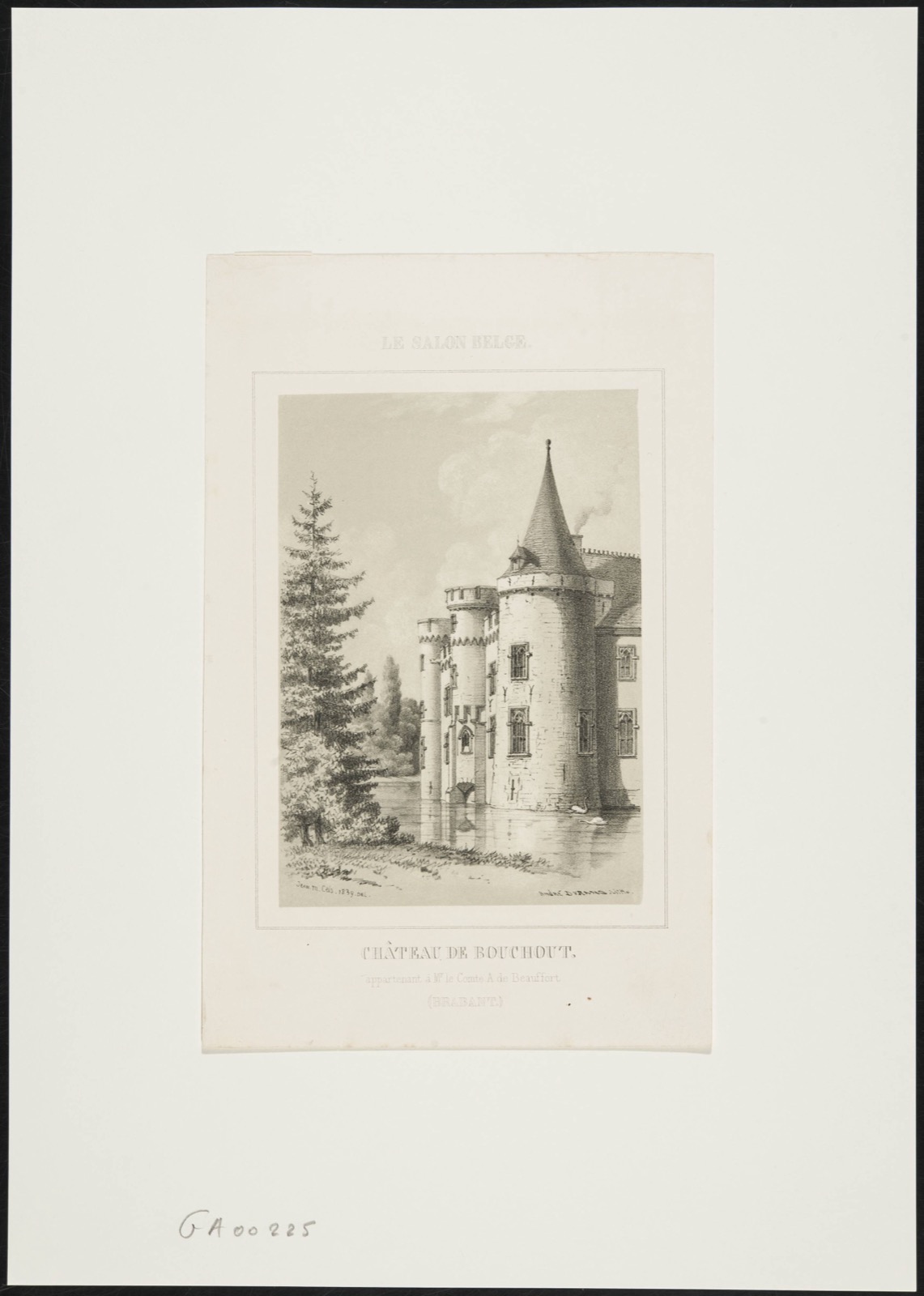
Château de Bouchout
· Catholic University of Leuven (via Europeana)
Public domain
Nearby
Landmarks within reach of Bouchout Castle.


Questions about Bouchout Castle
What is the history of Bouchout Castle?
What is inside Bouchout Castle?
Why was Bouchout Castle built, and what was it used for?
Where is Bouchout Castle?
When was Bouchout Castle built?
Which family or clan held Bouchout Castle?
What did Bouchout Castle look like in its prime?
Is Bouchout Castle still standing, or is it a ruin?
More castles of Belgium


Explore the city