Historic Cities · Belgium
Bruges through the ages
Bruges is the capital and largest city of the province of West Flanders, in the Flemish Region of Belgium. It is located in the northwest of the country, and is the sixth most populous city in Belgium. The predominant language is Dutch.

Bruges in 1300
Medieval Bruges
Bruges in 1300 is a thriving wool metropolis whose belfry and the great Waterhalle watch over a ring of crowded canals and quays where cogs and hulks land cloth, spices and credit. The walk follows arrival at the Waterhalle, moves through market and cloth halls, the weavers' quarters, the beguinage and riverside guild-houses, and finishes on the ramparts with the city’s silhouette against low, watery fields.
Low brick towers and a tall stone belfry puncture a dense necklace of stepped-gable merchant houses and covered quays, their red-brown tiles and pale plaster faces reflected in narrow canals. Wooden hulks and clinker-built cogs ride low in the water beside piles of wool and stacked bales. Streets are narrow and cobbled; banners, rope-work and drying cloth add vivid colour while horse carts and laden porters animate the scale.
The route: 22 streets, squares and views
The Zwin at Damme → Damme Quay → Waterhalle (Great Quay) → Belfort (Belfry) → Grote Markt (Big Market) → Vlamingstraat → Burg Square → Saint Donatian's Church → Dijver Canal → Rozenhoedkaai Quay → …
Step inside, 12 interiors
Covered Wool Quay · Belfry Treasury Chamber · Great Meat Hall · Comital Audience Chamber · Shrine Chapel · Canal Merchant Warehouse · Gruuthuse Great Chamber · St John's Ward · Weavers' Hall · Covered Fish Hall · Genoese Counting Room · Hanseatic Meeting Hall
Planned from the Wikipedia record: Bruges.
Bruges in 1440
Burgundian Bruges
Bruges in 1440 is a flourishing Burgundian mercantile centre where dukes, merchants and craftsmen meet amid canals and stepped-gable streets. The walk passes the ducal Prinsenhof and its festival spaces, the busy Beurse where foreign bankers gather, the brick spire of Our Lady's Church, grand canal-front palaces and the quarters of illuminators and panel painters.
The city presents a low, dense skyline of brick and sandstone punctured by a few tall church towers and the square, timbered belfry. Roofs are steep and mostly clay-tiled, façades show stepped gables, carved stone portals and painted shutters. Narrow streets open onto broad market squares and tree-lined quays along the Reie canals, where moored barges crowd the water and goods crowd the quays.
The route: 22 streets, squares and views
Road from Damme → Gentpoort → Steenstraat → Vlamingstraat → Verversstraat → De Beurse → Beurse Loggia → Vleeshuis → Grote Markt and Belfort → Lakenhalle → …
Step inside, 15 interiors
Gentpoort Guardroom · Dyer's Workshop · Beurse Loggia Counting-house · Great Hall of the Vleeshuis · Belfry Treasury and Archive · Cloth Hall Interior · City Council Chamber · Ducal Banquet Hall · Golden Fleece Chapter Hall · Gruuthuse Grand Chamber · South Choir Chapels · Sacristy with Reliquaries · Donatian Choir and Stalls · Van Eyck's Painting Studio · Illuminators' Workshop
Planned from the Wikipedia record: Burgundian Netherlands.
Bruges in 1895
Bruges-la-Morte
This is Bruges at the fin de siècle, the city Rodenbach called ‘dead’ yet already waking to visitors and antiquarian care. The walk shows its still canals with swans, beguines in the Beguinage, lace makers at doorways, and the neo‑Gothic faces put back on medieval façades as English sketchers settle with their pads.
Brick gables and stepped roofs, red-brown tiles and dark slate, rise above narrow, cobbled lanes and glass-smooth canals that mirror spires and winter trees. Stone and plaster façades bear fresh neo‑Gothic ornament where restorers have worked; willow and poplar overhang the quays, swans drift in the still water, and horse‑drawn carts, gas lamps and figures in black mourning dress and fine English coats animate the intimate scale.
The route: 21 streets, squares and views
Railway Approach → Steenstraat → 't Zand Square → Market Square → Belfry and Cloth Hall → Provinciaal Hof → Burg Square → Heilig-Bloedkapel → St Salvator's Cathedral → Vlamingstraat → …
Step inside, 13 interiors
Railway Waiting Room · Cloth Hall Trading Hall · Belfry Bell Chamber · Gothic Council Hall · Holy Blood Chapel Interior · Cathedral Nave and Choir · Lace-makers' Workshop · Doorway Lace Room · Vleeshuis Meat Hall · Canal Inn Parlour · Gruuthuse Display Gallery · Beguinage Church Nave · Jeruzalem Chapel Interior
Planned from the Wikipedia record: Bruges-la-Morte.
Its story
The story of Bruges.
From an Abbey Inventory to the Zwin, 851–1180
The oldest written trace of the name is an inventory of the treasure of Saint Bavo's Abbey in Ghent, compiled between 851 and 864 after Norsemen plundered the abbey: it records a golden cross sent to Bruggis for safekeeping that never came back. The name is on coins struck in the later ninth century, and appears as Bricge and Brycge in the Anglo-Saxon Chronicle in 1037 and 1049–52. Its origin is not settled: it resembles the Old Dutch brugga, 'bridge', but a derivation from the Scandinavian bryggja, 'quay' or 'jetty', is thought more likely.
Viking incursions in the ninth century prompted Count Baldwin I of Flanders to reinforce the Roman fortifications built after Julius Caesar's conquest of the Menapii, a fort being dated to 865. The same raids ruined Dorestad, Quentovic and Domburg as harbours for trade with England, the Baltic and Scandinavia, and Bruges filled the gap. Habitation on the Burgh terrain begins in the ninth and tenth centuries, and the town drew pilgrims once the relics of Saint Donatian of Reims were brought there; he became the city's patron saint.
Bruges became the capital of the County of Flanders in 1089 and received its city charter on 27 July 1128, after which new walls and canals were built; by the twelfth century it had an autonomous administration. Its access to the sea had been closing since about 1050 through gradual silting, and it was a storm in 1134 that reopened it, cutting the natural channel of the Zwin. The new sea arm reached as far as Damme, which became the commercial outpost of Bruges and had a harbour by 1180. As cog-ships grew, the harbour works had to be pushed beyond Damme to Sluys.
The Merchant Colonies and the Bourse, 1100s–1400s
The revival of town life in the twelfth century gave Bruges a wool market, a woollens weaving industry and a cloth market under the patronage of the counts of Flanders. Its entrepreneurs turned the wool districts of England and Scotland into economic colonies of the city, and English contacts brought Normandy grain and Gascon wines. When the old system of Flemish and French cloth fairs broke down, its merchants developed, or borrowed from Italy, forms of merchant capitalism in which several men shared risk, profit and market knowledge, trading on bills of exchange and letters of credit.
Foreign traders were courted rather than merely tolerated. The northern Hanseatic League kept a kontor in the city. In 1277 the first merchant fleet of the Republic of Genoa entered the port, the beginning of a colony that made Bruges the main link to Mediterranean trade and brought in the financial techniques, and the capital, that soon took over Bruges banking. Castilian wool merchants came in the thirteenth century, and after the Castilian wool monopoly ended, Basques, many from Bilbao, traded wool and iron goods and had their own consulate by the mid-fifteenth century. Portuguese merchants sold pepper and other spices. The Venetian galleys, first seen in 1314, were latecomers. These communities lived under their own laws until the economic collapse after 1700.
The Bourse opened in 1309 (most likely the first stock exchange in the world), and grew into the most sophisticated money market in the Low Countries during the fourteenth century. The weavers and spinners of Bruges were reckoned the best in the world, and the population reached at least 46,000 by around 1350. At the end of the fourteenth century the city became one of the Four Members alongside the Brugse Vrije, Ghent and Ypres, a parliament of four that quarrelled among themselves often.
The Bruges Matins and the Flemish Revolts, 1302–1328
Wealth on that scale produced social upheavals, which the city militia for the most part put down harshly. In 1302 the pattern broke: on the night of 18 May the French garrison in Bruges was massacred by members of the local Flemish militia, an event known as the Bruges Matins, and the population then joined the Count of Flanders against the French. The campaign ended in victory at the Battle of the Golden Spurs, fought near Kortrijk on 11 July. Jan Breydel and Pieter de Coninck, who led the rising, were given a monument on the Grote Markt in 1887.
Bruges kept its militia as a permanent paramilitary body, tied to a guild of the organised militia, its men buying and maintaining their own weapons and armour according to family standing and wealth. The city was drawn in again during the Flemish revolts that ran through the County of Flanders between 1323 and 1328.
The Burgundian Court and Its Withdrawal after 1482
In the fifteenth century Philip the Good, Duke of Burgundy, established a court at Bruges alongside Brussels and Lille, drawing artists, bankers and other prominent figures from across Europe. Jan van Eyck was working in the city by 1425 and Hans Memling from about 1465; Memling painted the St Ursula Shrine for St John's Hospital in 1489, and the new oil technique of the Flemish school carried the city's name abroad. The Order of the Golden Fleece was founded at Bruges in 1430. A printing press was at work by 1475, and the first book ever printed in English was published in Bruges by William Caxton. Edward IV and Richard III of England were living there in exile.
The wedding of Duke Charles of Burgundy and Margaret of York was held in July 1468, and the tournament staged for it on the Markt, the Pas d'Armes of the Golden Tree, was the subject the city drew on when it created the Procession of the Golden Tree in 1958. The turning point came with the death of Mary of Burgundy in 1482 and the quarrel with her husband Maximilian, after which the ruling house withdrew from Bruges and the end of the city as an international trading metropolis was in sight. Political unrest is recorded in 1488.
Silting, Antwerp and the Long Decline, 1500–1799
From about 1500 the Zwin channel that had made the city's prosperity began silting up. The Fuggers moved from Bruges to Antwerp in 1505 and the Hanseatic enterprise followed in 1545. In the sixteenth century Bruges was a centre of humanism and of Protestantism with international connections, and in 1578 the city briefly came under Protestant rule; the execution of three Franciscan friars on the Burg caused a great stir. In 1584 the city was taken by the Duke of Parma and became Spanish and Catholic again, and the secession of the Spanish Netherlands that same year led to its final decline, with Antwerp taking its place as the economic flagship of the Low Countries. The Spanish king was also count of Flanders from 1592 to 1713, and that rule, with the religious wars that came with it, drove the city further down.
The lace industry took off in the seventeenth century, and repeated attempts were made to recover the maritime position: the harbour infrastructure was modernised and new connections to the sea were built, and the Ghent–Bruges canal was dug in 1623, but Antwerp's dominance only grew and Bruges became impoverished. Charles II of England based his court in exile in the city during the 1650s. How poor the place really was is argued both ways: one view holds that between 1600 and 1885 Bruges was among the poorest towns in the Netherlands, on the figures for its needy population; the counter-argument is that a town able to maintain so many poor must have stayed rich, and that the large town houses built through the seventeenth and eighteenth centuries show at least a wealthy upper layer. The French took power in 1794; the Cloth Hall had been demolished in 1787 and St Donatian's Cathedral was demolished in 1799.
Bruges-la-Morte and the Fight for a Sea Harbour, 1815–1944
Bruges passed to the Netherlands in 1815 and to Belgium in 1830. The railway station opened in 1838 and the population was counted at 50,986 in 1863, but the industrial revolution did not greatly disturb the city; the campaign for a new sea harbour was the dominant civic cause of the century. English writers had praised Bruges as a place to live and as a historic site from early in the century, and in its second half the city became one of the world's first tourist destinations, drawing wealthy British and French visitors. Georges Rodenbach's symbolist novel Bruges-la-Morte, 'Bruges-the-dead', published in 1892, made the city itself a character, impoverished but mysterious, and drew further international attention; it was later adapted into Erich Wolfgang Korngold's opera Die tote Stadt. The exhibition of the Flemish Primitives in 1902 began the cultural and tourist development that has marked the city since.
Work on the sea harbour at Zeebrugge began in 1896 and the port opened in 1907. German forces occupied Bruges in the First World War and used Zeebrugge as a base for the Flanders U-boat flotilla; the city itself suffered virtually no damage and was liberated by the Allies on 19 October 1918. The Germans occupied it again from 1940, and again it was spared destruction. Canadian troops of the 12th Manitoba Dragoons liberated the city on 12 September 1944, helped by the bridge now called the Canada Bridge, which links the outer municipalities to the centre.
Restoration, the Ferry Disaster and World Heritage, 1965–2013
After 1965 the medieval core went through a restoration of houses, commercial buildings, monuments and churches that lifted tourism and business in the centre. The city's territory had grown by absorbing Sint-Pieters-op-den-Dijk in 1899 and the area that became Zeebrugge in 1901, and was greatly enlarged again in 1971 by a merger with seven surrounding municipalities. The port at Zeebrugge was greatly expanded in the 1970s and early 1980s.
On 6 March 1987 the British ferry MS Herald of Free Enterprise capsized after leaving Zeebrugge, bound for Dover, having sailed with its bow door open. One hundred and eighty-seven people died, the worst disaster involving a British civilian vessel since 1919. Most of those aboard had taken up a newspaper promotion offering a £1 return trip from Dover to Zeebrugge.
The historic centre, an oval of about 430 hectares, was inscribed as a UNESCO World Heritage Site in 2000, and the city holds two further inscriptions: the belfry, within the Belfries of Belgium and France, and the thirteenth-century Ten Wijngaerde Beguinage, within the Flemish Beguinages. Bruges was European Capital of Culture in 2002. Its population was 117,170 in 2013 across a municipality of 140.99 square kilometres, the sixth largest city population in Belgium; it is the capital of the province of West Flanders, the seat of the Diocese of Bruges, established in 1559, and of the College of Europe, a postgraduate institute for European economics, law and politics.
From the archive
Bruges on paper: the old town as it was mapped.
A period plan or bird's-eye view of the old town, drawn between 1500 and 1850, the streets this page's reconstructions walk. Public domain, with its source named.
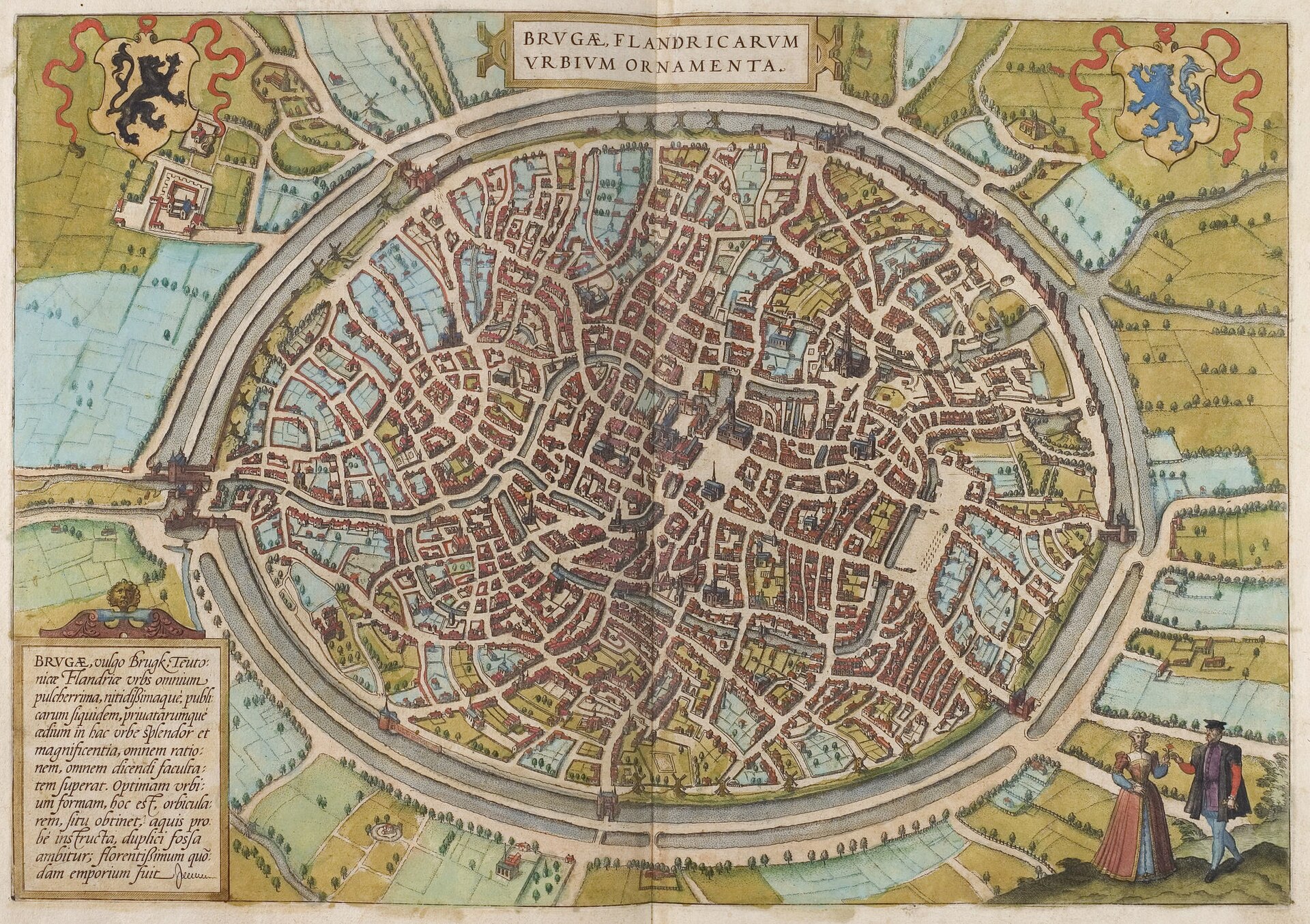
Bird's-eye view of Brugæ (Bruges), from Braun & Hogenberg's Civitates orbis terrarum
Shows the circular city walls and surrounding canals with multiple gates, inner canal basins, dense street grid, central market square and the prominent belfry and churches.
1572 · Georg Braun; Frans Hogenberg · Wikimedia Commons
Public domain (plate dated 1572)
In this city
Landmarks of Bruges, see each in its prime


More cities to explore
 BelgiumGhentExplore it in 1350 · 1913
 BelgiumYpresExplore it in 1300 · 1910
 BelgiumBrusselsExplore it in 1560 · 1700 · 1900
 BelgiumAntwerpExplore it in 1560 · 1910
Castles of Europe · Landmarks of Europe · create your own reconstruction.