Historic Cities · Belgium
Ghent through the ages
Ghent is a city and a municipality in the East Flanders province of the Flemish Region of Belgium. It is the capital and largest city of the province and the third largest in the country, after Brussels and Antwerp. It is a port and university city.

Ghent in 1350
Ghent of the Weavers
This is Ghent at the height of its cloth industry: a river city of water-powered mills, crowded quays and the guilds' rising power. The walk follows the rivers and marketways where English wool arrives, fulling hammers beat the cloth, stepped-gabled staple houses line the Graslei and Korenlei, and the belfry ascends above the cloth hall.
A densely roofed medieval skyline of red clay tiles and dark timber gables rises from a ring of stout stone walls. The Leie and Scheldt thread through quays crowded with barges, warehouses and fulling-mills; stepped gables and narrow brick façades line the waters. Stone towers (the Gravensteen's keep and the belfry under construction) puncture the roofs, while guild banners and the soot-darkened timber of workshops mark the city’s scale and industry.
The route: 20 streets, squares and views
Leie–Scheldt Confluence → De Reep Quays → Approach to the Gravensteen → Gravensteen Castle → St Michael's Bridge → Graslei Quay → Korenlei Quay → Fulling-mills on the Leie → Korenmarkt Square → Belfry and Cloth Hall → …
Step inside, 12 interiors
Weaver's Loft · Great Hall · Counting Room · Merchants' Exchange Hall · Fulling Mill Hall · Inspection Floor · Counting Chamber · Nave and Side Aisles · Choir and High Altar · Infirmary Ward · Abbey Chapter House · Fish Market Hall
Planned from the Wikipedia record: Ghent.
Ghent in 1913
Ghent of the World's Fair
This is Ghent in the spring and summer of 1913, a medieval centre freshly polished for the International Exposition: restored guild houses, new station architecture and a broad park given over to pavilions and flower shows. The walk moves from the railway arrival and the exposition grounds into the compact city of canals and quays, past trams, cotton-mill chimneys and the three towers that define Ghent's skyline.
Low sandstone and brick guild façades line narrow Quays, their gables freshly cleaned for visitors; the Leie and its channels carry small freighters past cotton-mill chimneys and river-trams. Electric tramlines and gaslit café terraces thread a compact medieval plan of stepped roofs, church spires and the belfry; across the Citadelpark a temporary cluster of exhibition pavilions and flower displays announces the 1913 World's Fair to the city.
The route: 22 streets, squares and views
The Muide Approach → Gent-Sint-Pieters Station → Flandria Palace Hotel → Citadelpark Approach → Exposition Grounds, Citadelpark → Sint-Pietersplein → Veldstraat → Korenmarkt and Post Office → Sint-Michielsbrug View → Graslei Quays → …
Step inside, 14 interiors
Great Concourse and Waiting Hall · Grand Dining Room, Flandria Palace · Machinery Pavilion Main Hall · Old Flanders Craftsman's Room · Post Office Sorting Hall · Guildhall Great Chamber · Riverside Brasserie Cellar · Wood-Panelled Museum Room · Cloth Hall Merchant Chamber · Choir Chapel with Altarpiece · Cafe Parlor at Vrijdagmarkt · Flower Show Glass Pavilion · Weaving Shed, Coupure Mill · Customs Warehouse Counting Room
Planned from the Wikipedia record: Ghent International Exposition (1913).
Its story
The story of Ghent.
Ganda: Abbeys, Vikings and the Portus, 650-1000
Ghent began where the Leie runs into the Scheldt, and there is archaeological evidence of people at the confluence as far back as the Stone Age and the Iron Age. The older name, Ganda, is Celtic; most historians read it as 'river mouth' or 'confluence', though the confluence reading has been challenged, and another explanation ties the name to an obscure deity called Gontia. No written records survive from the Roman period, but excavation confirms the area stayed inhabited. Frankish invaders from the end of the 4th century brought their speech with them, and Celtic and Latin gave way to Old Dutch.
Around 650 Saint Amand founded two abbeys here, St Peter's, or Blandinium, and St Bavo's; by about 800 they mattered enough for Louis the Pious, son of Charlemagne, to appoint Einhard, Charlemagne's biographer, abbot of both. The town grew out of several separate nuclei - the abbeys and a trading settlement - until Viking raiders destroyed both abbeys in 851-852 and again between 879 and 883, and settled on the Scheldt for a considerable time.
When the Vikings withdrew, economic life shifted west from St Bavo's Abbey to a second Scheldt landing, Portus Gandavum, where a walled trading town of some six hectares took shape with a small harbour beside St John's Church, later St Bavo's Cathedral. At the end of the 9th century Baldwin II the Bald raised a castrum on the site of the present Gravensteen. Through the 10th century the two cores grew together along the axis of the Hoogpoort, and the commercial centre moved to the banks of the Leie at the Graslei and Korenlei.
Wool, the Meersen and the Cloth Trade
The rivers wandered through ground that flooded periodically. Those wet grasslands, the meersen, were poor for arable farming and excellent for grazing sheep, and the wool made the town. Through the Middle Ages Ghent became the leading European city for the manufacture of cloth, importing wool from Scotland and England, and it held the staple right on grain, which added substantially to its wealth; flax and linen worked alongside the wool. Water was the other necessity. The Lieve was dug between 1251 and 1269, forty-five kilometres from Damme on the Zwin to the Leie beside the Gravensteen, the first artificial waterway from Ghent to the sea. The older link to the Braakman had gone: silting cost Ghent that connection in the 12th and 13th centuries, and the Graaf Jansdijk of 1402 finished it off.
Under the protection of the County of Flanders the town recovered from the Viking century and flourished from the 11th, growing into a small city-state. By the 13th century it was among the largest cities of northern Europe, reckoned second only to Paris north of the Alps by one account and behind both Paris and London by another, with somewhere between fifty and sixty-five thousand people inside walls formed by the Scheldt, the Ottogracht, the Leie, the Houtlei and the Ketelvest and strengthened with gates. From about the year 1000 until roughly 1550 it was the largest city of the Low Countries.
Artevelde, English Wool and the Defeat at Gavere
Ghent's cloth depended on English wool, which made English politics its own. Jacob van Artevelde received King Edward III of England on the Vrijdagmarkt on 26 January 1340. Five years later weavers and fullers killed each other on that same square, a prelude to Artevelde's own murder. His son Philip led the men of Ghent against the French army under Louis II of Male and Charles VI and fell at the Battle of Westrozebeke in 1382. Trade suffered badly during the Hundred Years' War. John of Gaunt, Duke of Lancaster, was born in the city, which English usage long called Gaunt.
The city recovered in the 15th century when Flanders was joined to neighbouring provinces under the Dukes of Burgundy, but heavy taxes brought rebellion and then the Battle of Gavere in 1453, where Ghent was crushed by Philip the Good. Around this time the political weight of the Low Countries began shifting from Flanders, from Bruges and Ghent, towards Brabant and the axis of Antwerp and Brussels. With Bruges, Ghent led two further revolts against Maximilian of Austria, the first Habsburg to rule Flanders. The burghers spent centuries fighting their princes over their privileges.
Charles V, the Stroppendragers and the Calvinist Republic
Juana of Castile gave birth to the future Emperor Charles V at the Hof ten Walle, later the Prinsenhof, on 24 February 1500. Being a native of the city bought it nothing: after the Revolt of Ghent in 1539 he made its nobles walk before him barefoot with a noose, in Dutch a strop, around the neck, and the people of Ghent have been called Stroppendragers, noose bearers, ever since. St Bavo's Abbey was abolished, pulled down but for a small portion, and replaced by a fortress for royal Spanish troops.
In the 16th century Ghent was important in the rise of Calvinism. The Pacification of Ghent was signed in the city in 1576, and from 1577 to 1584 a Calvinist Ghent Republic held it; the city's first, theological, university was founded then, in the Pand. Five mendicant friars were burned at the stake. After 1584 many Calvinists left for the northern Netherlands. The Eighty Years' War brought devastation through the late 16th and 17th centuries and ended Ghent's role as a city of international importance - which is why so much of its medieval fabric survived to be restored.
Bauwens's Mule Jenny, Orangism and the Famine of 1845-1848
French forces took the city in 1745 during the War of the Austrian Succession; it was handed back to Habsburg Austria under the Treaty of Aix-la-Chapelle in 1748, and this part of Flanders was the Austrian Netherlands until the settlement reached at the Congress of Vienna in 1815. Textiles came back first. Lieven Bauwens smuggled machine plans, and a Mule Jenny spinning machine, out of England, and in 1800 introduced the first mechanical weaving machine on the European continent; mechanised linen and cotton made Ghent one of the earliest industrial cities on the continent, and the 19th century brought the largest flax works in western Europe. The Treaty of Ghent, negotiated in the city and adopted on Christmas Eve 1814, ended the War of 1812 between Britain and the United States. Louis XVIII of France spent his exile of 1815, during the Hundred Days, here.
Under the United Kingdom of the Netherlands the city did well: it gained its university in 1816, under King William I, and a new connection to the sea in 1824-27. It did not support the Belgian Revolution of 1830-31, unlike Brussels, the Brabant towns, Liège and Namur, because its textile industry sold heavily into the Dutch East Indies and that market went with the revolution. Much of the Ghent bourgeoisie stayed Orangist, most of them French-speaking, and after 1848 the Orangists were absorbed into the Liberal Party. Port access to the sea was lost for more than a decade, the local economy collapsed, and the first Belgian trade union was founded in Ghent. The city had been the largest in Belgium through the 17th and 18th centuries and remained so until the famine of 1845-1848.
Socialists, Two Occupations and the Liberation of 6 September 1944
Ghent was where Belgium's first modern trade unions appeared and where the Belgian socialist movement began, though Edward Anseele, leader of the Ghent socialists, was first elected to parliament in Liège. The city hosted the world exhibition of 1913, laid out in the south of the city on grounds that afterwards became the Miljoenenkwartier; Sint-Pieters station was completed in 1912 for the occasion.
German forces occupied Ghent in both world wars, and the city escaped severe destruction. During the First World War the occupiers converted the university to teaching in Dutch; after the war it reverted entirely to French, and in 1919 the city saw an anti-Flemish campaign. On 6 September 1944 Ghent was liberated by the British 7th Armoured Division, the Desert Rats, together with local Belgian fighters, with the northern suburbs and the industrial area cleared over the following days by the 15th (Scottish) Infantry Division.
The Terneuzen Canal, Emirdag and a Preserved City
The Sassevaart was dug in 1547 to reach the Honte; it silted, was re-excavated and extended in 1823, and became the Ghent-Terneuzen Canal, which carries shipping to the Western Scheldt and serves what is now the third-largest port in Belgium, with ArcelorMittal, Volvo, Honda and Stora Enso among its occupants. The municipality took in surrounding territory in 1927 and 1965, and in 1977 absorbed Afsnee, Drongen, Gentbrugge, Ledeberg, Mariakerke, Oostakker, Sint-Amandsberg, Sint-Denijs-Westrem, Wondelgem and Zwijnaarde. Population then drained to the more residential suburbs, falling to just under 224,000 by 1999 before rising again on migration and urban renewal; the municipality counted 273,790 people on 1 January 2026, second in Belgium after Antwerp.
From the 1960s a steady migration ran from Emirdag in Turkey to Ghent under the guest-worker schemes, as Belgian firms recruited for factory and heavy industrial work; people from Emirdag and its district form the majority of the city's Turkish community, with their own associations, mosques and businesses. The 2020 census found 35.5 per cent of inhabitants with roots outside Belgium and 15.3 per cent holding a non-Belgian nationality, with several neighbourhoods - Brugse Poort, Dampoort, Rabot, Ledeberg, Nieuw Gent and the streets around the Sleepstraat - having a minority-majority population. Ghent is the capital of East Flanders and a university and port city; its beguinages, belfry and adjacent cloth hall were inscribed by UNESCO as World Heritage Sites in 1998 and 1999, and its centre is car-free.
From the archive
Ghent on paper: the old town as it was mapped.
A period plan or bird's-eye view of the old town, drawn between 1500 and 1850, the streets this page's reconstructions walk. Public domain, with its source named.
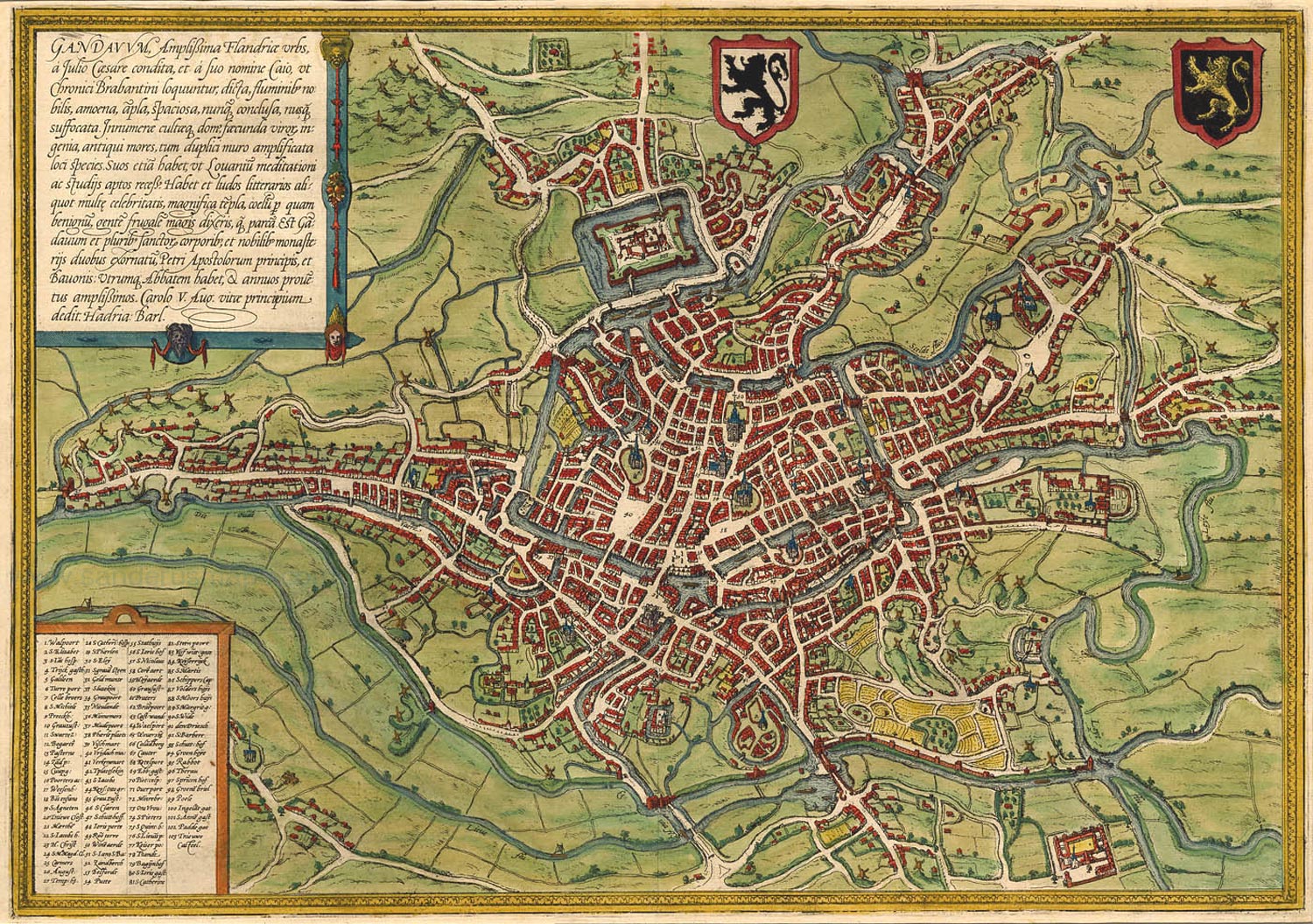
Bird's-eye view of Ghent (Gandavum), from Braun & Hogenberg's Civitates Orbis Terrarum
Depicts Ghent’s medieval street pattern with encircling walls and gates, church towers, and the rivers and canals with mills.
1572 · Braun_&_Hogenberg · Wikimedia Commons
Public domain (plate dated 1572)
Castles of Ghent

More cities to explore
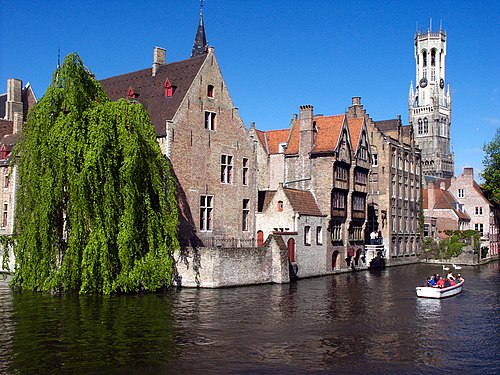 BelgiumBrugesExplore it in 1300 · 1440 · 1895
 NetherlandsSaeftingheExplore it in 1570
 BelgiumBrusselsExplore it in 1560 · 1700 · 1900
 BelgiumAntwerpExplore it in 1560 · 1910
Castles of Europe · Landmarks of Europe · create your own reconstruction.