Belgium · Restored
Beersel Castle
Château de Beersel
Beersel Castle is a medieval moated castle near Beersel, in Flemish Brabant, Belgium. It consists of three large cylindrical brick towers linked by high curtain walls, with steep slate roofs and defensive openings; the structure dates from around 1300 and today appears as a restored historic fortress.
First raised
1300
Its prime
1300
Today
Restored
As it stood in 1300
What Beersel Castle looked like in its prime.
Three massive red-brick cylindrical towers linked by high curtain walls rise from a surrounding moat. Each tower has a steep, dark slate roof with small dormers and stepped gable terminations; the upper wall courses show machicolations and a row of narrow vertical arrow-slits and rectangular windows. A timber bridge leads toward an entrance beside the left tower. The brick is weathered in tones of deep red and brown, and the site is set in low grassy banks with trees behind.
Its story
The story of Beersel Castle.
A Licence from Duke Jean II, 1300
Beersel sat on the frontier of the Duchy of Brabant with the County of Hainaut, south-west of Brussels and close to Halle. A fortified residence on the site is attested as early as 1292, and in 1300 Godefroid of Hellebeke, the first known Seigneur of Beersel and seneschal of the duchy, obtained permission from Jean II, Duke of Brabant, to raise a fortification beside his residence.
Sacked by Louis of Male, 1356–1357
In 1356, during the War of the Brabant Succession, soldiers of the County of Flanders under Louis of Male besieged the first castle, took it and sacked it. Rebuilding began in 1357 on a circular enceinte with three large towers and one small one, in brick, an unusual material for such a building at the time.
The Wittem Lords and the Brussels Sieges, 1391–1491
The lordship had passed during the fourteenth century to the Seigneurs of Wittem, who held it for seven generations, to the end of the sixteenth century. In 1391 Jan II van Witthem, seneschal under Duchess Joanna of Brabant and her husband Wenceslas of Luxembourg, won recognition of his seigneurial rights over Brussels and its surroundings, and with the help of a Brussels militia took nearby Gaasbeek Castle, where the murderers of Everaard t'Serclaes had taken refuge.
His descendant Henry III of Wittem sided with Maximilian I during the revolts of 1483–1492, against a Brussels that supported the rebellion. In 1488 the townsmen wrecked his house in the Voldersstraat and marched on Beersel with heavy guns under Philip of Cleves. Henry's son Philip of Wittem held the place: the Burgundian court chronicler Jean Molinet describes the besiegers driven off after repeated batteries and a fierce assault, abandoning weapons as they went. Because raids from the castle kept disrupting the city's supplies, the militias came back in 1489. This second siege battered the walls with cannon and the garrison surrendered after several days, the damage falling worst on the southern side; the captain, Willem van Ramilly, was hanged with several of his soldiers on the Grand Place in Brussels.
Maximilian then besieged Brussels, which capitulated under exhaustion and plague. Beersel was returned to the Seigneur of Wittem, and the peace of Danebroek obliged the city to pay for rebuilding Henry's town house and repairing the castle at its own expense. That restoration, begun in 1491, rebuilt the three main towers to take cannon. On 26 May 1491 Henry of Wittem was made a knight of the Order of the Golden Fleece for his loyalty, and was later chamberlain to Emperor Charles V.
From Garrison to Household, 1515–1877
Henry died in 1515; his son Philip succeeded him and died in 1523. With the death of Philip's grandson Jan II in 1591 the male line of Wittem ended, and through the marriage of his daughter Ernestina the castle and lordship passed to the dukes of Arenberg. The military obsolescence of castles had already made Beersel a private residence during the sixteenth century; the Fathers of Zevenborren lived in it from 1581 to 1606, and a restoration in 1617 gave the towers and ramparts tiled roofs. It was never remodelled into a country pleasure-house as others were.
The castle stood empty from 1796 and decayed. A cotton works installed in 1818 under King William I made little of it; part of the building was then pulled down and the rest left to fall, the roofs collapsing for want of repair as the property passed through a series of Belgian noble families. Victor Hugo visited in 1877 and wrote a short poem on the solitary manor lying in the valley, a stone falling from its battlements with every hour of the day.
The League of Friends and the Restorations, 1928–2012
In 1928 the derelict castle was given to the League of Friends of Beersel Castle. Work ran from 1928 to 1939 under Raymond Pelgrims de Bigard, assisted by Brother Herman of the Sint-Lucas school and the architect Ignace Van den Hulst, and returned the three towers and part of the ramparts to their appearance after 1617. The residential building and the eastern face had deteriorated badly and were not included, and only the foundations remain.
The site was placed on the register of protected landscapes in March 1934 and listed as a protected monument in August 1943. Since 1948 it has belonged to the Royal Association of Historic Residences and Gardens in Belgium, which leases it to the municipality of Beersel. A further restoration opened with archaeological survey in 2008 and continued after the Flemish government approved its subsidy in March 2011, running to 2012. The castle is open to the public and is reckoned one of Belgium's best-preserved.
Step inside
7 places to explore in 1300.
The record describes 7 distinct spots at Beersel Castle, including 1 interior: inner courtyard between towers. Create your own photoreal reconstruction and explore every one, more scenes means more rooms, more angles, and more of the place to stand in.
Build Your Own Castle
Recreate Beersel Castle with AI to explore it.
The artist rebuilds it as it stood in 1300, a photoreal reconstruction that belongs to you alone. Pay with coins, no subscription needed.
Recreate this castle →Defend this castle →Whose castle
Clans who held Beersel Castle.
The families that held Beersel Castle for a decade or more across its history, follow a name to its clan.
Hellebeke
Godefroid of Hellebeke, first known Seigneur of Beersel, built the fortification from 1300 by permission of Jean II, Duke of Brabant.
Wittem
Held by the Seigneurs of Wittem from the 14th century.
Merode
Held by the House of Merode until 1928, when they donated the derelict castle for restoration.
From the archive
Beersel Castle on paper: the measured plan and period views.
The survey plan and photographs below are the ground truth this page's reconstructions are checked against, drawn and photographed while the castle was still a working garrison. Every image is public-domain or openly licensed, with its source named.
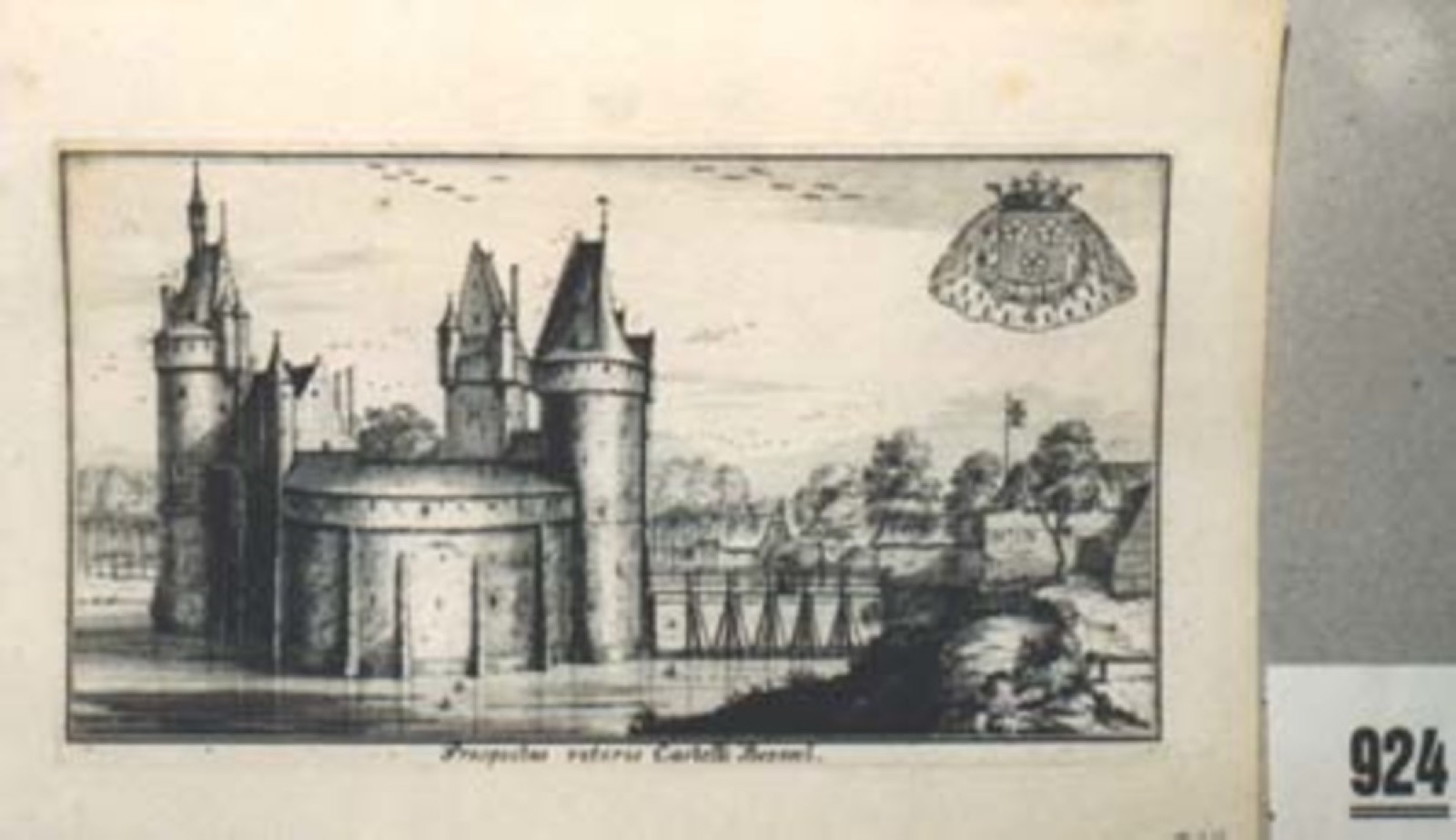
Gravure "Prospectus veteris Castelli Beersel" op papier
1956 · Castle Huis Bergh (via Europeana)
Public domain
Nearby
Landmarks within reach of Beersel Castle.


Questions about Beersel Castle
What is the history of Beersel Castle?
Why was Beersel Castle built, and what was it used for?
Where is Beersel Castle?
When was Beersel Castle built?
Was Beersel Castle ever attacked or besieged?
Which family or clan held Beersel Castle?
What did Beersel Castle look like in its prime?
Is Beersel Castle still standing, or is it a ruin?
Can you visit Beersel Castle?
What is inside Beersel Castle, and what can you see?
Who owns Beersel Castle now?
More castles of Belgium


Explore the city