Belgium · Restored
Het Steen
Het Steen is a medieval fortress on the banks of the Scheldt in Antwerp, Belgium. The surviving gateway and towers date from the early 13th century and were significantly rebuilt around 1520; much of the larger castle that once surrounded it was demolished in the 19th century. Today the structure survives as the city's oldest building and a visitor centre.
First raised
1200
Its prime
1520
Today
Restored
As it stood in 1520
What Het Steen looked like in its prime.
A compact stone gateway fortress of grey-beige limestone with two prominent cylindrical corner towers flanking a large pointed arched city gate, low curtain walls with crenellations and narrow slit windows, and stepped gables rising behind the battlements. Conical slate roofs cap the round towers and a slender central spire is visible behind the roofline. The building sits directly beside the Scheldt on a raised stone quay reached by a short stone bridge; the façade shows patched, coursed masonry.
Its story
The story of Het Steen.
Gate of the Antwerp Burcht, 1200–1225
A settlement and castle stood on this bank of the Scheldt as early as the Carolingian ninth century, and the first fortifications may have followed the Viking incursions; the Normans invaded Flanders in 879. The Margraviate of Antwerp came into being around 974, on the imperial side of a river frontier: the duchy belonged to the Holy Roman Empire, while across the Scheldt lay the county of Flanders, subordinate to the king of France. Godfrey of Bouillon held the margraviate from 1076 to 1100; Godfrey I, Count of Louvain, received the duchy in 1106, and his great-grandson Henry I became Duke of Brabant in 1183.
The building now called Het Steen was raised between 1200 and 1225 as the gate building of the Antwerp burcht, set against the city's first stone fortification wall beside the south gate, a position from which the fortress controlled access to the Scheldt. It is Antwerp's oldest surviving building, yet it covers less than five per cent of the original stronghold, which enclosed the Vierschaar court, the Sint-Walburgiskerk and the refuge of the Benedictine abbey of Affligem, with the fish market lying just outside the walls.
The King's Stone: Charles V's Rebuilding, c. 1520–1549
Around 1520, under Charles V, the gatehouse was thoroughly rebuilt and took the name 's-Heeren Steen, the King's stone castle, later shortened simply to Het Steen. The Dutch steen means "stone", but the word once served for a fortress or palace, as in the Gravensteen at Ghent. In 1549 Charles V gave the building to the city of Antwerp, which kept it in its ownership until 1828.
Court, Prison and the Secret Drownings, 1303–1823
Het Steen served the city as schepenbank, the aldermen's house, and as vierschaar, its court of justice, and from 1303 to 1823 it was Antwerp's prison. Executions took place within its walls: in the years 1557 to 1565, supporters of the Reformation were secretly drowned there.
From 1823 the building housed invalid soldiers. The state requisitioned it in 1827 and sold it to a wood-sawyer a year later; in 1842 the city bought its old gatehouse back.
The Quays, the Museums and the Visitor Centre, 1864–2021
In 1862 Pieter Génard proposed Het Steen as the seat of an antiquarian museum for Antwerp; after a restoration by the architect Kennes, the museum opened on 14 August 1864. Then, in the 1880s, the greater part of the old burcht (dozens of historic houses and the city's oldest church among them) was demolished when the Scheldt was widened and its quays straightened to stop the river silting up. Only a small cluster of buildings around the medieval gate survived, and a new wing in neo-Gothic and neo-traditional style was added in 1887–1890.
In 1952 the antiquarian museum gave way to the National Maritime Museum, whose indoor galleries closed on 28 December 2008, the collection passing to the new Museum aan de Stroom. A major restoration (funded under a 2017 agreement that set aside some 35.5 million euros for Het Steen and the town hall together) remade the building as the Antwerp Visitor Center, opened on 22 October 2021 with a multimedia route through the city's history in eleven rooms and a 350-metre cruise ponton moored on the Scheldt below. The renovated building won the Onroerenderfgoedprijs heritage award in October 2022.
Step inside
7 places to explore in 1520.
The record describes 7 distinct spots at Het Steen, including 2 interiors: vierschaar (court of justice) interior, prison / dungeon cell. Create your own photoreal reconstruction and explore every one, more scenes means more rooms, more angles, and more of the place to stand in.
Build Your Own Castle
Recreate Het Steen with AI to explore it.
The artist rebuilds it as it stood in 1520, a photoreal reconstruction that belongs to you alone. Pay with coins, no subscription needed.
Recreate this castle →Defend this castle →Whose castle
Clans who held Het Steen.
The families that held Het Steen for a decade or more across its history, follow a name to its clan.
Brabant
Gateway to the castle of the Dukes of Brabant, whose line ran from Godfrey I, Count of Louvain (1106) to Henry I, Duke of Brabant (1183).
From the archive
Het Steen on paper: the measured plan and period views.
The survey plan and photographs below are the ground truth this page's reconstructions are checked against, drawn and photographed while the castle was still a working garrison. Every image is public-domain or openly licensed, with its source named.
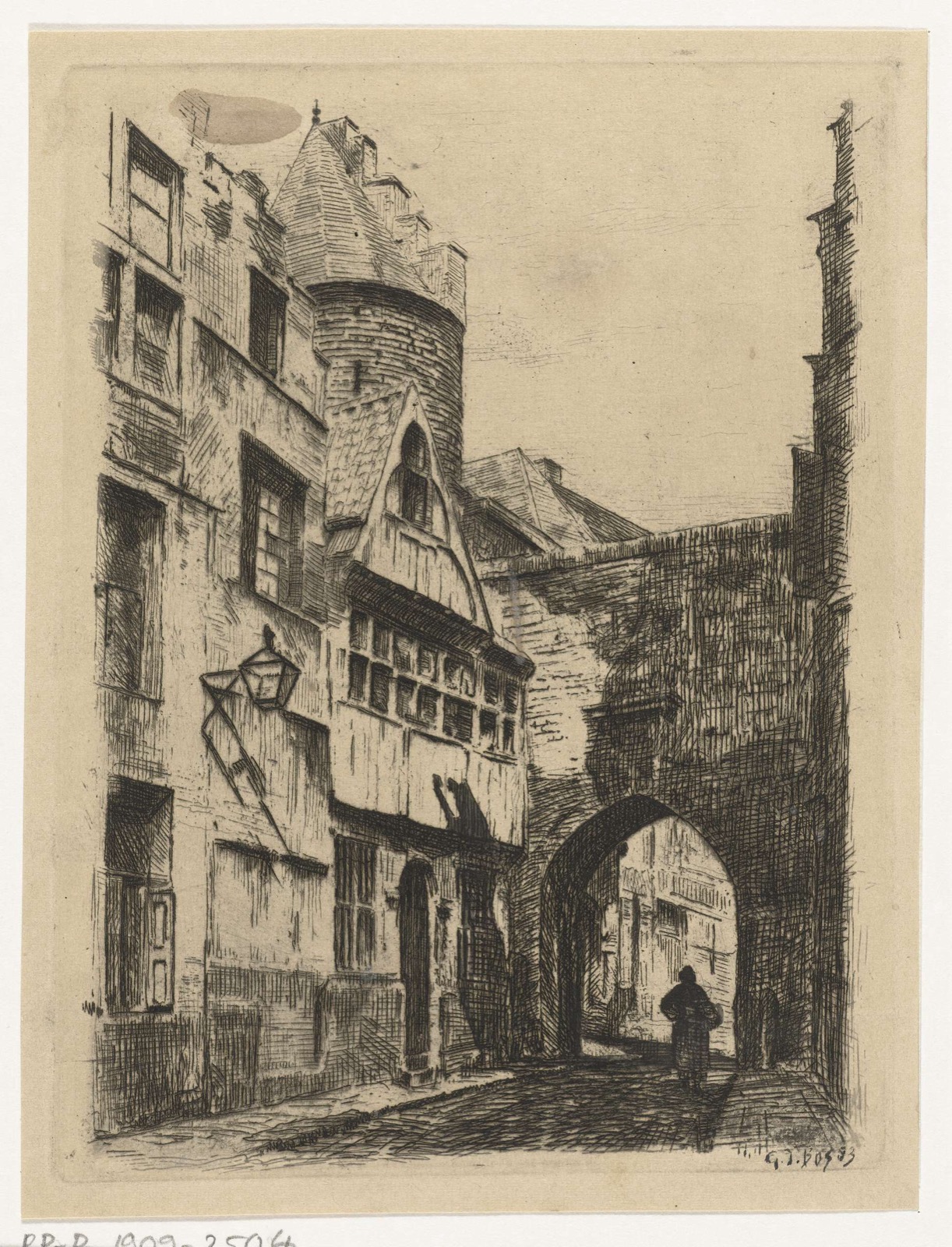
Straatgezicht
1883 · Rijksmuseum (via Europeana)
Public domain
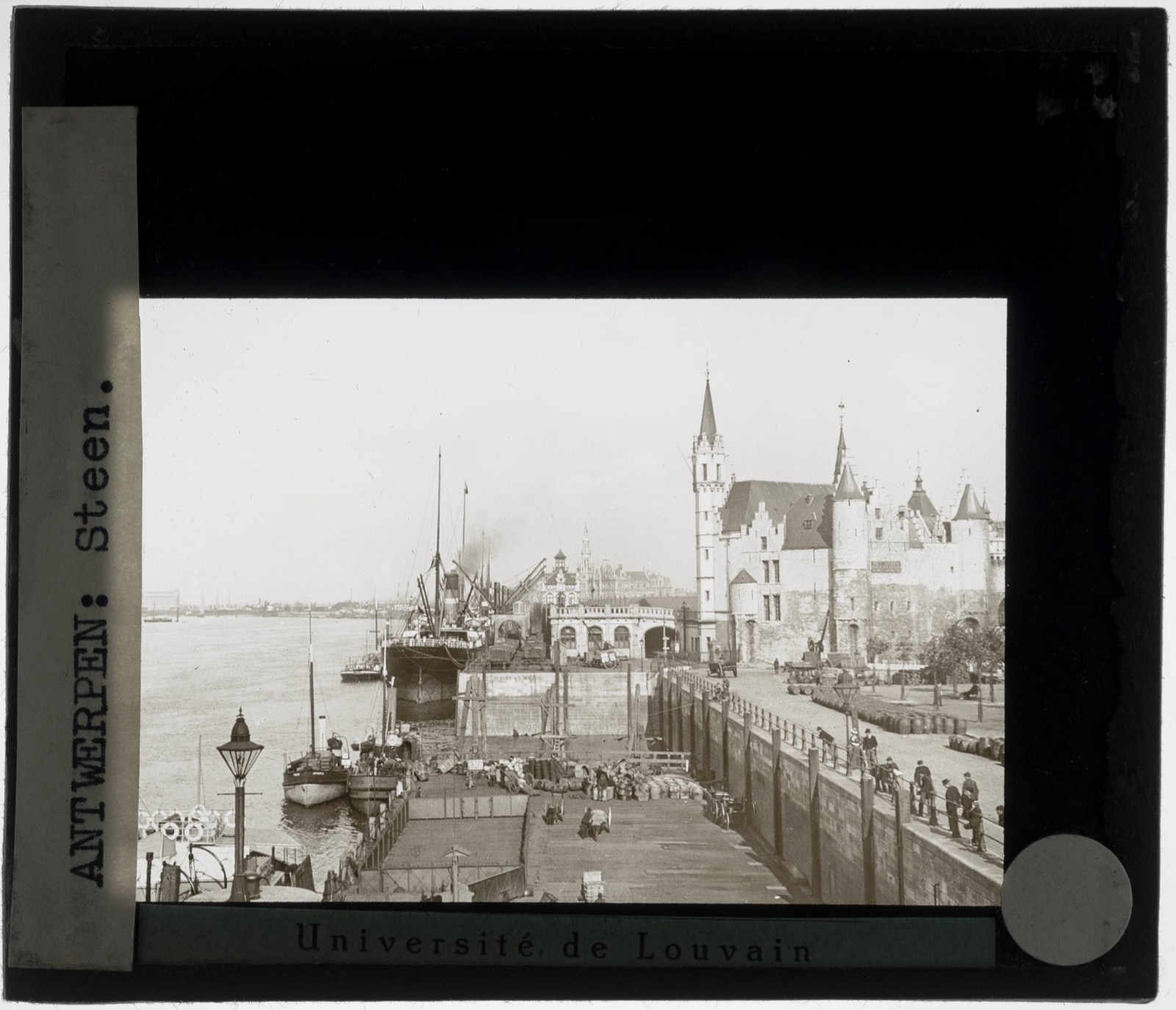
Antwerp. Het Steen Exterior: General view from the Scheldt
· Catholic University of Leuven (via Europeana)
Public domain
Nearby
Landmarks within reach of Het Steen.

Questions about Het Steen
What is the history of Het Steen?
What is inside Het Steen?
Why was Het Steen built, and what was it used for?
Where is Het Steen?
When was Het Steen built?
Which family or clan held Het Steen?
What did Het Steen look like in its prime?
Is Het Steen still standing, or is it a ruin?
Can you visit Het Steen?
More castles of Belgium


Explore the city