
Croatia · Still standing
Kamerlengo Castle
Kaštel Kamerlengo
Kamerlengo Castle is a 15th-century Venetian fortress on the waterfront of Trogir, Croatia, built between 1420 and 1437. It consists of a large cylindrical keep and adjoining crenellated curtain walls with a smaller square tower at the eastern corner, and contains an internal courtyard with a small chapel dedicated to St. Mark. Today the fortress survives intact and is used for public events.
First raised
1420
Its prime
1437
Today
Still standing
As it stood in 1437
What Kamerlengo Castle looked like in its prime.
A broad pale-beige limestone silhouette facing the harbour: a massive cylindrical keep with a corbelled machicolated crown at the west end, joined to a long low curtain wall pierced by an arched entrance and regular crenellations; a smaller rectangular tower with arched corbels and merlons stands at the east corner. The castle sits directly on the waterline beside a stone quay; roofs are minimal, the stone surfaces worn but continuous at the height of the fortress.
Its story
The story of Kamerlengo Castle.
The Venetian Conquest and the Castle of Trogir, 1420–1437
Kamerlengo Castle rose on the seaward corner of Trogir's walls, at the site of the polygonal Veriga (Chain) Tower built there in the late 14th century. In 1420 the Venetian Republic took Trogir after a siege of almost two months; the city's defences had been badly damaged in the fighting and its people were hostile to their new rulers, so Venice built a city-castle from which to hold the town. Construction ran from 1420 to 1437: the state engineer Lorenzo Picino was consulted on the design and the master builder Marin Radoj carried out the work, turning the existing corner tower into the castle's keep. The fortress was originally separated from the city by an outer crenellated wall and a wet moat.
Governors, Garrison and the City Prince, 1420–16th Century
The castle housed a garrison of Venetian mercenaries under the command of a kamerlengo, the chamberlain-governor from whom it eventually took its name, for more than a century after 1420 it was known simply as the castle of Trogir, only becoming Kamerlengo Castle from the mid-16th century onward. Luka Tron, a sopracomite (galley captain) in the Venetian fleet during the surrender of Korčula and the siege of Trogir, was given the office of city prince from 1421 to 1424, the second man to hold that post since Venice's new administration began.
The Chapel of St Mark
In the castle's courtyard stands a small chapel dedicated to St Mark, patron saint of the Venetian Republic. A Gothic relief of the lion, carved with the initials DC and the arms of the Contarini family, was placed on the chapel after Trogir's capture in memory of Doge Domenico Contarini; below it, a smaller relief set in a quadrilobe bears the arms of the Tron family.
The Demolition That Never Happened
Most of Trogir's city walls were pulled down in the mid-19th century and the castle's moat was filled in; by then dilapidated, Kamerlengo Castle was itself slated for demolition, but the plan was abandoned. It survives intact today as part of Trogir's UNESCO World Heritage historic centre and is protected as Croatian cultural heritage, and it hosts public performances during the summer months.
Step inside
7 places to explore in 1437.
The record describes 7 distinct spots at Kamerlengo Castle, including 1 interior: courtyard and chapel of st. mark. Create your own photoreal reconstruction and explore every one, more scenes means more rooms, more angles, and more of the place to stand in.
Build Your Own Castle
Recreate Kamerlengo Castle with AI to explore it.
The artist rebuilds it as it stood in 1437, a photoreal reconstruction that belongs to you alone. Pay with coins, no subscription needed.
Recreate this castle →Defend this castle →From the archive
Kamerlengo Castle on paper: the measured plan and period views.
The survey plan and photographs below are the ground truth this page's reconstructions are checked against, drawn and photographed while the castle was still a working garrison. Every image is public-domain or openly licensed, with its source named.
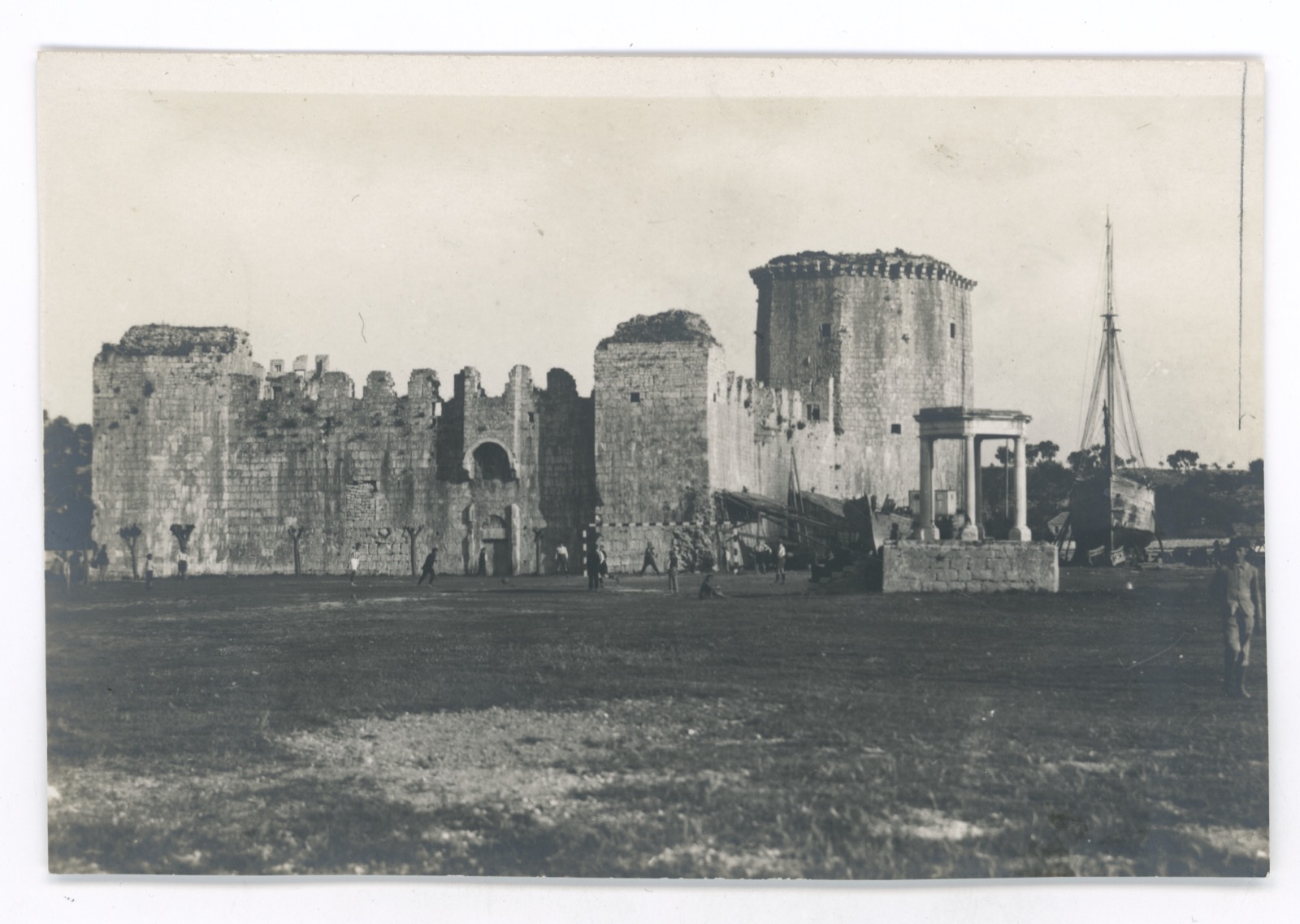
Trogir - Kamerlengo Castle
1920 · https://uri.hr/indigo/org:muo (via Europeana)
CC BY-SA
Nearby


