
Croatia · Restored
Trsat Castle
Gradina Trsat
Trsat Castle sits on a steep hill above the Rječina gorge in Trsat, Croatia, on the site of an earlier Illyrian and Roman fort. The present appearance is largely shaped by a 19th-century restoration when the Nugent mausoleum was added; the castle courtyard is now used as a restaurant and is a popular summer visitor spot. The complex retains a prominent cylindrical stone tower, curtain walls and a small classical porticoed building on the terrace.
First raised
1300
Its prime
1850
Today
Restored
As it stood in 1850
What Trsat Castle looked like in its prime.
A squat cylindrical tower of pale, roughly coursed stone with a round crenellated parapet and a tall flagpole stands at the left; adjoining low curtain walls of similar stone step down to a terraced courtyard. On the terrace a small classical portico with four round columns and a triangular pediment (inscribed MIR JUNAKA) fronts a low building with a red-tiled roof. A lower entrance with two short round columns and a recessed doorway opens beneath the terrace; planted beds and clipped shrubs sit along stone balustrades overlooking a steep gorge.
Its story
The story of Trsat Castle.
Tarsatica and the Frankopans' Castle Guarding Vinodol
The hill on the left bank of the Rječina gorge, immediately above Rijeka, has been in use since Roman days as an easy place from which to control access to the sea along the river. A Iapodian hill-fort called Darsata may have stood there, and the Roman fortification Tarsatica took its name from it; that fort was of vital importance on a road linking Aquileia with Pannonia and with Senia, modern Senj. The castle now on the hill was built in the thirteenth century by the Frankopan family, on the site Tarsatica had occupied, to protect their holdings in Vinodol. The Croatian noble Vuk Krsto Frankopan is buried in one of the churches at Trsat.
The Ban's Recapture, June to October 1509
The capture of Trsat castle compelled the Ban of Croatia, Andrew Bot of Bajna, to intervene in the Austro-Venetian war. In June 1509 he first retook Trsat with his Croatian army, then entered Rijeka after expelling the Venetians. In October the Venetians withdrew for good and Rijeka returned to the possessions of Maximilian of Habsburg. That episode is the sole event linking Rijeka with Venice, and so with Italy, in the town's entire history from the seventh century onward.
Decay, the Earthquake of 1750, and Captain Hoste's Handover of 1826
In the seventeenth century the castle fell into decay as the threats from Venice and the Ottoman Empire receded, and the earthquake of 1750 accelerated that decline. In 1811, during the Napoleonic Wars, Captain Hoste arrived at Fiume with his frigate in pursuit of the French and made himself lieutenant-governor. The situation at Trieste soon drew him away, but in 1826 he had the satisfaction of handing the castle over to Field-Marshal Laval Nugent von Westmeath, an Irishman then commanding the Austrian troops in the vicinity, the transfer intended to confer on him the rank of an Austrian noble.
The Nugent Mausoleum and the Last Countess
Nugent was later honoured by the Austrians and presented with the castle at Trsat as his residence. The nineteenth-century work amounted to a complete reconstruction: he had the place restored in Neo-Gothic style and built a mausoleum in its interior, adorned with the coat of arms of the Nugent family. Trsat remained in Nugent hands until nearly the end of the Second World War, when the general's great-granddaughter, Countess Nugent, died at the age of 82. The courtyard has been turned into a restaurant, and many visitors come to the castle during the summer months.
Step inside
7 places to explore in 1850.
The record describes 7 distinct spots at Trsat Castle, including 2 interiors: inner courtyard (restaurant), nugent mausoleum (interior). Create your own photoreal reconstruction and explore every one, more scenes means more rooms, more angles, and more of the place to stand in.
Build Your Own Castle
Recreate Trsat Castle with AI to explore it.
The artist rebuilds it as it stood in 1850, a photoreal reconstruction that belongs to you alone. Pay with coins, no subscription needed.
Recreate this castle →Defend this castle →Whose castle
Clans who held Trsat Castle.
The families that held Trsat Castle for a decade or more across its history, follow a name to its clan.
Frankopan
Built the present castle on the site of the Illyrian Tarsatica to protect their holdings in Vinodol.
Nugent
Presented by the Austrians to General Laval Nugent as his residence; held by the Nugents until nearly the end of the Second World War.
From the archive
Trsat Castle on paper: the measured plan and period views.
The survey plan and photographs below are the ground truth this page's reconstructions are checked against, drawn and photographed while the castle was still a working garrison. Every image is public-domain or openly licensed, with its source named.
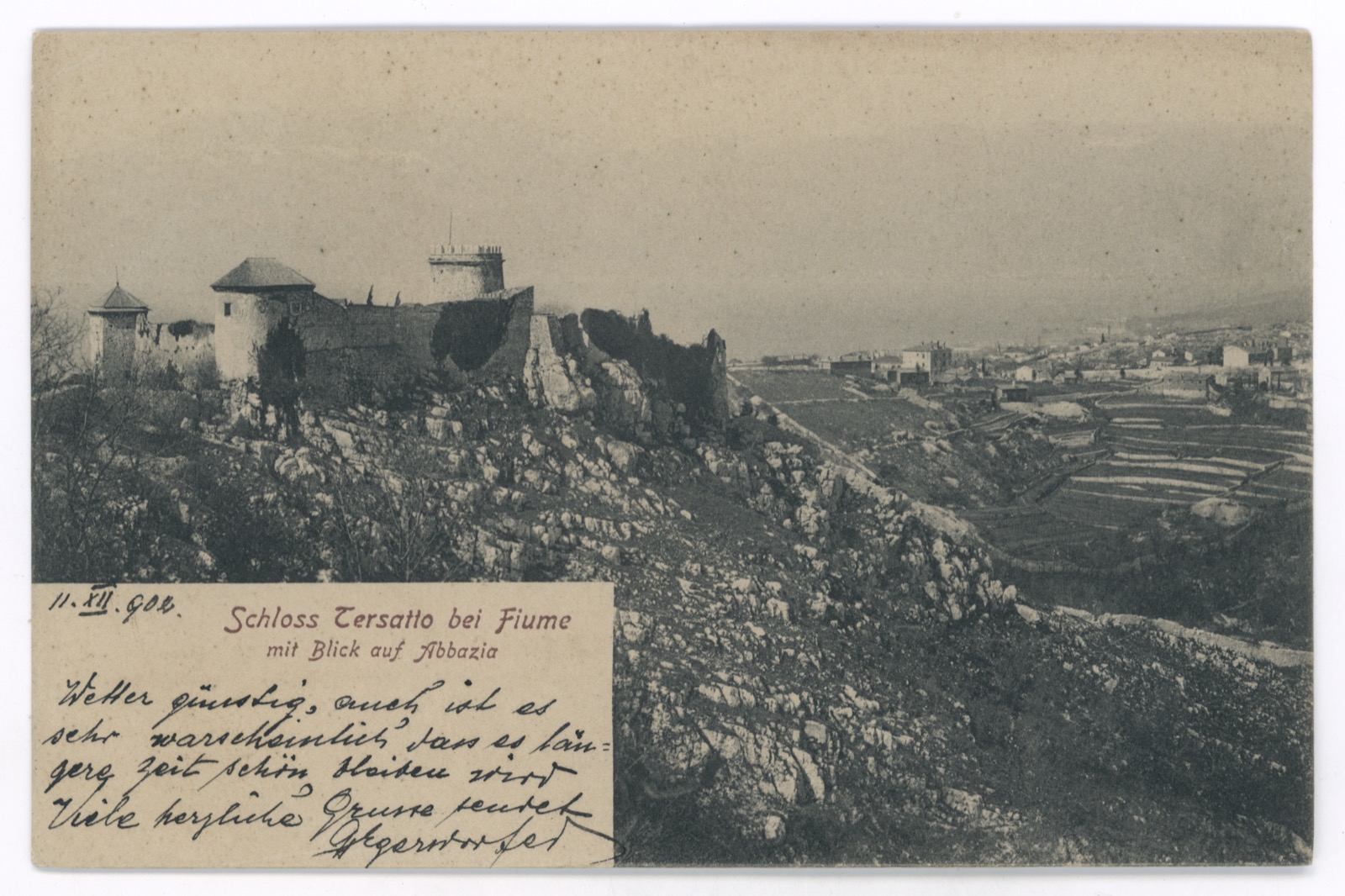
Rijeka - Trsat Castle
1900 · https://uri.hr/indigo/org:muo (via Europeana)
CC BY-SA


