Denmark · Still standing
Egeskov Castle
Egeskov Slot
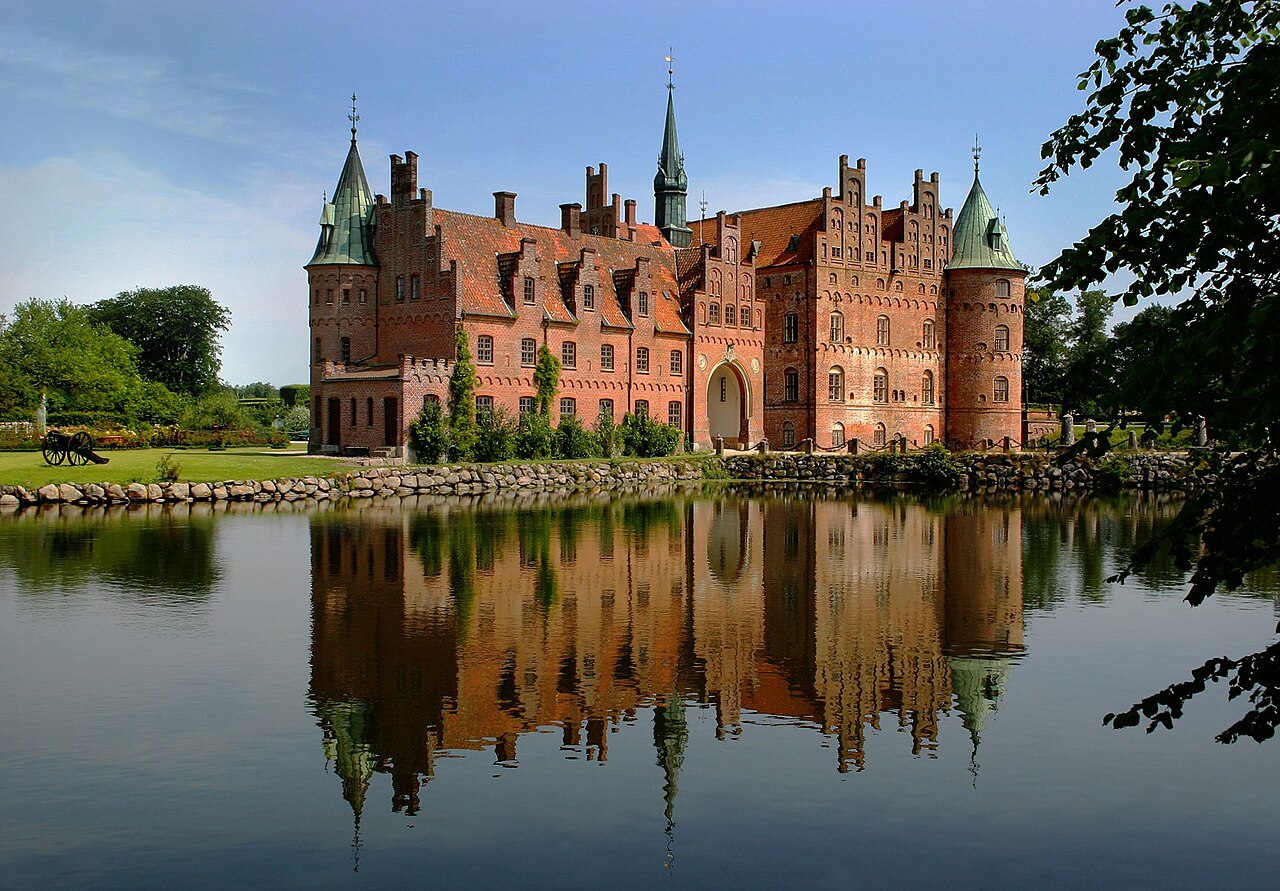
Egeskov Castle is a 16th-century water castle on the island of Funen in southern Denmark, built on oaken piles in a small lake. The extant brick structure comprises two long buildings linked by a thick central double wall, with round corner towers and fortified openings; much of the estate and parkland remain part of the property today.
First raised
1554
Its prime
1554
Today
Still standing
Ranked among Europe’s castles
As it stood in 1554
What Egeskov Castle looked like in its prime.
A red-brown brick water castle set on an island of oak piles within a shallow lake, formed by two long rectangular ranges joined by an unusually thick double wall. Each long range terminates in round corner towers with conical roofs built in vertical panel sections. Facades show oversized medieval "monks" bricks, round-arched windows and blank arcading in the gables, a double string course, steep tiled rooflines, artillery ports, scalding holes and narrow arrow slits.
Its story
The story of Egeskov Castle.
Egeskovgaard and the Skinkel Dowry, 1405-1545
Egeskov is first mentioned in 1405, held around that time by Lydike and Jørgen Skinkel. It was then Egeskovgaard, a large farm in a sizeable village rather than anything fortified, and the Skinkels kept it for roughly a century and a half. Laurids Skinkel Tinhuus died in 1533 leaving the property to his widow, Hilleborg Bille; in 1536 it passed to their daughters Anna Hilleborg and Rigborg Tinhuus, and in 1545 Anne Tinhuus brought Egeskov to Frands Brockenhuus, Marshal of the Realm, as her dowry.
Frands Brockenhuus Builds for a Siege, 1554
The Reformation and the civil war known as the Count's Feud had taught Danish landowners to build houses they could hold, and the castle Brockenhuus raised in 1554 is a fighting building before it is a residence. It went up in oversized medieval bricks of the kind called monk's bricks, founded on oak piles driven into a small lake no more than about five metres deep, with the only way in over a drawbridge. Tradition holds that a whole oak wood went into the foundations, giving the place its name, and that the work took thirty years.
The plan is two long houses joined by a double wall over a metre thick, so that defenders could give up one house and fight on from the other. That wall carries concealed stairs and a well, so a garrison under siege would not be cut off from water; the round corner towers let the defence take an attacker in the flank; and artillery ports, arrow slits and scalding holes are set through the walls, with about sixty shooting loops in all, a number of them since bricked up. It counts among the best preserved of Europe's Renaissance water castles.
Rigborg Brockenhuus, Immured 1599
Frands's son Laurids Brockenhuus, who held Egeskov from 1569, is remembered for his physical strength and for his hardness towards his daughter. Rigborg had been sent to court to attend the future queen Anna Catharine, and there she bore a son to Frederik Rosenkrantz, gentleman of the chamber to Christian IV. Rosenkrantz was ordered abroad to the wars. Rigborg was sentenced to be walled up, and in 1599 her father carried out the royal judgment, shutting her in a single room at Egeskov with her food passed through a hatch; several other noblewomen of the period were punished the same way. After five years the terms were eased enough to allow a weekly visit to the parish priest, and she was freed on her father's death in 1604. The room is still called Rigborgstuen.
Ulfeldt, Krag and the Stamhus, 1615-1925
Laurids's widow Karen Skram died in 1615 and Egeskov went to her daughter's sons Jacob and Frans Ulfeldt, who sold it the next year to their uncle Jakob Ulfeldt of Urup and Ulfeldtsholm. From Jakob's son Laurids it passed in 1648 to his father-in-law Oluf Parsberg, and from him to the councillor of the realm Otto Krag. When that line died out the estate was bought in 1784 by the privy councillor Henrik Bille-Brahe, and on 20 November 1811 his son Count Preben Bille-Brahe erected Egeskov into a stamhus, an entailed estate, for his second son Henrik.
The entail held until 1882, when Baron Frantz Preben Bille-Brahe died without heirs and Julius Ahlefeldt-Laurvig-Bille took it over, adding Bille to his name. Moving in during 1883, he put the Swedish architect Helgo Zettervall to a heavy restoration: the tower caps were raised, the stepped gables re-established and the gatehouse built, and the castle gained its own dairy, electricity works and railway siding. The stamhus was dissolved in 1925 when the entails were abolished.
From Family Seat to Museum, 1967-1994
The great hall carries a large painting of Niels Juel, who beat the Swedish force at the Battle of Køge Bay in 1677, and the house keeps an iron chest of at least the sixteenth century brought from Hvedholm, an estate some twenty kilometres west that Egeskov once owned. The knights' hall was restored in 1975. The vehicle museum in the grounds was founded in 1967, and the castle itself opened to visitors in 1986, the same year a full-size copy of it was built in Hokkaidō, Japan, to hold an aquarium, with the permission of Count Claus and Countess Louisa Ahlefeldt-Laurvig-Bille. Michael Ahlefeldt-Laurvig-Bille, who took the estate in 1994, keeps part of the house in private use.
A small wooden man lies in the loft of the stair tower. He is said to need fresh straw on the evening of 23 December and never to be taken away for more than a single day: forget either, and the castle will sink into its moat on Christmas night.
Step inside
9 places to explore in 1554.
The record describes 9 distinct spots at Egeskov Castle, including 5 interiors: great hall (first floor), east house servants' kitchen with well access, passage within the thick double wall and more. Create your own photoreal reconstruction and explore every one, more scenes means more rooms, more angles, and more of the place to stand in.
Build Your Own Castle
Recreate Egeskov Castle with AI to explore it.
The artist rebuilds it as it stood in 1554, a photoreal reconstruction that belongs to you alone. Pay with coins, no subscription needed.
Recreate this castle →Defend this castle →Whose castle
Clans who held Egeskov Castle.
The families that held Egeskov Castle for a decade or more across its history, follow a name to its clan.
Brockenhuus
Erected by Frands Brockenhuus in 1554; his descendants held it until 1784.
Bille-Brahe
Held by the Bille-Brahe family, 1784–1882.
Ahlefeldt-Laurvig-Bille
Inherited by the counts Ahlefeldt-Laurvig-Bille in 1882; they still own Egeskov.


