Denmark · Restored
Kronborg Castle
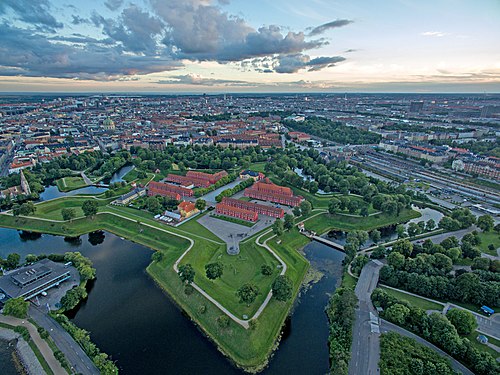
Kronborg is a large Renaissance castle and former fortress at the northeastern tip of Zealand in Helsingør, Denmark, commanding the narrow Øresund strait. Built up around a medieval curtain and rebuilt into a coherent late 16th-century quadrangular castle with bastioned outworks, it contains royal apartments, a large ballroom and a chapel within its walls and sits within a surrounding moat and star-shaped ramparts.
Its prime
1585
Today
Restored
As it stood in 1585
What Kronborg Castle looked like in its prime.
A rectangular, four-winged sandstone castle set on a low foreland projecting into the Øresund, surrounded by a water-filled moat and angular bastioned earthworks. The roofs are pitched and sheathed in copper, with several tall, copper‑clad tower roofs and slender spires rising above the uniform sandstone facades. The wings enclose a large central cobbled courtyard; a fortified causeway and gated approach from the town cross the moat. The exterior masonry is pale Scania sandstone and the overall plan reads as a compact, symmetrical quadrangle.
Its story
The story of Kronborg Castle.
Krogen and the Sound Dues, 1420s
Kronborg begins with a toll. In the 1420s Eric of Pomerania demanded that every ship entering or leaving the Baltic through the Øresund pay dues to the Danish crown, and to enforce it he built a fortress called Krogen, 'the Hook', on a sandy tongue of land reaching out from Zealand towards the coast of Scania, where the sound narrows to about four kilometres. Denmark held both shores, and between Krogen on one side, Helsingborg Castle on the other and a guard ship in the water between them, the crown could account for every keel that passed.
The dues had a trap built into them. A captain declared the value of his cargo and paid accordingly, but the king reserved the right to buy that cargo outright at the price declared, which left no profit in understating it. Christian III had the corners of the curtain wall supplemented with bastions in 1558–1559, and large stretches of Krogen's masonry still stand inside the castle that replaced it.
Frederick II Builds the Crown Castle, 1574–1585
Artillery had outgrown Krogen. With the Northern Seven Years' War concluded in 1570, Frederick II pushed the bastions outward to relieve the medieval curtain wall, work directed by the Flemish architect Hans Hendrik van Paesschen and completed in 1577; it was then that the place took the name it still carries, Kronborg, the Crown Castle. The castle inside those defences was rebuilt between 1574 and 1585, Krogen's separate houses drawn together into coherent wings, with chambers for the king and queen in the north wing and the medieval corner building in the south refitted as a chapel, inaugurated in 1582. Two storeys were thought enough at first; then in 1578 the Fleming Anthonis van Obbergen came in as master builder, the south wing gained a storey, and a ballroom was set above the chapel, 62 metres by 12, the largest hall in northern Europe when it was completed in 1582.
Frederick furnished it to be seen. Netherlandish weavers brought to Helsingør produced the Kronborg tapestries, commissioned around 1580, showing the Danish royal line from the legendary kings down to Frederick himself, and players performed at the castle when he held court there in 1579. In 1582 he created the office of commandant of Kronborg, a soldier to run the castle, recruit in North Zealand and oversee the toll. In 1590 James VI of Scotland stayed at the castle after his marriage to Anne of Denmark, and gave out 2,000 Danish dalers in gold coin to its officers and servants.
Two Careless Workmen, September 1629
A moment's carelessness by two workmen set the castle alight on a night in late September 1629, and most of it burned. Only the chapel came through, saved by the strength of its arches, and the tapestries survived by the accident of not hanging in the ballroom when the fire took hold. Christian IV rebuilt: work was under way by 1631 under Hans van Steenwinckel the Younger, and by 1639 the exterior stood magnificent again, reconstructed at the king's own wish without major change, though the interior never fully regained what it had been.
Wrangel's Siege and the Commandant's Death Sentence, 1658
In 1658 a Swedish army under Carl Gustaf Wrangel besieged Kronborg, attacked it and took it. The commandant, Poul Beenfeldt, surrendered after three weeks and fled to Lübeck; a furious Frederick III had him and his second-in-command condemned to death in absentia, and only General Hans Schack's intercession brought him home again, stripped of his commission.
The occupation ran until 1660. Hedvig Eleonora of Holstein-Gottorp, queen of Sweden, lived at Kronborg with Maria Eufrosyne of Pfalz, sister of the Swedish king, and Charles X visited them there during the campaign. German and Swedish soldiers stripped the interiors meanwhile. The richly decorated courtyard fountain went, with several of the ceiling paintings Christian IV had commissioned for the ballroom, and Frederick II's canopy, woven in wool and silk with gold and silver thread. The Swedes never used the canopy, because Frederick II and Sophie of Mecklenburg had their arms worked into it too conspicuously, a plain statement of whose power it was made to declare.
The Crownwork, the Convicts and Queen Caroline Mathilde
The loss of 1658 had shown the castle to be far from impregnable, and the defences were rebuilt in earnest: between 1688 and 1690 an advanced line called the Crownwork was thrown forward, with a fresh circuit of ramparts after it, and once these were complete Kronborg was reckoned the strongest fortress in Europe. Its royal character faded in step. From 1739 it served as a prison, the inmates guarded by the soldiers billeted in the castle and sentenced to labour on the very fortifications that held them: those with lighter sentences classed as honest and allowed to work outside the walls, those convicted of violence, murder or arson classed dishonest and kept at hard labour inside the ramparts, all of them in chains and sleeping in cold, damp dungeons. From 17 January to 30 April 1772 the castle held Caroline Mathilde, sister of George III, after the fall of Johann Friedrich Struensee and the scandal of their affair; an English warship then carried her from Kronborg to the British possession of Hanover.
In 1785 Kronborg ceased to be a royal residence and was fitted out as army barracks, the chapel cleared of its furniture and turned into a gymnasium and fencing hall. The abolition of the Sound Dues in 1857, under pressure from the United States, cost Kronborg most of its military significance. The garrison left its mark on the castle's other life: Hamlet, set at Elsinore, the English form of Helsingør, was first staged at Kronborg in 1816 to mark the 200th anniversary of Shakespeare's death, performed by soldiers of the garrison in the telegraph tower at the south-western corner, and Laurence Olivier and, in 2009, Jude Law are among those who have played the part there since. The army left in 1923; after a thorough renovation the castle opened to the public in 1938, and in 2000 it was inscribed on the UNESCO World Heritage List.
Step inside
12 places to explore in 1585.
The record describes 12 distinct spots at Kronborg Castle, including 7 interiors: royal apartments (north wing), king's chamber bay window overlooking the approach, queen's chamber and adjoining vaulted tower and more. Create your own photoreal reconstruction and explore every one, more scenes means more rooms, more angles, and more of the place to stand in.
Build Your Own Castle
Recreate Kronborg Castle with AI to explore it.
The artist rebuilds it as it stood in 1585, a photoreal reconstruction that belongs to you alone. Pay with coins, no subscription needed.
Recreate this castle →Defend this castle →From the archive
Kronborg Castle on paper: the measured plan and period views.
The survey plan and photographs below are the ground truth this page's reconstructions are checked against, drawn and photographed while the castle was still a working garrison. Every image is public-domain or openly licensed, with its source named.
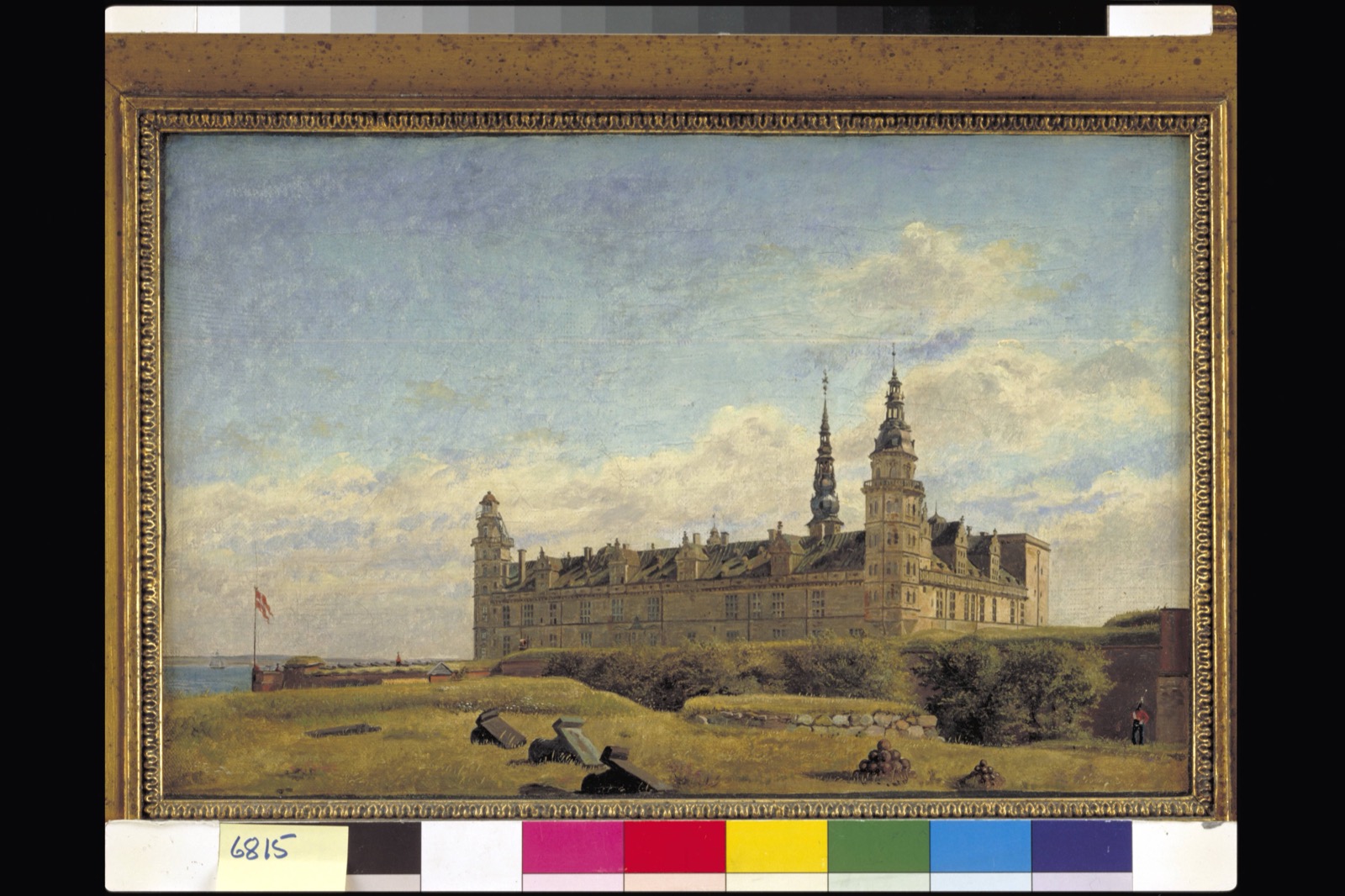
Kronborg Castle
1834 · National Gallery of Denmark (via Europeana)
Public domain
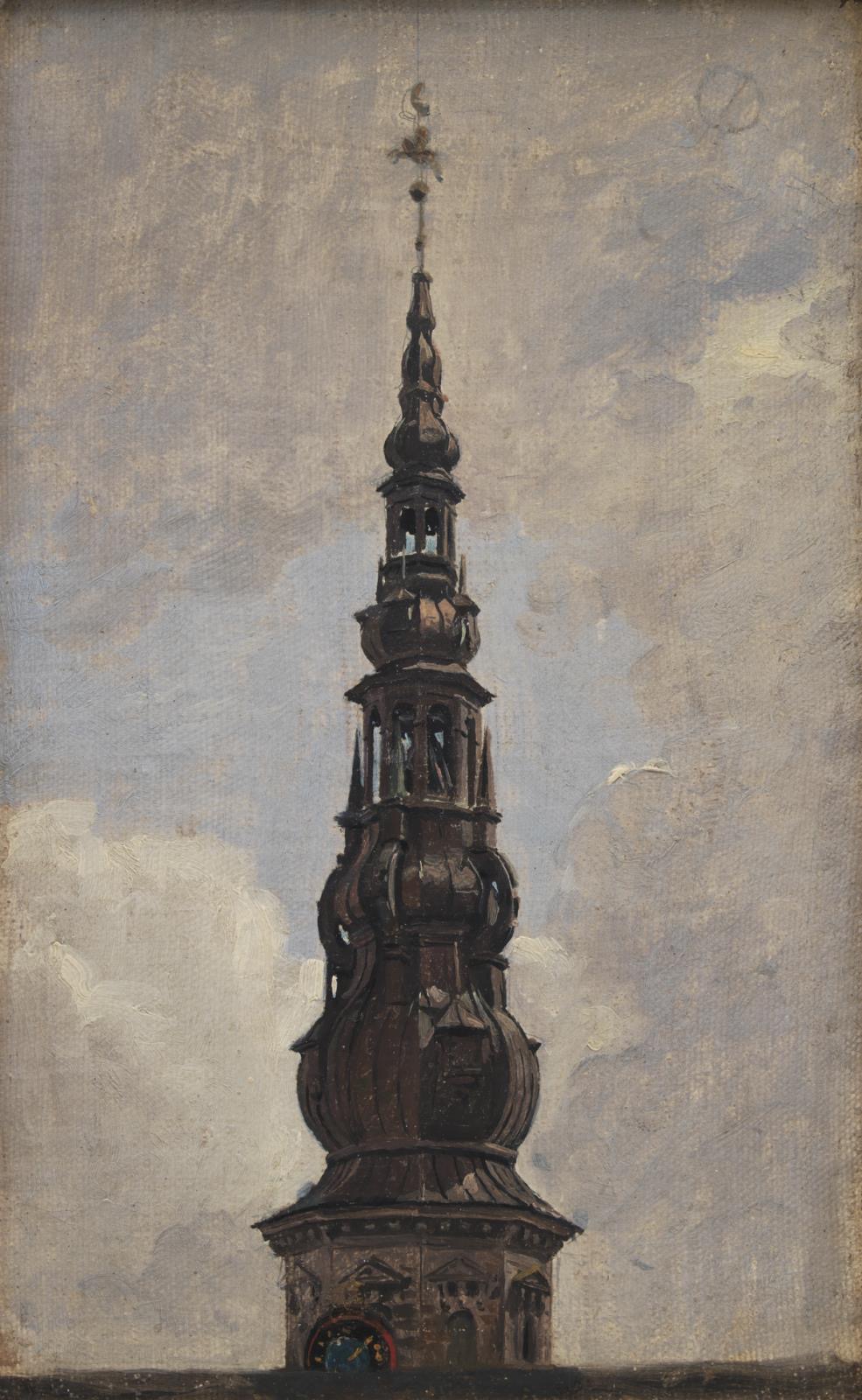
The Great Spire of Kronborg Castle. Study
1834 · National Gallery of Denmark (via Europeana)
Public domain
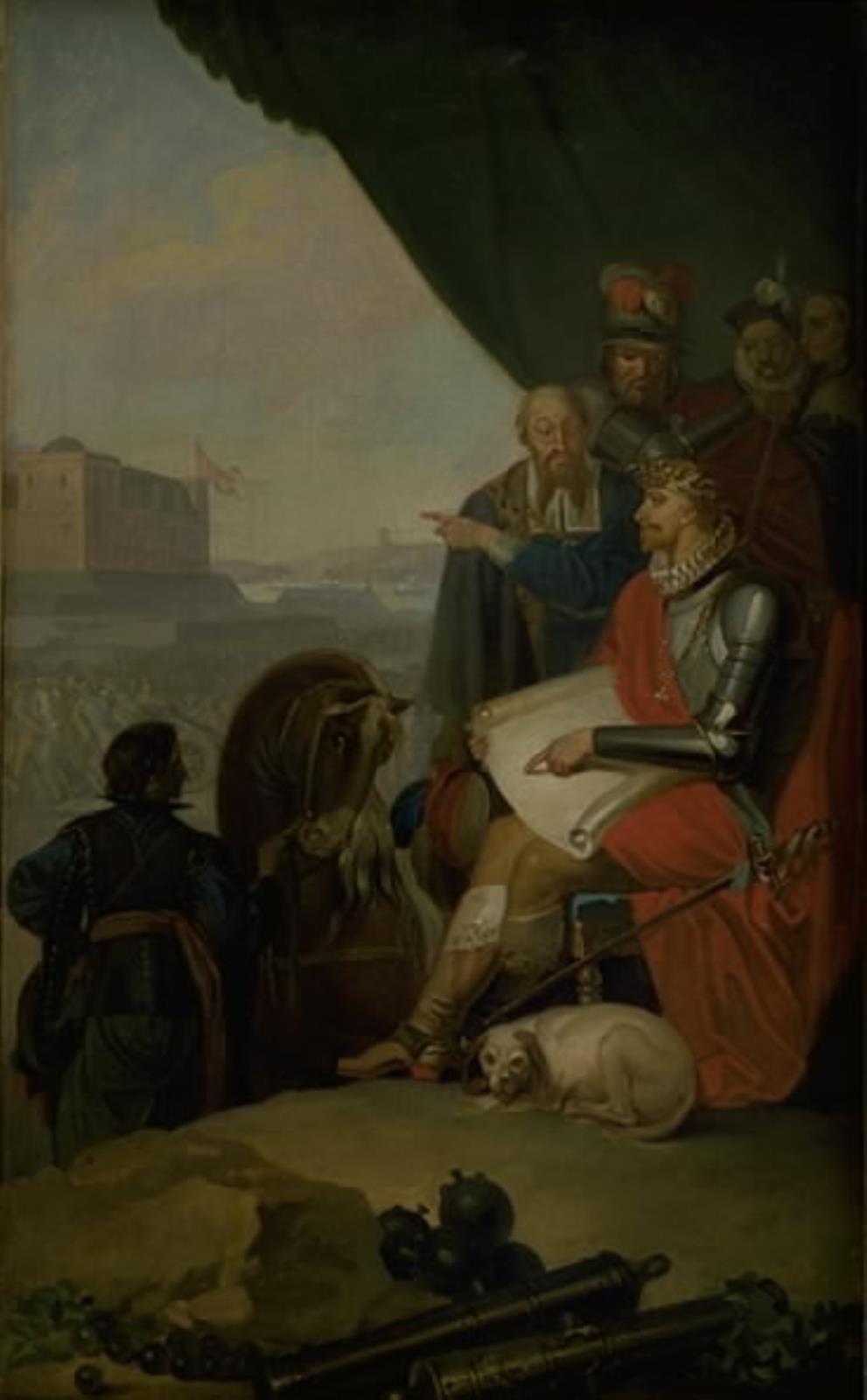
Frederik II Builds Kronborg Castle at Elsinore
1781 · National Gallery of Denmark (via Europeana)
Public domain
Nearby