
England · Restored
Appleby Castle
Appleby Castle is a medieval castle in Appleby-in-Westmorland centred on a 12th-century square keep known as Caesar's Tower and an attached mansion house set around a walled courtyard. The complex includes curtain walls, a battlemented gateway with adjoining cottages, and ancillary buildings such as Lady Anne's Beehouse; parts of the site now house a museum in the keep and the grounds are open to the public.
First raised
1120
Its prime
1695
Today
Restored
As it stood in 1695
What Appleby Castle looked like in its prime.
A tall, square 12th-century stone keep of grey rubble and ashlar rises above a low, battlemented curtain enclosing a rectangular courtyard; the keep has four storeys and a castellated parapet. Attached to it is a two-winged classical mansion with slate roofs and sash windows set at right angles, the north wing punctuated by a semicircular round tower and the east wing terminating in a large square tower. The courtyard has gravel approaches, clipped lawns, stone paving and a central stone well.
Its story
The story of Appleby Castle.
Ranulf le Meschin's Foundation and the 1174 Scottish Invasion
Ranulf le Meschin founded Appleby Castle at the beginning of the 12th century overlooking the River Eden, and in about 1170 the square stone keep known as Caesar's Tower was built. The castle was in royal hands when William the Lion, King of Scots, invaded the Eden Valley in 1174; its constable surrendered without a fight.
The Vipont and Clifford Inheritance, 1203–1617
King John granted the castle to Robert I de Vipont in 1203. It passed to Roger de Clifford in 1264 through his marriage to Isabel de Vipont, one of the two daughters and co-heiress of Robert II de Vipont, and Roger's son Robert de Clifford inherited it in 1282. The Cliffords held Appleby for nearly 400 years and were responsible for much restoration of the castle. The north wall of the house and the west part of the north wing, with its round tower, date from the 13th century, while the eastern part of the house was built in 1454. James I stayed at the castle in 1617, between visits to Brougham Castle and Wharton Hall.
The Roundhead Siege and Lady Anne Clifford's Restoration
In the mid-17th century Lady Anne Clifford made Appleby her home. The castle was besieged by roundhead forces in 1648, during the Second English Civil War, and partly dismantled following the siege. Lady Anne restored it in 1651–53, and is credited as the architect of the work. On her death the castle passed to the Earls of Thanet.
From Classical Mansion to Rare Breeds Centre
The Thanets converted the hall block into a classical mansion house; the house was largely rebuilt in 1686 and the north-west wing added in 1695. The upper parts of Caesar's Tower were altered in the 17th and 18th centuries, and sash windows were inserted during a further restoration in the 19th century.
Ferguson Industrial Holdings bought the castle in 1973, and it became the home of the company's chief executive, Denis Vernon, until 1990. Vernon established a rare breeds survival centre there, and the castle served as Ferguson's headquarters and training centre; the 1998 BBC documentary The Gypsies Are Coming, about Appleby Horse Fair, featured Vernon and the castle. Christopher Nightingale bought the castle in 1998, and Sally Nightingale became its sole owner in 2009. In 2024 the castle was put up for sale at an asking price of £9.5 million, reduced to £5.5 million in 2025.
Step inside
11 places to explore in 1695.
The record describes 11 distinct spots at Appleby Castle, including 1 interior: caesar's tower interior / norman centre chamber. Create your own photoreal reconstruction and explore every one, more scenes means more rooms, more angles, and more of the place to stand in.
Build Your Own Castle
Recreate Appleby Castle with AI to explore it.
The artist rebuilds it as it stood in 1695, a photoreal reconstruction that belongs to you alone. Pay with coins, no subscription needed.
Recreate this castle →Defend this castle →Whose castle
Clans who held Appleby Castle.
The families that held Appleby Castle for a decade or more across its history, follow a name to its clan.
de Vipont
Granted to Robert I de Vipont by King John in 1203 and held by the Viponts until it passed by marriage to the Cliffords in 1264.
Clifford
Held by the Clifford family for nearly 400 years from 1264, after Roger de Clifford married Isabel de Vipont; the family restored much of the castle.
From the archive
Appleby Castle on paper: the measured plan and period views.
The survey plan and photographs below are the ground truth this page's reconstructions are checked against, drawn and photographed while the castle was still a working garrison. Every image is public-domain or openly licensed, with its source named.

Appleby Castle, Lake District, England-LCCN2002696838
ca. 1890-1900 · Photochrom Prints Collection (via Wikimedia Commons)
Public domain
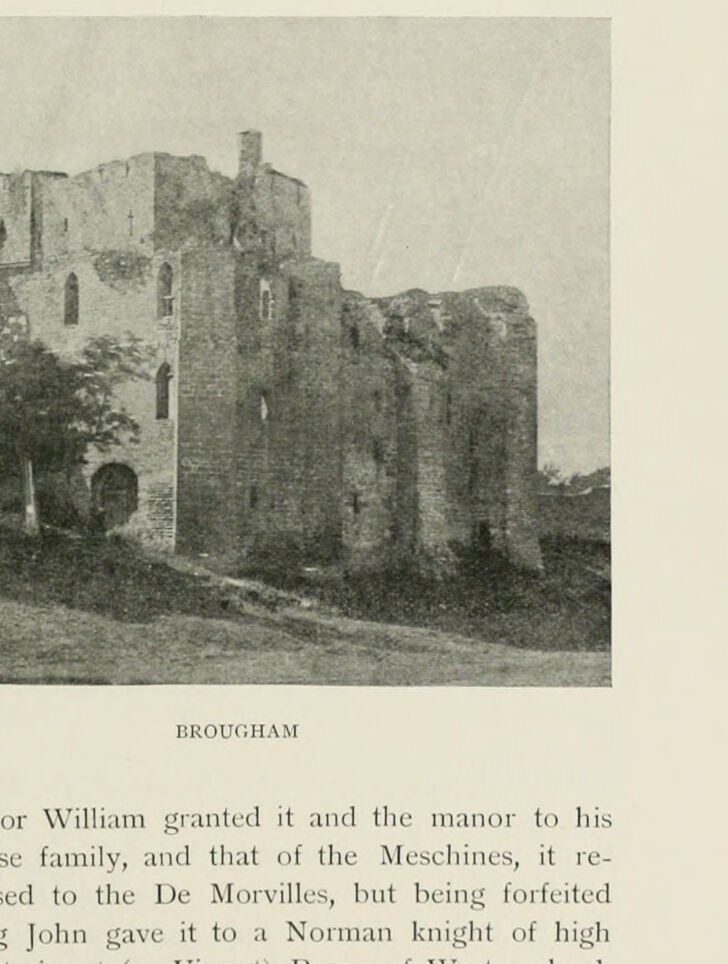
BROUGHAM
1897 · J. D. Mackenzie, The Castles of England, vol. 2 (1897)
Public domain


