
England · Partial ruin
Hertford Castle
Hertford Castle is a Norman-origin castle beside the River Lea in Hertford, Hertfordshire, England. Most of its internal buildings have been demolished; the surviving Tudor gatehouse is the main extant structure and is a Grade I listed building, with sections of the medieval bailey wall also still standing.
First raised
1066
Its prime
1540
Today
Partial ruin
As it stood in 1540
What Hertford Castle looked like in its prime.
A three-storey red-brick Tudor gatehouse stands at the heart of the site, with a prominent central stone-arched entrance and tall vertically proportioned mullioned windows in the ranges either side. Flanking rectangular towers rise only slightly above the main eaves, and surviving stretches of medieval bailey wall of flint and brick return toward the gatehouse. The castle sits in a town riverside setting with open lawned forecourt and mature trees immediately before the entrance; at its prime the gatehouse and connected curtain walls were complete and occupied.
Its story
The story of Hertford Castle.
From Edward the Elder to the French Siege, 913–1217
Hertford Castle stood on a site first fortified by Edward the Elder around 913; by the time of the Norman invasion in 1066 a motte and bailey surrounded by a moat were on the site, and William the Conqueror granted the castle to Peter de Valognes, High Sheriff of Essex and Hertfordshire. Henry II took a great interest in it, and between 1170 and 1174 it was practically reconstructed, with flint walls, drawbridges and gatehouses; it was strengthened further in Richard I's reign by his regent, William Longchamp. Robert de Valognes died in 1184 leaving no male heirs and the Crown took the castle over, but his son-in-law Robert Fitzwalter claimed it, seizing it and installing his own tenants and garrison; evicted by King John, he was eventually appointed its governor.
In 1216 a French invasion besieged the castle for a month until its governor, Walter de Godarvil, surrendered. The country then supported Henry III, and by 1217 the French had left. The castle's military role afterwards became secondary to its use as a royal residence.
Royal Prisoners and John of Gaunt, 1299–1399
Edward I gave the castle to his second wife Margaret in 1299. During the reign of Edward II it saw its first political prisoners, some of the Knights Templar, in 1309; his wife Isabella of France and their son, the future Edward III, both spent much time there, and Isabella died at the castle in 1358.
During the Hundred Years' War the castle was used to detain prisoners of royal and noble rank, among them King David II of Scotland and, in 1359, King John II of France. The following year it was granted to Edward III's third son, John of Gaunt, who spent much time there, using it as his chief country home when not abroad on campaigns; the defences were repaired and strengthened again at this time. When John of Gaunt died in 1399, Richard II seized all the Lancastrian estates, including Hertford, and installed his new wife, the eight-year-old Princess Isabella of Valois, there.
A Castle of Queens, from 1418
Henry V granted the castle in 1418 to his new wife, Princess Katherine of France, and the couple spent much time there together; it was repaired around 1440, the work paid for by demolishing the manor of Camelot, thought to be Camlet Moat in Enfield Chase. Henry VI, who spent much of his infancy at Hertford, married Margaret of Anjou in 1445 and granted her the castle. The Wars of the Roses brought the crown to Edward IV, who granted the castle to his wife Elizabeth Woodville; when Richard III became king it went to one of his greatest supporters, the Duke of Buckingham.
Henry VIII's Gatehouse and the Tudor Palace, from 1487
Henry VII conferred the castle on his wife Elizabeth of York in 1487, and their son Henry VIII spent considerable sums turning it into a civilian palace, including building the gatehouse that still stands. Edward VI granted it to Princess Mary, and during her eventual reign it was used to imprison Protestant martyrs; Elizabeth I was a frequent visitor to Hertford.
Decay, the Cecils and the Gift to the Town
From the reign of James I the castle ceased to be a royal residence and fell into decay. After Charles I came to the throne it was granted to William Cecil, 2nd Earl of Salisbury, and leased to Sir William Harrington of Hertingfordbury Park, who carried out work to restore the buildings; he then assigned his lease to Sir William Cowper. The castle remained in the ownership of the Cecil family, who leased it out to a succession of occupiers. The south wing was added to the gatehouse around 1790, and around 1800 a new gateway and lodge were built. The East India Company College was housed there between 1805 and 1809. In 1911 Hertford Corporation leased the gatehouse, all that then remained, from the Marquess of Salisbury to house its administration, and in the late 20th century Lord Salisbury gave what was left of the castle to the town.
Step inside
7 places to explore in 1540.
The record describes 7 distinct spots at Hertford Castle, including 1 interior: gatehouse passage (through-passage). Create your own photoreal reconstruction and explore every one, more scenes means more rooms, more angles, and more of the place to stand in.
Build Your Own Castle
Recreate Hertford Castle with AI to explore it.
The artist rebuilds it as it stood in 1540, a photoreal reconstruction that belongs to you alone. Pay with coins, no subscription needed.
Recreate this castle →Defend this castle →Whose castle
Clans who held Hertford Castle.
The families that held Hertford Castle for a decade or more across its history, follow a name to its clan.
Valognes
Granted by William the Conqueror to Peter de Valognes, High Sheriff of Essex and Hertfordshire.
Granted to William Cecil, 2nd Earl of Salisbury, after Charles I came to the throne.
From the archive
Hertford Castle on paper: the measured plan and period views.
The survey plan and photographs below are the ground truth this page's reconstructions are checked against, drawn and photographed while the castle was still a working garrison. Every image is public-domain or openly licensed, with its source named.
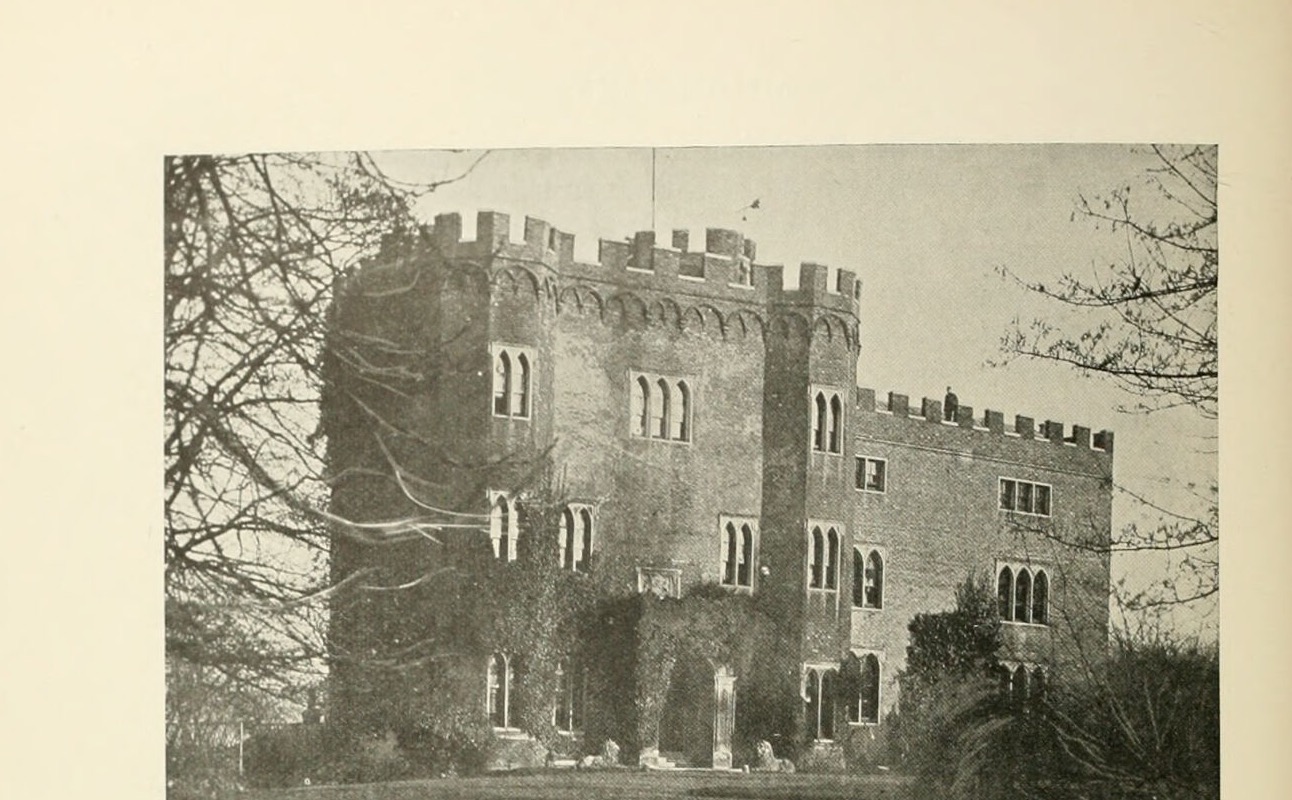
HERTFORD
1897 · J. D. Mackenzie, The Castles of England, vol. 1 (1897)
Public domain
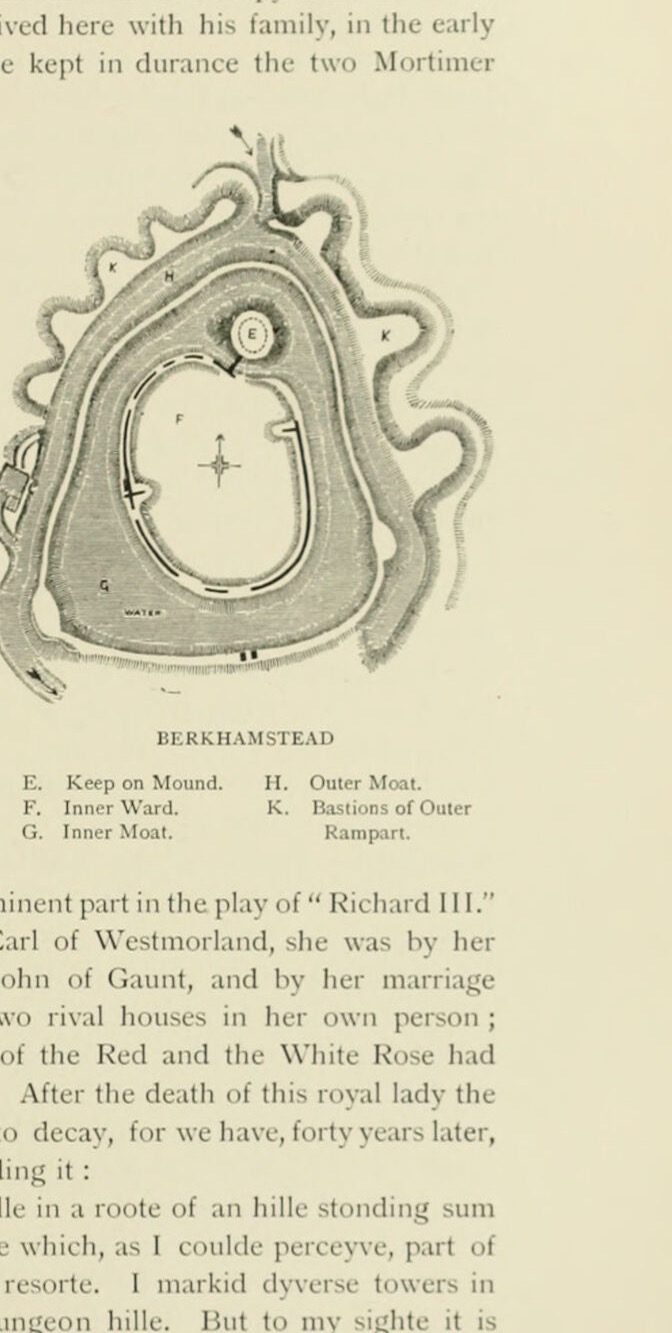
BERKHAMSTEAD. E. Keep on Mound. F. Inner Ward. G. Inner Moat. H. Outer Moat. K. Bastions of Outer Rampart.
1897 · J. D. Mackenzie, The Castles of England, vol. 1 (1897)
Public domain
Nearby


