
England · Still standing
Greystoke Castle
Greystoke Castle is a privately owned country house-style castle in the village of Greystoke, Cumbria, long associated with the Howard family. The present building incorporates an older medieval pele tower and was substantially rebuilt in the 19th century to form a large family residence within landscaped parkland and an ornamental lake. The estate remains private and is not open to the public.
First raised
1353
Its prime
1848
Today
Still standing
As it stood in 1848
What Greystoke Castle looked like in its prime.
A compact, pale-sandstone country castle consisting of a long, rectangular main block with projecting wings, multiple steep slate rooflines and numerous tall chimneys. The complex incorporates an earlier, squat square pele tower of thicker masonry set close to the main house. The castle stands within sweeping lawns and parkland with specimen trees and an ornamental lake to the rear; a gravel approach and a rectangular forecourt lead up to the principal entrance. The building appears whole and occupied at its mid-19th-century rebuilding.
Its story
The story of Greystoke Castle.
Ligulf's Pale and Ivo's Stone Building, 1069–1129
In 1069, after the Norman Conquest, the English landlord Ligulf de Greystoke was re-granted his land and built a wooden tower surrounded by a pale, or pele. The first stone structure on the site was raised in 1129 by his grandson, Ivo.
William de Greystoke's Licence to Castellate, 14th Century
The building grew into a large pele tower, and in the 14th century, after William de Greystoke, 2nd Baron Greystoke, obtained a royal licence to castellate it, the castle was further enlarged.
The Howards, the Dacre Marriage and Lambert's Parliamentarians, 1571–1648
In 1571 the castle was in the ownership of Thomas Howard, 4th Duke of Norfolk and Earl Marshal of England, through his marriage into the Dacre family, who had been the previous owners. The Howards were Catholics and Royalists, and in consequence the castle was laid waste during the Civil War by Parliamentarians under General Lambert in 1648.
Salvin's Rebuildings and the Fire, 1789–1868
The castle was enlarged and altered in 1789, then rebuilt between 1838 and 1848 to a design by Anthony Salvin, incorporating the older structures including the pele tower, while Charles Howard developed the estates into a modern farm. In 1868 the house caught fire and many treasures and works of art were lost; the castle was rebuilt under Henry Howard, again by Salvin.
Tank Training Ground, Prisoner-of-War Camp and the 1950 Restoration
During the Second World War the army requisitioned the castle and estate as a tank drivers' training area, and the castle itself became a prisoner-of-war camp, with much damage done to both building and estate. In 1950 Stafford Howard, son of Sir Edward Stafford Howard, inherited the estate and began a further period of restoration; it is now managed by his son, Neville.
Step inside
6 places to explore in 1848.
The record describes 6 distinct spots at Greystoke Castle, including the full exterior approach. Create your own photoreal reconstruction and explore every one, more scenes means more rooms, more angles, and more of the place to stand in.
Build Your Own Castle
Recreate Greystoke Castle with AI to explore it.
The artist rebuilds it as it stood in 1848, a photoreal reconstruction that belongs to you alone. Pay with coins, no subscription needed.
Recreate this castle →Defend this castle →Whose castle
Clans who held Greystoke Castle.
The families that held Greystoke Castle for a decade or more across its history, follow a name to its clan.
Greystoke
Ligulf de Greystoke was re-granted the land in 1069 and built the first wooden tower here.
Dacre
The Dacres owned Greystoke before it passed by marriage to Thomas Howard, 4th Duke of Norfolk.
In Howard hands from the 4th Duke of Norfolk's marriage into the Dacres, by 1571; still the family's private residence.
From the archive
Greystoke Castle on paper: the measured plan and period views.
The survey plan and photographs below are the ground truth this page's reconstructions are checked against, drawn and photographed while the castle was still a working garrison. Every image is public-domain or openly licensed, with its source named.
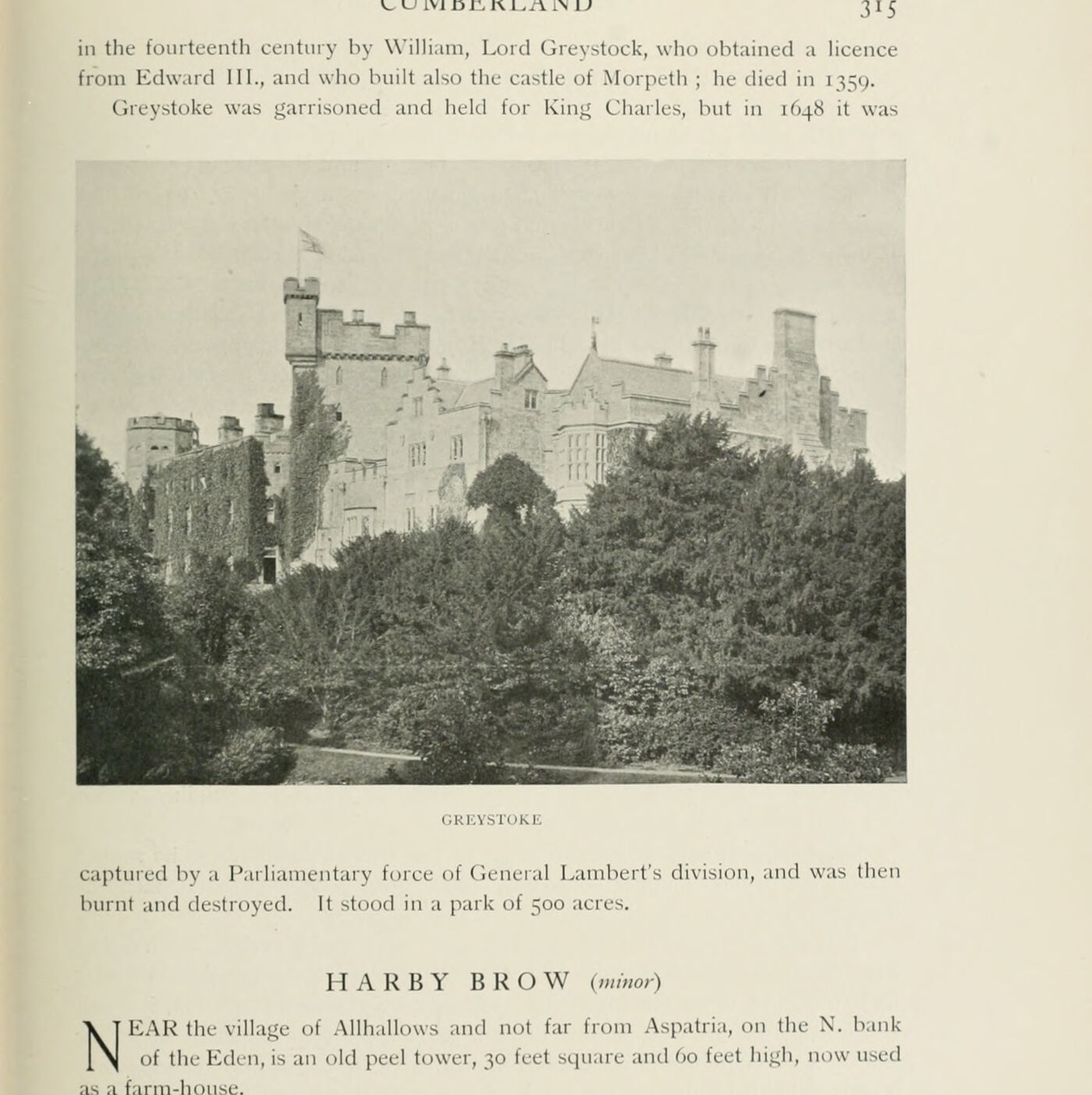
GREYSTOKE
1897 · J. D. Mackenzie, The Castles of England, vol. 2 (1897)
Public domain


