
England · Ruin
Bowes Castle
Bowes Castle is a medieval stone hall-keep erected within the perimeter of the Roman fort of Lavatrae in County Durham, England. Built in stone under Henry II in the 12th century, the three-storey keep survives today as a prominent ruin managed by English Heritage.
Its prime
1174
Today
Ruin
As it stood in 1174
What Bowes Castle looked like in its prime.
A rectangular three-storey stone hall-keep approximately 25 by 18 metres and c.15 metres high, standing on the raised interior of an older Roman fort. Thick stone walls are pierced by large rounded (Romanesque) window openings; one end of the keep has collapsed into an irregular mass of rubble producing a broken silhouette. The keep sits within a shallow inner ditch and is surrounded by broad earthen ramparts of the former fort, on open grassy ground with scattered mature trees and the village approach uphill.
Its story
The story of Bowes Castle.
Lavatrae and Alan de Bretagne's Timber Castle, c.1136–1171
Bowes Castle stands inside the perimeter of the Roman fort of Lavatrae, on the road over the Stainmore Pass that is now the A66. The route was one of the few upland passes linking England and Scotland, and it remained strategically important during the medieval period. The site lay within the Honour of Richmond, a grouping of lands traditionally owned by the Counts of Brittany in the early medieval period, though the land itself was demesne estate belonging to the Crown. Around 1136 Alan de Bretagne, Count of Brittany, raised a timber castle in the north-west corner of the old fort. The use made of the old Roman fort here was similar to that at the nearby castles of Brough and Brougham to the west, on the same Roman road. Alan's son Conan inherited it, and when Conan died in 1171 the castle was claimed by Henry II.
Henry II's Hall-Keep and the Planned Village of Bowes
Royal concern for security in the north led Henry II to invest heavily in a new structure on the site between 1171 and 1174. A new royal castle was an unusual thing to raise in this part of England during the twelfth century, and the king appears to have been driven by the military threat from Scotland before and during the Great Revolt of 1173 to 1174. He spent almost £600 at Bowes between 1170 and 1187, most of it in the first few years, and the rebuilding of the older structure was carried out under the supervision of the Count of Brittany's local tenants, Torfin, Osbert and Stephen of Barningham.
What went up was a hall-keep, an uncommon design in English castles: a three-storeyed building of stone, 82 feet long, 60 feet wide and 50 feet high, divided internally to form a long hall and a solar and lit by large rounded windows. It had architectural kin among the castles of the region, in particular Middleham and Pendragon at Outhgill. A ditch cut an inner bailey around the keep while the ramparts of the old fort served as a larger outer bailey, and a mill, then an essential part of any castle, was built by the River Greta to supply the garrison with flour. The village of Bowes came after the castle rather than before it, laid out as a planned site running up to the walls, complete with a church and a market place; that form of planned village is again unusual in England.
William the Lion's Siege and the End of the Great Revolt
In England the Great Revolt against Henry's rule brought together a coalition of rebel barons, bolstered by support from the King of Scots and from European allies. William the Lion pushed south from Scotland in 1173 and Bowes Castle was damaged in the raids; work was then carried out in anticipation of further attacks the following year, including repairs to the chamber and the gates and the construction of bulwarks around the keep. The next year William besieged the castle directly, and was forced to retreat after the arrival of a relief force led by Henry's illegitimate son Geoffrey, then Bishop of Lincoln.
Henry went on to quell the revolt, capturing William the Lion at the second battle of Alnwick and imprisoning him until a peace treaty was agreed that extended Henry's authority north into Scotland. In the years that followed, the security situation in the north of England improved significantly.
Vieuxpont, the Earls of Richmond and the Ruin of the Manor
King John gave control of Bowes Castle in 1203 to Robert de Vieuxpont, an important administrator in the north, who retained the fortification until 1228. John stayed there himself in 1206 and again in 1212, and the castle was also used briefly to hold his niece Eleanor of Brittany, who had been placed in Vieuxpont's custody.
Henry III granted the castle briefly to William de Blockley and Gilbert de Kirketon, until it was given to Duke Peter of Brittany in 1232 and afterwards to William de Valence. In 1241 Peter II, Count of Savoy, was made Earl of Richmond and was then given Bowes by the king. It remained in the hands of the Earls of Richmond until 1322, by which time it was in a poor state of repair.
Edward II then gave Bowes Castle to John de Scargill instead, and the local tenants of the Earl of Richmond rebelled and attacked it. The lord of the castle was away at the time; the attackers burnt part of a hall, drank four tuns of wine and carried off armour, springalds and other goods. Conflict with Scotland brought further raids against the castle and the surrounding manor, the neighbouring fields were abandoned as a result, and by 1340 the castle was in ruins and the manor worth nothing.
The Nevilles, the Civil War and English Heritage
Still ruined, Bowes Castle was reclaimed by the Crown in 1361. Between 1444 and 1471 it was controlled by the Neville family, powerful landowners in the region, before reverting to the Crown once again. James I sold the castle in the early seventeenth century, and most of the remaining fortifications were dismantled in the mid-seventeenth century after the English Civil War.
By 1928 the castle was in poor condition, with little interest shown in it either by local people or by its owner, Lady Lorna Curzon-Howe. Facing death duties on her estate, Curzon-Howe agreed in 1931 to pass it into the care of the Office of Works. It has been protected as a scheduled monument since 1915 and listed at Grade I since 1986. The ruins of the keep survive largely intact, and English Heritage now owns and operates the site as a tourist attraction, with free admission during daylight hours.
Step inside
8 places to explore in 1174.
The record describes 8 distinct spots at Bowes Castle, including 2 interiors: great hall inside the hall-keep, solar (upper private chamber). Create your own photoreal reconstruction and explore every one, more scenes means more rooms, more angles, and more of the place to stand in.
Build Your Own Castle
Recreate Bowes Castle with AI to explore it.
The artist rebuilds it as it stood in 1174, a photoreal reconstruction that belongs to you alone. Pay with coins, no subscription needed.
Recreate this castle →Defend this castle →From the archive
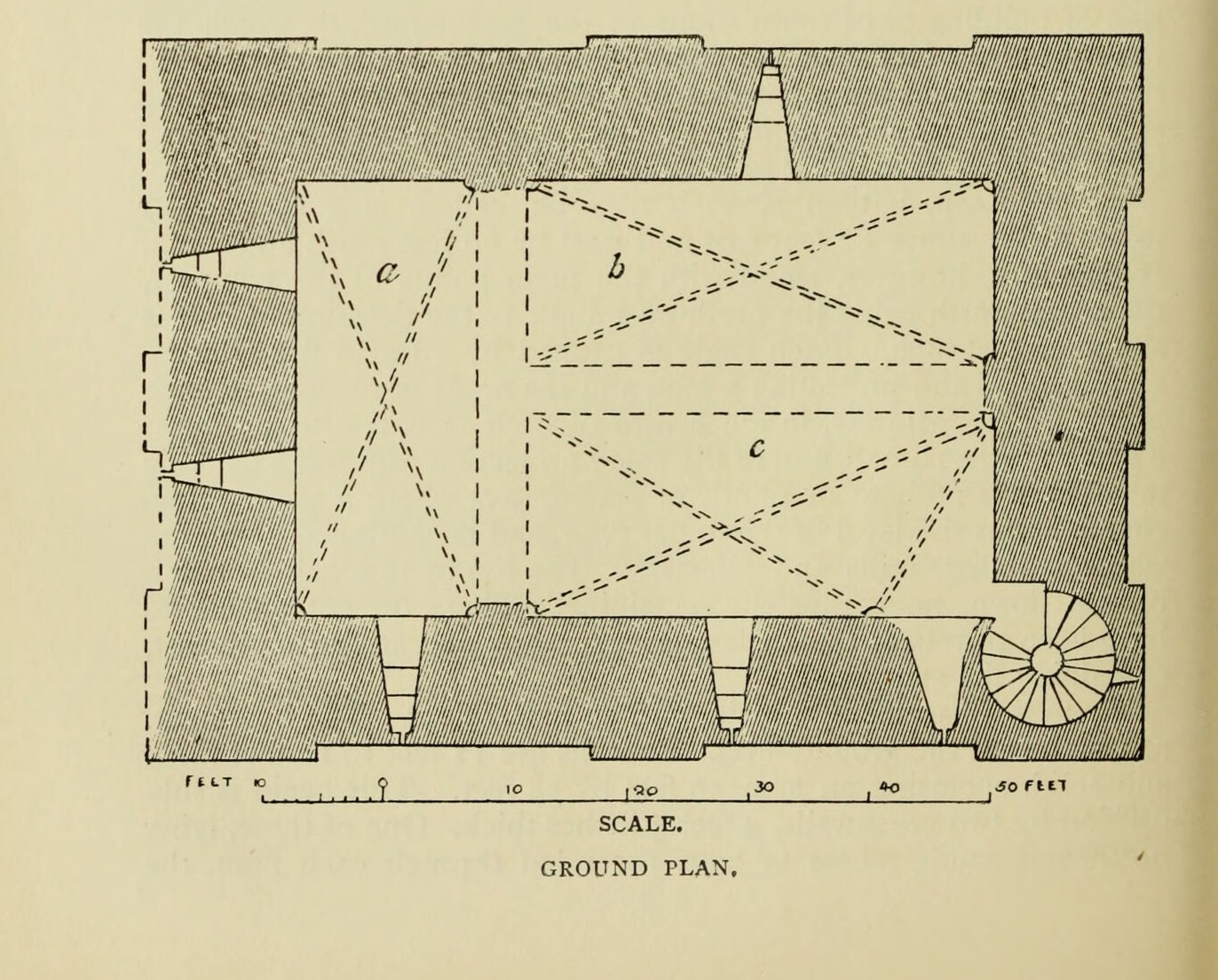
Bowes Castle on paper: the measured plan and period views.
The survey plan and photographs below are the ground truth this page's reconstructions are checked against, drawn and photographed while the castle was still a working garrison. Every image is public-domain or openly licensed, with its source named.
BOWES CASTLE. FIRST OR MAIN FLOOR.
1884 · G. T. Clark, Mediaeval Military Architecture, vol. 1 (1884)
Public domain
SCALE. GROUND PLAN.
1884 · G. T. Clark, Mediaeval Military Architecture, vol. 1 (1884)
Public domain


