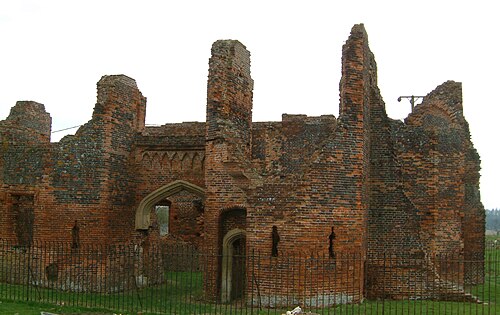
England · Partial ruin
Cockermouth Castle
Cockermouth Castle is a medieval stone castle standing at the junction of the Rivers Cocker and Derwent in Cockermouth, Cumbria. The site preserves a substantial curtain wall and an inhabited domestic range alongside older towers and a gatehouse; parts survive as ruins while other ranges remained lived-in into the 20th century.
Its prime
1600
Today
Partial ruin
As it stood in 1600
What Cockermouth Castle looked like in its prime.
A compact, rectangular stone castle of pale-grey sandstone with a continuous high curtain wall and a central, square gatehouse projecting over the entrance passage; the gatehouse base has thick, squared buttresses forming the flanking walls of the approach. The inhabited residential range rises behind the curtain with small mullioned windows and tall stone chimney stacks breaking the roofline. Crenellated parapets and narrow slit windows punctuate the walls. The castle stands on a grassy slope beside riverbanks and town trees.
Its story
The story of Cockermouth Castle.
Origins at the Cocker and Derwent, 1134–14th Century
The first castle on this site was built by the Normans in 1134, at the junction of the Rivers Cocker and Derwent. Some of the stone was sourced from the Roman site of Derventio, now Papcastle. Significant additions followed in the 13th and 14th centuries.
Percy Earls, the Wars of the Roses and the Civil War, 15th–17th Century
Various magnates held the castle over the following centuries, most prominently the Percy Earls of Northumberland, who possessed it from the 15th to the 17th century. Cockermouth played a significant role in the Wars of the Roses, and again in the Civil War, when it was badly damaged.
The Wyndhams, Lady Egremont and a Castle at Risk, 18th Century–2022
The castle passed to the Wyndham family in the 18th century, and they own it still. It was the home of the dowager Lady Egremont until her death in 2013.
By 2008 Cockermouth was one of 135 sites in North West England on the Heritage at Risk Register maintained by English Heritage and later Historic England: the majority of the castle was in good repair, but the 13th-century Bell Tower was badly leaning and potentially dangerous, and the 14th-century Kitchen Tower was suffering from water ingress. The situation worsened in December 2015, when northern England experienced historically heavy rainfall that triggered flooding; the flood defences at Cockermouth were overwhelmed, a landslide struck near the castle, and the river washed away part of its bank. Historic England noted a clear risk to the historic structure. The riverbank was reinforced, though a permanent solution had yet to be agreed as of 2022.
Cockermouth Castle is Grade I listed and a scheduled monument, and has been opened to the public as part of the Heritage Open Days scheme.
Step inside
7 places to explore in 1600.
The record describes 7 distinct spots at Cockermouth Castle, including 3 interiors: gatehouse passage, c14 kitchen tower (interior), inner court/ward. Create your own photoreal reconstruction and explore every one, more scenes means more rooms, more angles, and more of the place to stand in.
Build Your Own Castle
Recreate Cockermouth Castle with AI to explore it.
The artist rebuilds it as it stood in 1600, a photoreal reconstruction that belongs to you alone. Pay with coins, no subscription needed.
Recreate this castle →Defend this castle →Whose castle
Clans who held Cockermouth Castle.
The families that held Cockermouth Castle for a decade or more across its history, follow a name to its clan.
Held by the Percy Earls of Northumberland from the 15th to the 17th century.
Wyndham
Held by the Wyndham family from the 18th century to the present day.