England · Restored
Compton Castle
Compton Castle is a fortified manor house in the parish of Marldon, Devon, long associated with the Gilbert family and now a National Trust property. The present frontage dates from the early 16th century; the house contains a restored great hall, separate medieval kitchen, solar and defensive curtain walls enclosing small gardens.
Its prime
1520
Today
Restored
As it stood in 1520
What Compton Castle looked like in its prime.
A long, fortress-like stone frontage of roughly coursed grey local stone with a central recessed arched gateway set into a crenellated curtain wall; the façade is punctuated by tall rectangular gabled blocks and narrow slit windows, with several mullioned windows and tall stone chimneys breaking the roofline. The building stands behind a trimmed lawn and straight paved drive, with a separate lower kitchen range to one side and a low stone curtain wall enclosing small formal gardens.
Its story
The story of Compton Castle.
The de la Poles to the Gilberts: Building a Manor and a Front, 1154–1520
Compton Castle was the seat of Sir Maurice de la Pole in the reign of Henry II, from 1154 to 1189; after his family the manor was known as Compton Pole, and it came into the hands of Sir Peter Compton. An undefended manor house was built on the site in the mid-14th century, its hall flanked at each end by a solar and service rooms; this was rebuilt in the later Middle Ages. The fortress-like front was added around 1520 by John Gilbert.
Sir Humphrey Gilbert and the Newfoundland Voyage, 1539–1583
Compton's most notable resident was Sir Humphrey Gilbert (1539–1583), coloniser of Newfoundland and half-brother of Sir Walter Raleigh; legend has it that Raleigh smoked the first pipe of tobacco in Britain while visiting him there. A model of the Squirrel, the ship in which Gilbert sailed to Newfoundland, stands in the great hall, and the Gilbert crest is a squirrel sejant on a hill, feeding on a crop of nuts.
Ruin, Sale and Return to the Trust, 18th Century–1950s
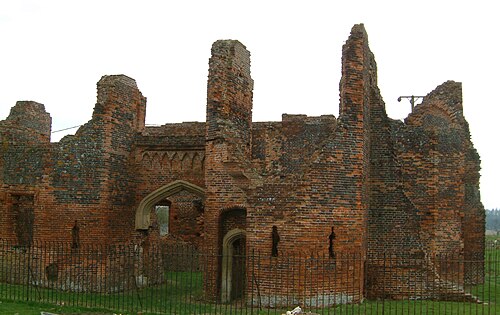
The central hall stood in ruins by the 18th century. The Gilbert family held Compton until the estate was sold in 1785, after which it gradually declined, until a descendant of the family bought it back in 1931 and gave it to the National Trust in 1951 on condition that Gilberts continue to occupy the castle. They do so still, administering the property for the Trust. The central hall was faithfully reconstructed in the 1950s.
Portcullises, Boiling Oil and a Trust-Run Castle
The castle's external defences included two portcullises that could be lowered against attackers, arrow loopholes covering the gateway, and slits in the curtain walls through which stones and boiling oil could be dropped on anyone scaling the walls. Compton Castle was used as a filming location for the 1995 version of Sense and Sensibility. It is Grade I listed and has been a National Trust property since 1951.
Step inside
9 places to explore in 1520.
The record describes 9 distinct spots at Compton Castle, including 6 interiors: gatehouse passage and entrance, great hall (central hall), the solar (private retiring room) and more. Create your own photoreal reconstruction and explore every one, more scenes means more rooms, more angles, and more of the place to stand in.
Build Your Own Castle
Recreate Compton Castle with AI to explore it.
The artist rebuilds it as it stood in 1520, a photoreal reconstruction that belongs to you alone. Pay with coins, no subscription needed.
Recreate this castle →Defend this castle →Whose castle
Clans who held Compton Castle.
The families that held Compton Castle for a decade or more across its history, follow a name to its clan.
de la Pole
Seat of Sir Maurice de la Pole in the reign of Henry II (1154–1189).
Compton
The manor, known as Compton Pole, came into the hands of Sir Peter Compton.
Gilbert
Home of the Gilberts for most of its history; sold in 1785, bought back in 1931 and given to the National Trust in 1951 with the family remaining in occupation.
Nearby