Clan Rising
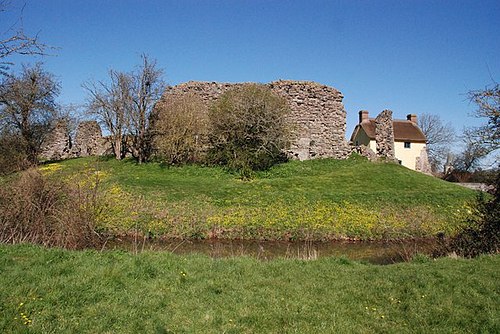
Embleton Tower today

England · Still standing

Embleton Tower

Embleton Tower is a medieval peel tower in the village of Embleton, Northumberland, historically associated with the parish vicar. The stone tower stands three storeys high with vaulted basement chambers and an open parapet belfry; it is a Grade I listed building and remains standing attached to later domestic buildings.

Photograph via Wikimedia Commons

Its prime

1395

Today

Still standing

As it stood in 1395

What Embleton Tower looked like in its prime.

A rectangular, three-storey peel tower of weathered brownish sandstone with a high chamfered base and crenellated parapet having six open embrasures. The roofline is low with thin gables and a small central chimney on the east wall; a three-light window and narrow slits puncture the elevations. The tower sits beside a raised churchyard and sheltered by trees, with rough grass and a neighbouring field containing an old dovecote visible nearby. The basement is vaulted.

Its story

The story of Embleton Tower.

Embleton Tower is a peel tower in the Northumberland village of Embleton. Tradition holds it was built in 1395 to protect the minister and parishioners of the Church of the Holy Trinity after the village suffered a Scots raid; a "Vicar's Turris de Emyldon" was known to exist by 1416. The first vicarage here had been provided in 1332 by Merton College, Oxford, which held the patronage of the parish.

The tower stands three storeys high over two vaulted basement rooms, with stone groining similar to the towers at Alnwick and Morpeth, and probably once carried a wooden, lead-covered spire like that at Ryton. A house built about 1828 as the vicarage adjoins it.

The historian Mandell Creighton occupied the vicarage from 1875 to 1884. When Peter Karney, vicar from 1954, retired in 1974, the vicarage passed into private hands and became known as Embleton Tower. It is a Grade I listed building.

Step inside

10 places to explore in 1395.

The record describes 10 distinct spots at Embleton Tower, including 5 interiors: ground-floor vaulted receiving area, northern vaulted basement chamber, stair cupboard showing steps to upper floor and more. Create your own photoreal reconstruction and explore every one, more scenes means more rooms, more angles, and more of the place to stand in.

Approach from the north churchyardEast wall with chimney and windowsParapet and belfry stageGround-floor vaulted receiving areaNorthern vaulted basement chamberStair cupboard showing steps to upper floorFirst-floor roomSecond-floor single chamber with corbelsAdjoining field with ancient dovecoteLow ridge view toward Embleton Bay and Dunstanburgh

Build Your Own Castle

Recreate Embleton Tower with AI to explore it.

The artist rebuilds it as it stood in 1395, a photoreal reconstruction that belongs to you alone. Pay with coins, no subscription needed.

Recreate this castle →Defend this castle →

Nearby

Landmarks within reach of Embleton Tower.

Questions about Embleton Tower

What is the history of Embleton Tower?

Embleton Tower’s history begins in the late 14th century, when tradition holds that it was built after a Scots raid to protect the minister and parishioners of the Church of the Holy Trinity. A vicar’s tower was known to exist by 1416, and the adjoining vicarage was built about 1828. The vicarage later passed into private hands in 1974 and became known as Embleton Tower.

What is inside Embleton Tower?

Inside Embleton Tower are vaulted basement chambers, including a northern chamber, and a vaulted ground-floor receiving area. A stair cupboard contains steps leading to the upper floor, while the first floor has a room and the second floor has a single chamber with plain stone corbels around the walls. The stair to the vaults is not accessible in the present day.

Why was Embleton Tower built, and what was it used for?

Embleton Tower was built as a fortified refuge for the minister and parishioners of the Church of the Holy Trinity after a Scots raid on the village. Its later role was connected with the vicarage: a house was built onto the tower about 1828, and the property remained associated with the parish vicar until 1974.

Where is Embleton Tower?

Embleton Tower is in the village of Embleton, Northumberland. It stands beside the Church of the Holy Trinity, with Embleton Bay about a mile away and Dunstanburgh Castle approximately 1 mile away. A low ridge lies between the vicarage and the sea.

When was Embleton Tower built?

Embleton Tower was traditionally built in 1395, placing its construction in the late 14th century. A vicar’s tower was known to exist by 1416. The present building also includes a vicarage constructed about 1828 against the medieval tower.

Was Embleton Tower ever attacked or besieged?

Yes, Embleton Tower was associated with a Scots raid on Embleton in 1395. The tower was built to protect the minister and parishioners of the Church of the Holy Trinity after the attack. The supplied account does not state whether the tower itself was captured or damaged.

What did Embleton Tower look like in its prime?

In its prime, Embleton Tower was a rectangular, three-storey peel tower built of weathered brownish sandstone. It had a high chamfered base, thin gables, a low roofline and a crenellated parapet with six open embrasures. Narrow slits and windows punctuated the walls, and a small central chimney stood on the east wall.

Is Embleton Tower still standing or is it a ruin?

Embleton Tower is still standing and is intact. The medieval tower remains attached to later domestic buildings, including a house built about 1828 as the vicarage. It is a Grade I listed building.
All castles of England · Castles of Europe · the best castles in Europe · explore the finished reconstructions.