Clan Rising
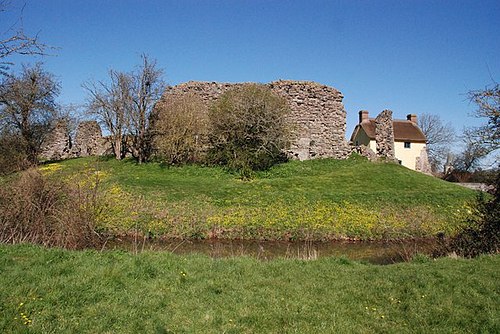
Benington Castle today

England · Ruin

Benington Castle

Benington Castle is the earthwork and foundation remains of a late 11th/12th-century motte-and-bailey in Benington, Hertfordshire. A stone keep was added in the 12th century, later slighted and finally destroyed in the early 13th century; only foundations and earthworks survive. The site was later incorporated into the grounds of the Georgian Benington Lordship and its gardens, with limited public access.

Photograph via Wikimedia Commons

Its prime

1192

Today

Ruin

As it stood in 1192

What Benington Castle looked like in its prime.

A motte-and-bailey castle set on a raised earthen motte, topped by a compact stone keep built of flint-faced rubble with larger dressed corner stones; the keep has narrow vertical arrow-slit windows. A low stone curtain and earthen banks enclose the adjacent bailey, with a stream and dam forming part of the outer defence. The castle sits in parkland beside a village church and would appear as a solitary stone keep and enclosing walls rising from grassy earthworks.

Its story

The story of Benington Castle.

Benington Castle began as a motte-and-bailey, founded in the late 11th or early 12th century by Peter de Valognes. In 1136 Roger de Valognes built a stone castle with a keep, a tower that stood barely two generations, for in 1177 Henry II ordered it demolished, one of at least 21 castles the historian Sidney Painter counts as slighted on that king's orders.

The castle was back in use by 1192, but was finally destroyed in 1212 after Robert Fitzwalter rebelled against King John. Only the foundations of the keep and some earthworks survive, protected as a scheduled monument since 1936, within the privately owned grounds of Benington Lordship.

Step inside

6 places to explore in 1192.

The record describes 6 distinct spots at Benington Castle, including the full exterior approach. Create your own photoreal reconstruction and explore every one, more scenes means more rooms, more angles, and more of the place to stand in.

Exterior approach from park across the dammed streamMotte summit at the base of the stone keepInner bailey courtyard enclosed by curtain and earthworksExposed foundations of the keep at ground levelBailey edge by the stream and dammed defenceView from St Peter's churchyard across the bailey to the castle

Build Your Own Castle

Recreate Benington Castle with AI to explore it.

The artist rebuilds it as it stood in 1192, a photoreal reconstruction that belongs to you alone. Pay with coins, no subscription needed.

Recreate this castle →Defend this castle →

Whose castle

Clans who held Benington Castle.

The families that held Benington Castle for a decade or more across its history, follow a name to its clan.

  • de Valognes

    Founded by Peter de Valognes in the late 11th or early 12th century; Roger de Valognes added the stone keep in 1136.

Questions about Benington Castle

What is the history of Benington Castle?

Benington Castle began as a motte-and-bailey in the late 11th or early 12th century, founded by Peter de Valognes. Roger de Valognes added a stone keep in 1136, but Henry II ordered its demolition in 1177. It was in use again by 1192 and was finally destroyed in 1212 after Robert Fitzwalter rebelled against King John.

Why was Benington Castle built, and what was it used for?

Benington Castle was built as a motte-and-bailey fortified site, later strengthened with a stone keep. Its keep was demolished in 1177, the castle returned to use by 1192, and the site was finally destroyed in 1212 after Robert Fitzwalter rebelled against King John. The surviving remains now form part of the grounds and gardens of Benington Lordship.

Where is Benington Castle?

Benington Castle is in the village of Benington, Hertfordshire, near Stevenage. It stands within the grounds of Benington Lordship, beside the medieval church of St Peter and near a stream that formed part of the medieval defences.

When was Benington Castle built?

Benington Castle was built in phases from the late 11th or early 12th century. Peter de Valognes founded the original motte-and-bailey, and Roger de Valognes added a stone keep in 1136. The first-raised year is not recorded, while the castle was in use again by 1192.

Which family or clan held Benington Castle?

The de Valognes family held Benington Castle in its early history. Peter de Valognes founded the motte-and-bailey in the late 11th or early 12th century, and Roger de Valognes added the stone keep in 1136.

What did Benington Castle look like in its prime?

At its height, Benington Castle was a motte-and-bailey with a compact stone keep on a raised earthen motte. The keep had flint-faced rubble walls, larger dressed corner stones and narrow vertical arrow-slit windows. A low stone curtain and earthen banks enclosed the bailey, with a stream and dam forming part of the outer defence.

Is Benington Castle still standing, or is it a ruin?

Benington Castle is a ruin, with only the foundations of the keep and some earthworks surviving from the original structure. The stone keep was demolished in 1177, and the castle was finally destroyed in 1212. The site is now incorporated into the grounds and gardens of Benington Lordship.

Can you visit Benington Castle?

Benington Castle has limited public access because it lies within the privately owned grounds of Benington Lordship. Public access is provided on a limited basis, including under the auspices of the National Gardens Scheme. The castle has been protected as a scheduled monument since 1936.
All castles of England · Castles of Europe · the best castles in Europe · explore the finished reconstructions.