England · Ruin
Eynsford Castle
Eynsford Castle is a ruined medieval fortification in Eynsford, Kent, originally founded on an earlier Anglo-Saxon stone burh and constructed by William de Eynsford in the late 11th century. The site comprised an inner and outer bailey with a stone curtain wall, hall complex and ancillary buildings; it fell out of regular occupation in the early 14th century and survives today as protected ruins managed by English Heritage.
Its prime
1231
Today
Ruin
As it stood in 1231
What Eynsford Castle looked like in its prime.
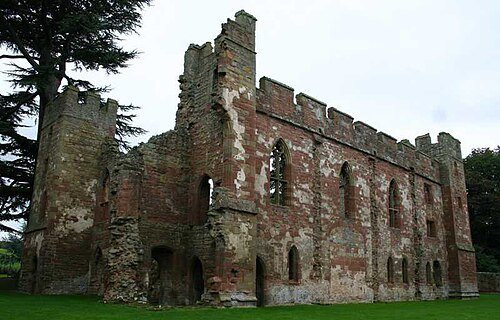
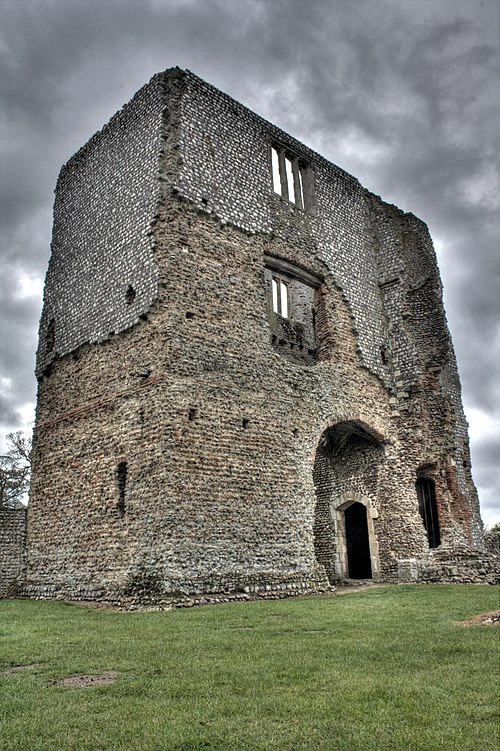
A compact inner bailey set on a low earthen terrace, ringed by a very thick, high coursed-flint curtain wall with a rough, nodular surface and visible masonry holes; large stretches of wall stand without towers, ending in irregular tops. A moat surrounds the mound, crossed by a timber bridge leading to the entrance area. The hall complex and service buildings sat against the inner wall, built of flint with green sandstone dressings and roofs of reused Roman tiles.
Its story
The story of Eynsford Castle.
Lanfranc's Answer to Odo of Bayeux, 970–1087
The manor of Eynsford sat at a strategic point on the River Darent, overlooking a crossing, and in 970 it was acquired by Christ Church, Canterbury. In the early 11th century a stone building went up on an artificial terrace within the manor, and it is possible that earlier stone buildings had stood on the same ground. A ditch and possibly a rampart enclosed it, each around 5 metres wide and up to 3 metres deep and high. How far those outer defences reached is uncertain; they may have traced the shape of the later castle, taking in a late Anglo-Saxon cemetery to the south-east. What stood here was a burh, a secure aristocratic residence, and the use of stone rather than timber in a secular building of this kind was very unusual for the period. Like some other burhs it may have carried an entrance tower, a burh-geat, advertising the status of its owner.
After the Norman invasion of 1066 the manor was probably acquired by Odo, Bishop of Bayeux and the new Earl of Kent, its Canterbury owners having lost it by that date. The burh appears to have stayed in use, either because the estate went on being managed much as before, or because occupying the old elite site demonstrated Norman power over the local community. Odo's lands and those of the Archbishop of Canterbury bordered one another, and Eynsford lay inside an area mainly controlled by Canterbury. The Italian monk Lanfranc became archbishop in 1070 and set about recovering the manor, probably succeeding around 1082, when Odo was arrested by King William. Lanfranc put a knight called Ralph, probably a lay retainer from Normandy, in charge of the estate, and on Ralph's death appointed his son, William de Eynsford, in his place.
Odo still worried Lanfranc, and the archbishop authorised William to improve the defences at Eynsford. The work was probably carried out between 1085 and 1087, enclosing the former burh with a stone curtain wall and making a castle of the residence. It had an inner and an outer bailey looking over the Darent, the inner one protected by that wall.
The Hall of 1130 and the Quarrel with Becket
William's family held Eynsford on the archbishop's behalf until 1261, through six descendants all named William and distinguished by historians, for convenience, as William de Eynsford II to VII. Around 1130 a new hall was raised inside the castle, superseding the Anglo-Saxon buildings that had by then been abandoned, and the defences were strengthened with a new gate house and by raising the height of the curtain wall. That wall had been built in two phases: the lower two thirds in the 11th century, the upper 3.7 metres in about 1130, partly out of reused Roman tiles.
William I retired to become a monk in the 1130s, and his son William II had handed control of the castle to William III by the late 1140s. It was William III who was drawn into the dispute between Henry II and Thomas Becket, then Archbishop of Canterbury, during the 1160s. He was an ally of Becket, which did not stop the two of them falling out over the appointment of a priest to Eynsford's church; he was excommunicated for a period as a consequence.
William V, Rochester and the End of the Line, 1200–1261
William IV died soon after inheriting the castle. William V, who came of age in 1200, moved increasingly in wider baronial politics: he served in Ireland with King John, and he took part in the First Barons' War. In that civil war he sided with the rebels against John, was captured at Rochester Castle, and had his estates, Eynsford among them, forfeited to the Crown. He recovered them once the war was over, and later became constable of Hertford Castle.
His daughter's son, William VI, inherited the castle in 1231. Around that time the hall burnt down and was rebuilt, this time complete with glazed windows. Both William VI and his own son, William VII, died young, and with them the family line ended in 1261.
The Divided Inheritance, 1261–1314
An enquiry was held to settle who should inherit the de Eynsford lands. The castle and the rest of the family estates were divided equally between William Heringaud, a powerful landowner in east Kent, and Nicholas de Criol, a smaller local Kentish landowner, both of them descended from William V. When the Second Barons' War broke out in 1264 the two men both supported the rebels against Henry III, and Eynsford, unoccupied by now, was seized by a royal official, Ralph de Farningham, who in turn passed it to a royal judge, Ralph de Sandwich. De Sandwich squeezed the Heringauds out of their inheritance, striking a deal in 1292 with Heringaud's daughter, the lady of Horton Kirby, after which he and the Criols held the castle jointly. Around 1300 it was lived in once more, probably by the widow of Nicholas or of William VI, or else by a castle bailiff.
In 1307 Ralph de Sandwich sold his share to William Inge, another royal judge. Inge set about exerting his rights over the property, and that brought him up against Nicholas de Criol's grandson and heir, also called Nicholas. According to the law case Inge brought in 1312, Nicholas and two of his brothers attacked several of Inge's properties in the area; Inge claimed, probably accurately, that the de Criols had broken down the doors and windows at the castle, ransacked it and released his livestock. The case was settled two years later, with both men's claims to half of the castle upheld. Eynsford was never reoccupied, though the hall was still used when required to hold the local manorial court.
From Hunting Kennels to Guardianship
William Inge's share of the castle was inherited by the Zouche family, and when the last of the de Criols died in 1461 the Crown granted the Zouches complete ownership. It passed next to Lady Elizabeth Chaworth, and on her death in 1501 the Crown gave it to the Harts of Lullingstone Castle. The Harts-Dykes branch of that family later acquired the lordship of the castle, and through the 18th century they used the ruined site to hold their hunting kennels and stables.
The kennels were given up in 1835, when the architect Edward Cresy was employed to remove the more recent modifications. Cresy surveyed and excavated parts of the castle as he worked, clearing up to 9 feet of accumulated debris. Neglect followed again, and sections of the north-western walls collapsed in 1872. A local landowner, E. D. Till, leased the castle in 1897 and undertook restoration work; after his death in 1917 the lease passed to Agnes Lady Fountain, who agreed to a plan to protect the place, buying the freehold and transferring it to the Society for the Protection of Ancient Buildings in 1937. Once the leasehold on the property had expired, the castle was passed into the guardianship of the Ministry of Works in 1948.
S. Rigold excavated the site between 1953 and 1961 while the castle was being restored, and again between 1966 and 1967 during work to install a new bridge over the moat. Further excavation in the early 1980s by Valerie Horsman led to a substantial reassessment of the fortification's earlier history. Eynsford Castle is now controlled by English Heritage and open to visitors; it has been a Grade I listed building since 1934, and the ruins are protected under UK law as an ancient monument.
Step inside
8 places to explore in 1231.
The record describes 8 distinct spots at Eynsford Castle, including 5 interiors: great hall (interior), solar and undercroft, forebuilding and rear kitchen and more. Create your own photoreal reconstruction and explore every one, more scenes means more rooms, more angles, and more of the place to stand in.
Build Your Own Castle
Recreate Eynsford Castle with AI to explore it.
The artist rebuilds it as it stood in 1231, a photoreal reconstruction that belongs to you alone. Pay with coins, no subscription needed.
Recreate this castle →Defend this castle →Whose castle
Clans who held Eynsford Castle.
The families that held Eynsford Castle for a decade or more across its history, follow a name to its clan.
de Eynsford
Built by William de Eynsford c. 1085–87; the family held the castle on the archbishop's behalf until the male line died out in 1261.
Heringaud
William Heringaud received a half-share in 1261, when the de Eynsford estates were divided.
de Criol
Nicholas de Criol received a half-share in 1261; a later Nicholas de Crioll ransacked the castle in 1312 amid a dispute with his co-owner.
Nearby