England · Partial ruin
Acton Burnell Castle
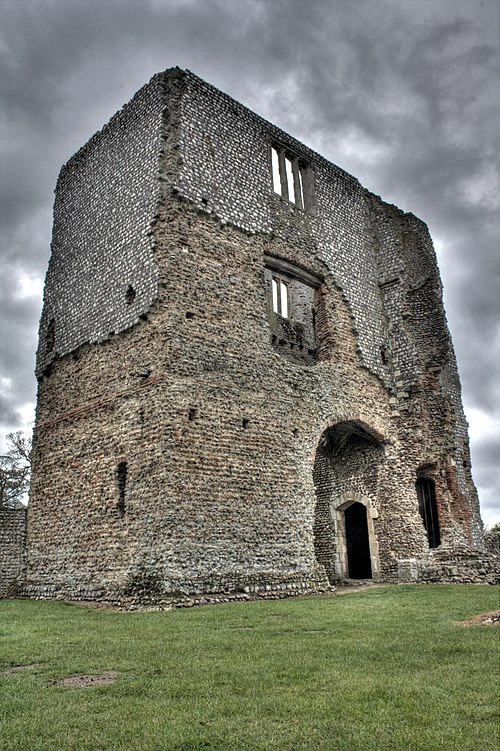
Acton Burnell Castle is a late 13th-century fortified manor house in Shropshire built by Robert Burnell. Today only the outer shell of the three-storey rectangular manor and the gable ends of the adjacent barn survive; the site is managed by English Heritage and open to the public.
Its prime
1284
Today
Partial ruin
As it stood in 1284
What Acton Burnell Castle looked like in its prime.
A rectangular, three-storey fortified manor of red sandstone with a tower at each corner and a continuous crenellated parapet along the roofline. Tall, narrow pointed-arch window openings and doorways pierce the outer walls; there is no roof and most openings are empty to the sky. The masonry shows patches of lighter repair or render. The building stands on a lawned setting with trees nearby and the gable ends of a large barn adjacent to the main range.
Its story
The story of Acton Burnell Castle.
The Parliament of Autumn 1283 and the Statute of Acton Burnell
In the autumn of 1283 Edward I held a parliament at Acton Burnell, presumably in the adjacent great barn, the only building there large enough to take it. It is believed to have been the first parliament of England at which the Commons were fully represented, and the first time in English history that the law-making process included them. The measure passed there became known as the Statute of Acton Burnell, a law giving protection to creditors and a mark of how far traders had risen in importance.
Robert Burnell's Licence to Crenellate, 1284
The manor house was built in 1284 by Robert Burnell, Bishop of Bath and Wells, friend and adviser to Edward I, and on 28 January of that year Burnell was granted a royal licence to crenellate and fortify it, a benefit extended only to trusted people. Its position mattered because it lay near the old Roman road of Watling Street. The building was rectangular with a tower at each corner and stood three storeys high, holding a hall, solar, bedrooms, offices, chapel and kitchen. It would have been substantial enough to accommodate Edward I with his retinue, soldiers and advisers, though it was never an actual castle. Burnell also built the nearby Church of St Mary and the village around it. How far the estate extended is not known, since much of the building has been destroyed or has never been found.
From the Lovels to English Heritage
Robert Burnell died in 1292 and the estate passed down the family line, coming by marriage to the Lovels of Titchmarsh in Northamptonshire. Following the Battle of Stoke Field in 1487 the land was confiscated by Henry VII, who granted it in turn to Thomas Howard, 2nd Duke of Norfolk. By the time it reached the Smythe family in the middle of the seventeenth century the house had been mostly demolished.
Acton Burnell Castle is maintained today by English Heritage, and is a Grade I listed building on the Statutory List of Buildings of Special Architectural or Historic Interest; the park and garden around it carry a Grade II listing. What remains open to the public is the shell of the former private residence, reached by a footpath through a small wood, with the gable ends of the barn standing beside it.
Step inside
9 places to explore in 1284.
The record describes 9 distinct spots at Acton Burnell Castle, including 4 interiors: great hall (interior), solar (upper private chamber), chapel and more. Create your own photoreal reconstruction and explore every one, more scenes means more rooms, more angles, and more of the place to stand in.
Build Your Own Castle
Recreate Acton Burnell Castle with AI to explore it.
The artist rebuilds it as it stood in 1284, a photoreal reconstruction that belongs to you alone. Pay with coins, no subscription needed.
Recreate this castle →Defend this castle →Whose castle
Clans who held Acton Burnell Castle.
The families that held Acton Burnell Castle for a decade or more across its history, follow a name to its clan.
Burnell
Robert Burnell was licensed to crenellate and fortify the manor in 1284; the estate passed down the family line after his death in 1292.
Lovel
The estate came by marriage to the Lovels of Titchmarsh; confiscated after the Battle of Stoke Field, 1487.
Granted by Henry VII to Thomas Howard, 2nd Duke of Norfolk, after 1487.
Smythe
Passed to the Smythe family in the mid-17th century, by which time the house was mostly demolished.
Nearby