Clan Rising
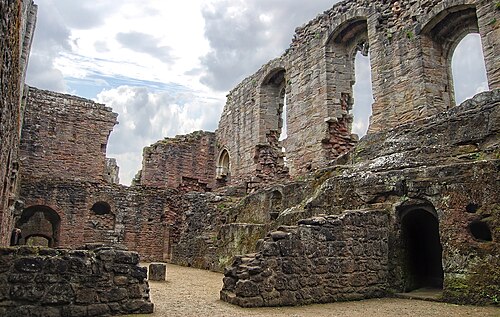
Topcliffe Castle today

England · Ruin

Topcliffe Castle

Topcliffe Castle is a medieval motte-and-bailey castle near the village of Topcliffe in North Yorkshire, England. Built around 1071 at the junction of the River Swale and Cod Beck and re-fortified in 1173, the site was later abandoned in the 14th century and survives today as earthwork mounds.

Photograph via Wikimedia Commons

Its prime

1173

Today

Ruin

As it stood in 1173

What Topcliffe Castle looked like in its prime.

A compact motte-and-bailey complex dominated by a rounded earthen motte rising from flat pasture, with a surrounding ditch and an adjoining lower, level bailey. At its prime the motte would have carried a timber keep and been ringed by a wooden palisade; the bailey lay within earthen banks and fenced enclosures. The site sits on low ground at the junction of two waterways, with grass and scattered trees on the mound.

Its story

The story of Topcliffe Castle.

A motte-and-bailey castle was built at Topcliffe around 1071, at the junction of the River Swale and Cod Beck in North Yorkshire. Archbishop Geoffrey of York re-fortified it in 1173 during the revolt of 1173–74, with William de Stuteville appointed as governor. The Percy family held Topcliffe, and Edward III spent a few hours resting at the castle in August 1333.

The castle, also known as Maiden's Bower, appears to have been abandoned during the 14th century, and survives today as earthwork mounds. Its site saw one last violent scene: in 1489 Henry Percy, 4th Earl of Northumberland, was slain there by a mob angry over higher taxation.

Step inside

6 places to explore in 1173.

The record describes 6 distinct spots at Topcliffe Castle, including the full exterior approach. Create your own photoreal reconstruction and explore every one, more scenes means more rooms, more angles, and more of the place to stand in.

Exterior approach across pastureFoot of the motte and surrounding ditchSummit of the motte with timber keepInterior of the baileyMain gate through the palisadeRiver bank at the junction of Swale and Cod Beck

Build Your Own Castle

Recreate Topcliffe Castle with AI to explore it.

The artist rebuilds it as it stood in 1173, a photoreal reconstruction that belongs to you alone. Pay with coins, no subscription needed.

Recreate this castle →Defend this castle →

Whose castle

Clans who held Topcliffe Castle.

The families that held Topcliffe Castle for a decade or more across its history, follow a name to its clan.

  • Percy

    The Percy family held Topcliffe; Henry Percy, 4th Earl of Northumberland, was slain on the castle site by a mob in 1489.

Questions about Topcliffe Castle

What is the history of Topcliffe Castle?

Topcliffe Castle was built around 1071 as a motte-and-bailey castle at the junction of the River Swale and Cod Beck. Archbishop Geoffrey of York re-fortified it in 1173 during the revolt of 1173–74, appointing William de Stuteville as governor. The Percy family later held Topcliffe, and Edward III rested there for a few hours in August 1333. It appears to have been abandoned during the 14th century.

Why was Topcliffe Castle built, and what was it used for?

Topcliffe Castle was built as a motte-and-bailey fortification at the junction of the River Swale and Cod Beck. Its defensive arrangement comprised a raised motte, a lower bailey, a surrounding ditch, earthen banks and timber structures. It was re-fortified in 1173, showing that its military role continued after its initial construction.

Where is Topcliffe Castle?

Topcliffe Castle is near the village of Topcliffe in North Yorkshire, at the junction of the River Swale and Cod Beck. The settlement of Topcliffe is the castle's administrative locality. The site lies on low ground surrounded by pasture, with the two waterways meeting nearby.

When was Topcliffe Castle built?

Topcliffe Castle was first raised around 1071, placing its construction in the 11th century. It was later re-fortified in 1173, during the revolt of 1173–74. The first-raised year is not recorded more precisely in the site record.

Which family or clan held Topcliffe Castle?

The Percy family held Topcliffe Castle. Henry Percy, 4th Earl of Northumberland, was slain on the castle site in 1489 by a mob angry over higher taxation. This identifies the Percys as the family associated with holding Topcliffe, rather than establishing present ownership.

What did Topcliffe Castle look like in its prime?

In its prime, Topcliffe Castle was a compact motte-and-bailey complex dominated by a rounded earthen motte rising from flat pasture. A timber keep would have stood on the summit, surrounded by a wooden palisade, while the adjoining bailey lay within earthen banks and fenced enclosures. A surrounding ditch completed the defensive layout.

Is Topcliffe Castle still standing or is it a ruin?

Topcliffe Castle is a ruin that survives as earthwork mounds. The rounded earthen motte, surrounding ditch and adjoining lower bailey remain visible in the pasture. The timber keep, wooden palisade and fenced enclosures described for its prime are not stated to survive today.
All castles of England · Castles of Europe · the best castles in Europe · explore the finished reconstructions.