England · Demolished
Hereford Castle
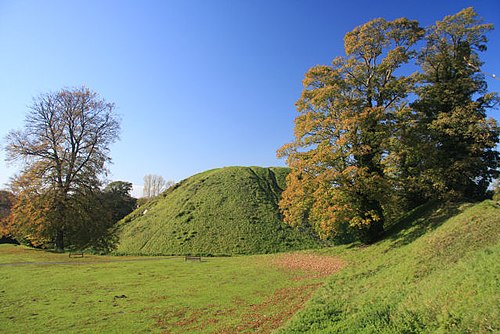
Hereford Castle was a medieval motte-and-bailey and later stone royal castle located in the eastern quarter of the city of Hereford beside the River Wye. Founded before 1052, it saw repeated sieges in the medieval period and was largely dismantled in the 1650s; its former bailey survives as the public open space known as Castle Green.
Its prime
1520
Today
Demolished
As it stood in 1520
What Hereford Castle looked like in its prime.
In its prime the castle occupied a commanding motte (earthen mound) with an adjoining wide bailey that is today Castle Green, set in the east of Hereford with the River Wye to the south. By the early 16th century it was a large, stone-built royal fortress with extensive curtain walls and defensive earthworks enclosing a broad interior court; the whole complex rose above the townroofline and presented a continuous fortified silhouette.
Its story
The story of Hereford Castle.
Earl Ralph's Castle and the Welsh Sack, 1046–1075
Ralph, son of the Count of Vexin, was made Earl of Hereford around 1046 and chose to build a castle within the town's defences rather than repair them, guarding against the Welsh attacks Herefordshire was subject to through the eleventh century. Its foundation date is uncertain but it was standing by 1052, making it one of the earliest castles in England. In 1055 a Welsh and Irish force sacked the town: Earl Ralph raised an army to meet them at Hereford, but the Anglo-Saxon Chronicle records that before a spear was thrown the English fled "because they were on horses," and the attackers killed some four to five hundred men before burning the town and plundering the minster Bishop Athelstan had built. Harold Godwinson repaired the town's defences the following year, though the Chronicle says nothing of the castle's fate. It was back in use by 1067, when Eadric the Wild harassed its garrison under William FitzOsbern, made Earl of Hereford after the Conquest and thought to have rebuilt it. FitzOsbern died in 1071 and his son Roger inherited the castle, but forfeited it after joining an unsuccessful attempt to depose William.
Two Sieges in the Anarchy, 1138–1140
During the civil war between Stephen and Matilda the castle changed hands three times by force. In April 1138 Geoffrey Talbot seized it from Stephen's supporters, and Stephen besieged it until it surrendered later that year. In 1140 Talbot and Miles of Gloucester took it back from the king's garrison, digging into the graveyard of the Church of St Guthlac to raise their siege works; the Gesta Stephani recorded townsfolk lamenting as the half-rotten and freshly buried dead of their own families were dragged up to build the rampart. With catapults trained on the castle from two directions, the garrison surrendered again.
Royal Castle: Henry II to Owain Glyndŵr, 1154–1411
In 1154 Henry II granted the motte to Roger of Gloucester, but a rebellion followed and Henry retook it; the castle stayed in royal hands for the rest of its working life. King John gave Walter de Lacy custody as sheriff of Herefordshire in 1216, and the following year the castle was strengthened against renewed Welsh attack. Between 1264 and 1267 it served as headquarters for Simon de Montfort's baronial party in the Second Barons' War, and between 1400 and 1411 Henry IV based himself there while campaigning against Owain Glyndŵr.
Leland's Description and the Civil War Demolition, Early 16th Century–1650s
Writing in the early sixteenth century, the antiquary John Leland described Hereford's castle as once "nearly as large as that of Windsor" and "one of the fairest and strongest in all England." It did not survive as such: though Herefordshire was a Royalist stronghold in the Civil War and the city itself changed hands several times, withstanding an unsuccessful Scottish siege in 1645, the castle does not appear to have played a significant part in the fighting. It was sold to Sir Richard Harley and several friends, and most of what remained seems to have been pulled down in the 1650s, its stone taken for other buildings in the city.
Castle Green, 1752 to the Present
The bailey was leased to the Society of Tempers in 1752 and laid out as the public Castle Green it remains today; a monument to Lord Nelson was raised at its centre in 1809. The county council took a 200-year lease on the ground in 1833 and still maintains it as a recreation area. The site has been a scheduled monument since 1960.
Step inside
5 places to explore in 1520.
The record describes 5 distinct spots at Hereford Castle, including the full exterior approach. Create your own photoreal reconstruction and explore every one, more scenes means more rooms, more angles, and more of the place to stand in.
Build Your Own Castle
Recreate Hereford Castle with AI to explore it.
The artist rebuilds it as it stood in 1520, a photoreal reconstruction that belongs to you alone. Pay with coins, no subscription needed.
Recreate this castle →Defend this castle →Nearby