England · Still standing
Kimbolton Castle
Kimbolton Castle is a former medieval castle in Kimbolton, Cambridgeshire, later transformed into a stately country house and the seat of the Montagu (Earls and Dukes of Manchester) family. Substantial rebuilding and refronting took place in the late 17th and early 18th centuries; a gatehouse was added in 1766. The building now serves as Kimbolton School and stands as a largely intact ashlar stone country house remembering its castle origins.
First raised
1200
Its prime
1766
Today
Still standing
As it stood in 1766
What Kimbolton Castle looked like in its prime.
A long rectangular ashlar stone block in a pale oolite, three storeys high with a regular rhythm of tall sash windows and smaller basement openings; the central bay is emphasised by a large arched carriage entrance with a heavy timber door. Low square projecting end towers rise only one storey above the main cornice and the whole roofline is masked by a crenellated parapet. The principal façade faces onto a broad level lawn; the building reads as a converted medieval castle refronted into a classical country house.
Its story
The story of Kimbolton Castle.
Fitz Peter's Castle, Recast by the Wingfields
Geoffrey Fitz Peter, 1st Earl of Essex, built the castle at Kimbolton in the late 12th century, and Anne, Duchess of Buckingham, rebuilt its inner court in the late 15th. Sir Richard Wingfield acquired it in 1522 and died three years later, leaving it to his eldest son Charles; the Wingfields reconstructed the medieval castle as a Tudor manor house, parts of which survive.
Catherine of Aragon's Last Years, 1534-1536
In April 1534 Catherine of Aragon was sent to Kimbolton for refusing to give up her status or to deny that her marriage to Henry VIII was valid. It was imprisonment, and hard to disguise as anything else: in July that year a fool in the retinue of the diplomat Eustache Chapuys tried to swim the moat, drawing attention to her confinement. The fenland climate damaged her health, and she died in the castle on 7 January 1536. Kimbolton was the final home of the king's first wife.
The Montagus at Kimbolton, 1615-1951
Sir John Popham bought the castle in 1600, and in 1615 it was purchased by Sir Henry Montagu, later created 1st Earl of Manchester; it remained the seat of the Earls and Dukes of Manchester until 1950. Charles Montagu, 4th Earl and from 1719 1st Duke, had extensive reconstruction carried out between 1690 and 1720. The south wing, which had fallen down, was rebuilt to a design by Sir John Vanbrugh, assisted by Nicholas Hawksmoor; the courtyard was remodelled in 1690-95 in work attributed on stylistic grounds to Henry Bell, who refronted the Tudor courtyard and introduced the galleries and the main staircase. George Montagu, 4th Duke, commissioned Robert Adam to design the gatehouse, built in 1766.
Warren House, where the estate's rabbit warrener lived, was turned into a folly in the late 18th century at the command of one of the castle's inhabitants, given a single decorative façade facing the castle to add interest to his horizon. Alexander Montagu, 10th Duke of Manchester, sold the contents in 1949, and in 1951 the castle and 50 acres were sold to Kimbolton School.
Step inside
9 places to explore in 1766.
The record describes 9 distinct spots at Kimbolton Castle, including 4 interiors: main staircase and first-floor galleries, south chapel (memorial monuments), north chapel and more. Create your own photoreal reconstruction and explore every one, more scenes means more rooms, more angles, and more of the place to stand in.
Build Your Own Castle
Recreate Kimbolton Castle with AI to explore it.
The artist rebuilds it as it stood in 1766, a photoreal reconstruction that belongs to you alone. Pay with coins, no subscription needed.
Recreate this castle →Defend this castle →Whose castle
Clans who held Kimbolton Castle.
The families that held Kimbolton Castle for a decade or more across its history, follow a name to its clan.
Wingfield
Acquired by Sir Richard Wingfield in 1522; the family recast the medieval castle as a Tudor manor house and held it until its sale to Sir John Popham in 1600.
Popham
Bought by Sir John Popham in 1600 and held until Sir Henry Montagu's purchase in 1615.
Montagu
Family seat of the Montagus, Earls and Dukes of Manchester, from 1615 until 1950, when the 10th Duke sold up and the castle passed to Kimbolton School.
From the archive
Kimbolton Castle on paper: the measured plan and period views.
The survey plan and photographs below are the ground truth this page's reconstructions are checked against, drawn and photographed while the castle was still a working garrison. Every image is public-domain or openly licensed, with its source named.
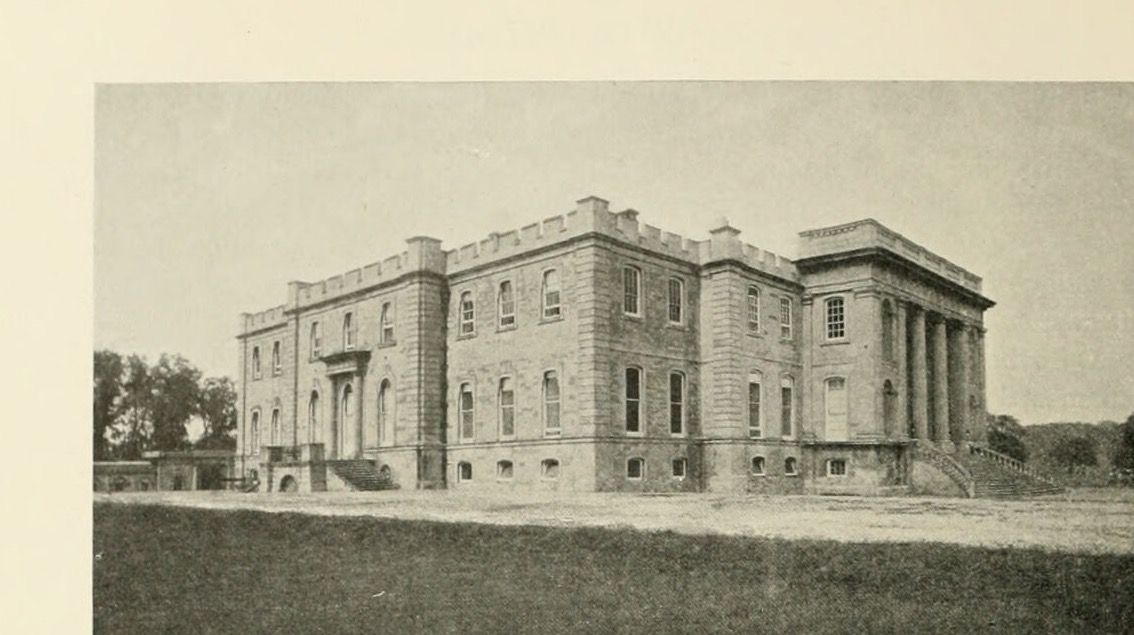
KIMBOLTON
1897 · J. D. Mackenzie, The Castles of England, vol. 1 (1897)
Public domain
Nearby