England · Still standing
Powderham Castle
Powderham Castle is a fortified manor house on the west bank of the River Exe estuary in Exminster, Devon, and the ancestral seat of the Courtenay family, Earls of Devon. The fabric began after 1390 and was extensively altered and extended in the 18th and 19th centuries; it is a Grade I listed building and sits within registered parkland.
Its prime
1860
Today
Still standing
As it stood in 1860
What Powderham Castle looked like in its prime.
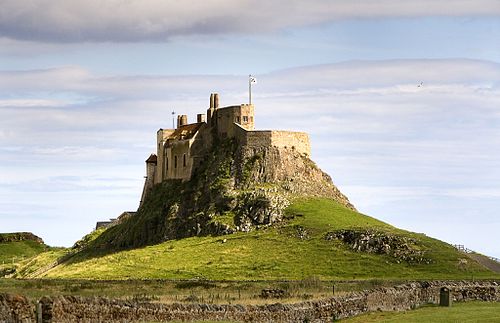
A low-lying castellated complex of grey local stone set on flat parkland beside the Exe estuary. The west front presents crenellated curtain walls and a mid-19th-century gatehouse, with a taller rectangular medieval tower rising behind; a lighter-coloured Victorian dining-hall projection with three pointed Gothic windows sits to the north. A tall flagpole often flies a yellow Courtenay flag. Surrounding the house are lawns, specimen trees, and to the east a former curtain-wall line now occupied by the rose garden.
Its story
The story of Powderham Castle.
Sir Philip Courtenay Builds on the Reclaimed Marsh
The name comes from the ancient Dutch word polder: Powderham means the hamlet of the reclaimed marsh-land, and the house sits on flat ground on the west bank of the Exe estuary where the River Kenn runs into it, six miles south of Exeter. At some point after 1390 Sir Philip Courtenay (d. 1406), fifth or sixth son of the 2nd Earl of Devon (d. 1377), raised the medieval core of the present building there: a thickly walled, double-height rectangular block that ran north to south through withdrawing room, great hall, screens passage and kitchens.
What he built was a fortified manor house rather than a castle proper, with neither keep nor moat, though a curtain wall enclosed a yard on the east side, ground now under the rose garden, and Leland mentioned a barbican or bulwark there. Buck's engraving of 1745 still showed the walled yard. The word castle was probably attached to the place no earlier than the 17th century, and many of the castle-like elements on the west front were added in the 19th.
Besieged Two Months in 1455
The Earls of Devon were seated at Tiverton Castle, and the Powderham cousins ran on beside them as county gentry, not always amicably. In the Wars of the Roses the Tiverton earls' enemies were the Bonvilles of Shute, and Sir William Courtenay of Powderham (d. 1485) married Margaret Bonville, daughter of the 1st Baron Bonville (1392–1461), a match that confirmed Powderham as a Bonville stronghold against his own kin.
On 3 November 1455 the 5th Earl of Devon (1414–1458) seized Exeter and its castle at the head of a private army of a thousand men, then laid siege to Powderham for two months. Lord Bonville came to raise the siege from the east, crossing the Exe, and was driven back by the earl's forces. The quarrel was settled in the field on 15 December 1455 at the First Battle of Clyst Heath, where Bonville was defeated and after which the earl sacked and pillaged Shute.
Colonel Hammond Takes the House, January 1646
In the Civil War Powderham held a Royalist garrison of 300 men under Sir Hugh Meredith. A Parliamentarian detachment under Sir Thomas Fairfax tried to take it in December 1645 and at first failed; it fell on 25 January 1646 to Colonel Robert Hammond. The assault left the house badly damaged, and parts of it stood open to the elements until the early 1700s, when Sir William Courtenay, 2nd Baronet (d. 1735), repaired it.
Dividing the Great Hall, 1755–1860
The medieval great hall was cut in two by an internal wall in the early 18th century. Its lower, southern half became the Marble Hall, completed in 1755 and named for its black and white marble floor, with a ceiling inserted to make bedrooms above and the staircase driven into the upper part of the northern half. The timber screen that closed the north side of the screens passage went at the same time. Outside, the barbican and bulwark were cleared away by landscaping designed to give the lower rooms an uninterrupted view down to the estuary.
The Victorians put the castle look back on. The gatehouse went up between 1845 and 1847 to a design by Charles Fowler, who also designed the Victorian dining hall. The 10th Earl of Devon (d. 1859) built that hall from 1847 until his death, and his son completed the internal decoration in 1860 with linen-fold panelling carrying several dozen ancestral shields and a heraldic chimneypiece in memory of his grandfather Reginald Courtenay (1741–1803), Bishop of Exeter. It copies the medieval chimneypiece installed at the Bishop's Palace in Exeter about 1485 by Peter Courtenay (d. 1492), also Bishop of Exeter and a younger son of the Powderham line.
De Jure Earls from 1556, Confirmed in Law in 1831
When the senior Courtenay line of Tiverton was extinguished in 1556 the Powderham branch became de jure Earls of Devon, and de facto earls only from 1831, when the title was confirmed to them in law. They had gained the right to sit in the House of Lords well before that, on being created Viscounts in 1762, and through the long interval they were actively engaged in the local administration of Devon as justices of the peace, sheriffs and members of parliament, arguably its leading and most prestigious gentry family.
The Courtenays hold Powderham still. On 3 December 2008 the earl auctioned the Courtenay Compendium, a 14th-century manuscript discovered at the house, and on 29 September 2009 sold further contents at Sotheby's in London for £1,013,638, used to pay off debts; he then handed control of the estate to his son Charles, the present Earl of Devon. The house has been a Grade I listed building since 1952.
Step inside
11 places to explore in 1860.
The record describes 11 distinct spots at Powderham Castle, including 5 interiors: marble hall (interior), staircase hall (interior), victorian dining hall (interior) and more. Create your own photoreal reconstruction and explore every one, more scenes means more rooms, more angles, and more of the place to stand in.
Build Your Own Castle
Recreate Powderham Castle with AI to explore it.
The artist rebuilds it as it stood in 1860, a photoreal reconstruction that belongs to you alone. Pay with coins, no subscription needed.
Recreate this castle →Defend this castle →Whose castle
Clans who held Powderham Castle.
The families that held Powderham Castle for a decade or more across its history, follow a name to its clan.
Courtenay
Seat of the Courtenay family, Earls of Devon, since the 14th century, held to this day.
Bonville
A Bonville stronghold by marriage in the 15th century, besieged by the Earl of Devon in 1455.
Nearby