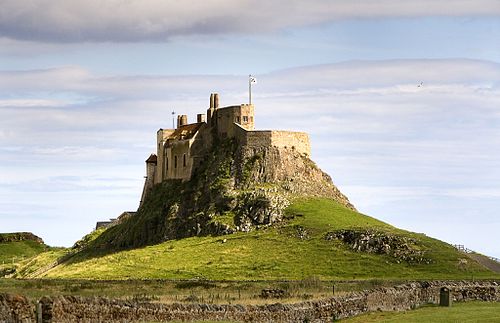
England · Partial ruin
Rochester Castle
Rochester Castle is a medieval stone fortress on the east bank of the River Medway in Rochester, Kent. Its dominant feature is the large 12th-century rectangular keep built for the Archbishop of Canterbury; surrounding curtain walls and ruined ranges enclose the inner ward. The site saw major sieges in the 13th century and later fell into partial ruin before being conserved and opened as a public park.
First raised
1087
Its prime
1141
Today
Partial ruin
Ranked among Europe’s castles
As it stood in 1141
What Rochester Castle looked like in its prime.
A massive rectangular 12th-century stone keep of roughly coursed local ragstone rises above lower curtain walls and ruined ranges; the keep has narrow slit and arched windows, vertical-faced walls and a crenellated parapet. Curtain walls of similar stone connect to fragmentary domestic ranges with arched openings. The castle stands beside the River Medway and the town, set on a raised ward with visible ditches and an open grassy forecourt leading up to the base of the keep.
Its story
The story of Rochester Castle.
Bishop Odo's Rebellion and the Siege of 1088
The first castle at Rochester went up after the Norman Conquest. The Domesday Book of 1086 shows the Bishop of Rochester given land at Aylesford worth 17s 4d in compensation for the site, of the 48 castles named in the survey, the only one whose displaced owners were reimbursed.
William the Conqueror probably gave city and castle to his half-brother Odo, Bishop of Bayeux. On William's death in September 1087 Odo declared for Robert Curthose against William Rufus and made Rochester a headquarters of the rebellion. Rufus seized Pevensey first and made the captured bishop swear Rochester would be handed over; the garrison answered the summons by sallying out and taking the whole party prisoner. The siege began in May 1088, two siege-castles cutting the city's supply lines. Odo and his fellow rebels capitulated on terms, marching out with weapons and horses but forfeiting their English estates, and the first castle was probably abandoned soon after.
Rochester's castle-guard ran to sixty knights' fees, a mark of how important the fortification was reckoned. Odo's position in Kent made it a base from which to raid London and harry Rufus's forces in the county, and the siege that answered it was a hard one: Orderic Vitalis records disease running through the packed city, made worse by heat and flies. When terms were finally agreed, Odo marched out with Eustace, Count of Boulogne, and Robert of Bellême, son of the Earl of Shrewsbury. The two siege-castles were abandoned with the siege and have since vanished from the ground.
Gundulf's Bargain and the Keep of William de Corbeil
The replacement, raised on the present site between 1087 and 1089, came out of a bargain. Rufus wanted £100 to reconfirm the grant of Haddenham manor, held by Rochester's monks; Henry, Earl of Warwick brokered a swap by which Gundulf, Bishop of Rochester, built the king a castle instead, at a cost to Gundulf of £60. Gundulf, who had supervised the White Tower, fixed the castle's extent and enclosed it in stone on the footings of the Roman town wall.
In 1127 Henry I granted the castle in perpetuity to William de Corbeil, Archbishop of Canterbury, with leave to build "a fortification or tower within the castle and keep and hold it forever". Corbeil's great tower rose at about 10 feet a year, probably finished before his death in 1138 and certainly by 1141, when Robert, Earl of Gloucester was imprisoned in it during the Anarchy. Upkeep took only small sums until the loss of Normandy in 1204 left King John bracing the south-east against invasion, and £115 went on the ditches and the keep in 1206.
Through the twelfth century the archbishops held Rochester under the king while the crown paid for it, and the Pipe Rolls show the sums were usually small, except in 1172-73, when more than £100 went into the castle as Henry II's sons rose against him. The keep mattered beyond its walls: it was put on the town's seal in the thirteenth century.
Seven Weeks Against King John, 1215
John's crisis had been building for years. A plot to overthrow him was uncovered in 1212, defeat at Bouvines in July 1214 ended his hopes of retaking Normandy, and in May 1215 a group of barons renounced their fealty and took London, Lincoln and Exeter. The king persuaded Stephen Langton, the new Archbishop of Canterbury, to put Rochester in the hands of a royal constable, Reginald de Cornhill, on terms that returned it to the archbishop at Easter 1215, later extended to Easter 1216; Langton was to hold it "in such a way that by it no ill or harm shall come to us or our kingdom". At Runnymede on 19 June the barons renewed their vows of fealty and Magna Carta was sealed, and the Cornhill arrangement was dissolved soon after, giving the castle back to the archbishop. How the rebels then took it is unclear. Ralph of Coggeshall records that the king demanded the castle, that Langton refused him, and that the rebels (fearing the archbishop would give way under pressure) seized it themselves with the consent of Cornhill, who by then had changed sides. Langton left the country that month.
When the First Barons' War broke out the rebels seized the castle from Archbishop Stephen Langton, whom John afterwards called "a notorious traitor to us". Rochester blocked the direct road to rebel-held London, and William d'Aubigny, lord of Belvoir, commanded a garrison the chroniclers put at 95 to 140 knights. Royal troops surprised the city on 11 October, John arrived on 13 October, and Rochester bridge was pulled down to block relief. Contemporaries reckoned it the greatest siege operation England had yet mounted. "Our age has not known a siege so hard pressed nor so strongly resisted," wrote the Barnwell chronicler.
Five siege engines threw stone at the walls day and night. How much they achieved is disputed: the Barnwell chronicler has them smashing a hole through the outer wall, while Roger of Wendover held that they did nothing and the king had to find another way in. John was already preparing one. On 14 October he wrote to Canterbury for the making "by day and night of as many picks as you are able", to be sent to Rochester. A relief force of seven hundred horse left London on 26 October and turned back before it arrived, perhaps on word that the king was riding out to meet it.
Once the outer walls were breached the garrison fell back into the keep, which shrugged off the engines, so John mined beneath its south-east corner and on 25 November ordered forty of the fattest pigs "of the sort least good for eating" to fire the tunnel props. The corner came down; the defenders held the far side of the keep's cross-wall and gave up the ruined half. "For such was the structure of the stronghold," the Barnwell chronicler wrote, "that a very strong wall separated the half that had fallen from the other." To make the provisions last, the garrison put out those least able to fight; some accounts record that the besiegers cut off their hands and feet.
Reduced to eating horseflesh, they surrendered on 30 November. John meant to hang them all, but his captain Savaric de Mauléon warned that royal garrisons would be treated in kind, and only one man was hanged. The man hanged was a crossbowman who had been in the king's service since childhood; the rest were dispersed to royal castles, many of them to Corfe. Louis of France, son of Philip II, had by then been invited by the barons to lead the rebellion and to take the throne if they won. "Afterwards few cared to put their trust in castles," wrote the Barnwell chronicler. The French Prince Louis took the castle in 1216, by means no surviving document records.
Henry III Rebuilds, and Leybourne Holds the Keep in 1264
Rochester came under direct royal control in 1217, badly broken. Around £680 went on repairs by 1237, £530 of it on the keep, whose fallen south-east corner was rebuilt as a cylinder, while a rounded tower 30 feet across filled the breach in the curtain wall. A new ditch cost £300 in 1225–1226, drawn round Boley Hill to deny that ground to an attacker, and Henry III added a chapel, stables, an almonry and a rebuilt gatehouse by 1250.
The repairs ran on for a generation. The hall, buttery and dispensary were mended in 1226, work on the keep lasted from about that year until 1232, and in 1230-31 a stone wall was thrown across the enclosure to divide it in two, of which nothing survives. Henry also built for comfort: £132 on a second chapel beside the royal apartments in 1244, stables and an almonry in 1248, a rebuilt main gatehouse costing over £120 between 1249 and 1250. More than £120 went on the keep again in 1256, and further work followed on the defences later in the decade, as the king's relations with his magnates worsened.
They worsened past mending. Defeat in Wales, famine and a quarrel with the pope brought Henry to promise reform in 1258, and in June a council of fifteen magnates took the government of the country out of his hands; his authority was restored with foreign help in 1261, and Simon de Montfort raised a rebellion.
In 1264 the constable Roger de Leybourne held the castle for Henry III, with John de Warenne, Earl of Surrey, as co-commander of the garrison. Gilbert de Clare marched from Tonbridge and laid siege on 17 April; the garrison fired the suburbs as he came on, and the king's hall inside the castle burned too. Simon de Montfort was twice thrown back from the Medway and crossed on Good Friday, 18 April, behind a fire-ship. The two armies had arranged the attack between them; they entered Rochester that evening and the cathedral was raided in the night. The rebels took the outer enclosure next day and the garrison withdrew into the keep. The engines resumed after Easter Sunday and, as in 1215, made no impression; a mine was reportedly about to be started when, on 26 April, word of a relief force under Henry III and Prince Edward ended it.
The Great Wind of 1362 and Edward III's £2,262, 1275–1381
The keep had held, but everything round it was wrecked and nothing was repaired for a century. In 1275 the constables were found to have stolen stone from the castle for use elsewhere, and in 1281 the constable John of Cobham was given leave to pull down the burnt-out hall and chambers left by the 1264 siege. A survey of 1340 put repairs at about £600; a survey of 1363 put them at £3,333 6s 8d. A "great wind" did further damage in 1362, and by 1369 only the keep, the gatehouses, a hall, a kitchen and a stable still stood.
Between May 1367 and September 1370 Edward III spent £2,262 here, mending stretches of curtain wall and raising two mural towers north-east of the keep. The royal apartments were never rebuilt, and the castle's use tilted from residence towards barracks and administration. Richard II put £500 into the defences as French raids struck England's southern coast during the Hundred Years' War, £350 of it between 1378 and 1383 on a tower guarding the Medway bridge. The castle saw fighting for the last time in 1381, when rebels of the Peasants' Revolt captured and plundered it and freed a prisoner.
Anne of Cleves, the Weldons and the Public Park, 1423–1950
Henry V's widow Catherine of Valois held the castle from 1423 as part of her dower; on her death in 1437 it passed to the clerk of the King's works. On New Year's Day 1540 Henry VIII came in disguise to surprise Anne of Cleves, resting here on her way to Greenwich; she did not know him and spurned his advances, an embarrassment that told against the marriage he annulled six months later. Between 1599 and 1601 stone from Rochester was carried off to build the artillery fort at Upnor.
James I granted the castle to Sir Anthony Weldon in 1610. Weldon declared for Parliament in the Civil War, and the castle saw no fighting even when Royalists took the city in 1648; his allegiance may be why it escaped the slighting that levelled so many others. Walker Weldon pulled down part of the outer wall in the 18th century and sold the material; Dickens, who lived in Rochester, later wrote the ruin into The Pickwick Papers and The Mystery of Edwin Drood. The 7th Earl of Jersey leased it to the Corporation of Rochester in 1870 for a public park, opened in 1872, and the Corporation bought it outright in 1884 for £6,572. It was scheduled as a monument on 13 January 1915 and Grade I listed on 24 October 1950, and the ruins are in the guardianship of English Heritage.
Step inside
8 places to explore in 1141.
The record describes 8 distinct spots at Rochester Castle, including 2 interiors: keep first-floor hall (interior), keep prison chamber. Create your own photoreal reconstruction and explore every one, more scenes means more rooms, more angles, and more of the place to stand in.
Build Your Own Castle
Recreate Rochester Castle with AI to explore it.
The artist rebuilds it as it stood in 1141, a photoreal reconstruction that belongs to you alone. Pay with coins, no subscription needed.
Recreate this castle →Defend this castle →From the archive
Rochester Castle on paper: the measured plan and period views.
The survey plan and photographs below are the ground truth this page's reconstructions are checked against, drawn and photographed while the castle was still a working garrison. Every image is public-domain or openly licensed, with its source named.

Rochester Castle photochrome print
ca. 1890-1900 · Photochrom Prints Collection (via Wikimedia Commons)
Public domain
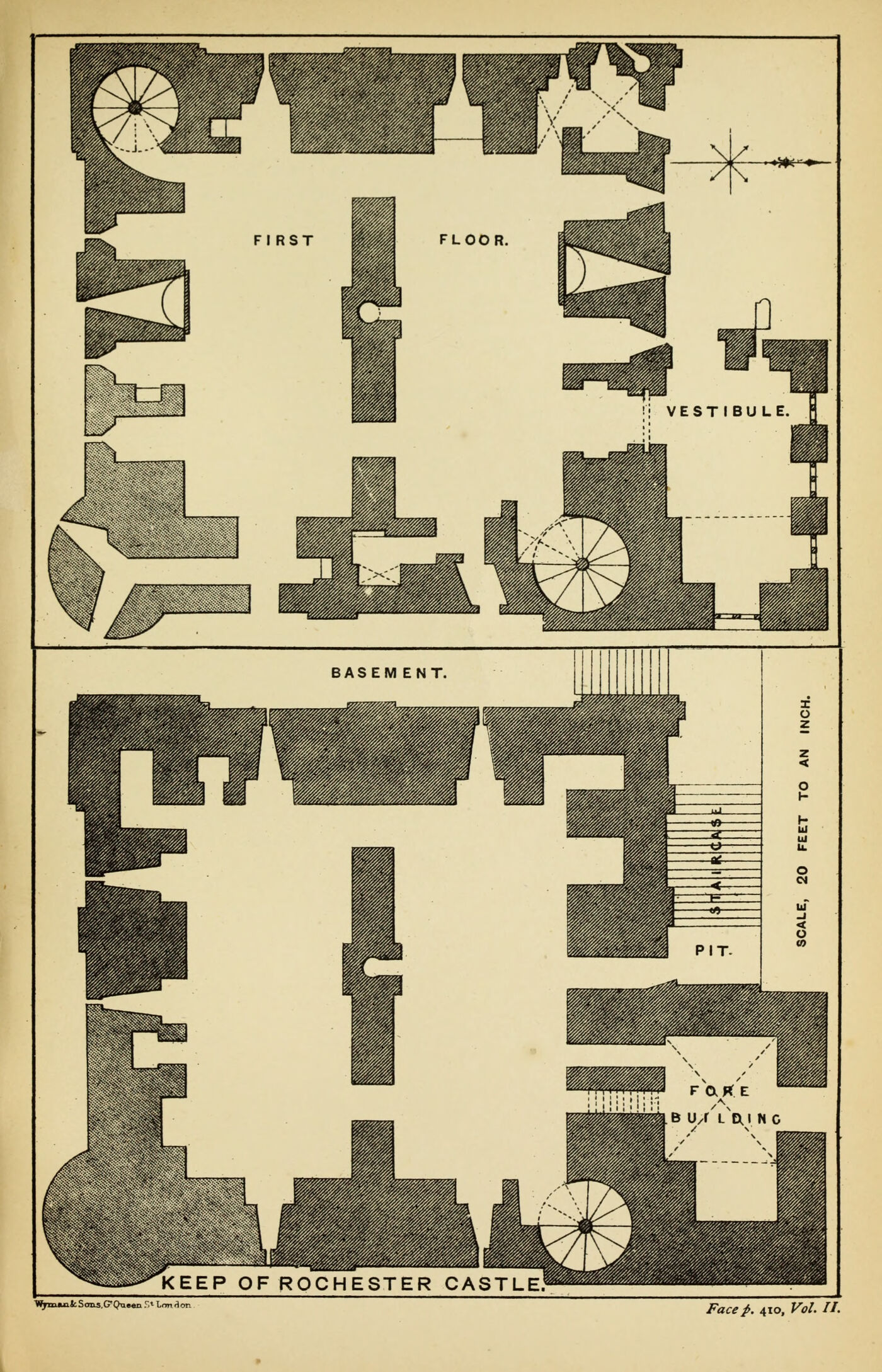
KEEP OF ROCHESTER CASTLE.
1884 · G. T. Clark, Mediaeval Military Architecture, vol. 2 (1884)
Public domain
Nearby