England · Ruin
King Charles's Castle
King Charles's Castle is a 16th-century polygonal artillery fort on Castle Down, Tresco, built to guard New Grimsby harbour. It survives as a ruined granite blockhouse with low, thick walls and adjacent rectangular earthworks and is managed by English Heritage.
Its prime
1551
Today
Ruin
As it stood in 1551
What King Charles's Castle looked like in its prime.
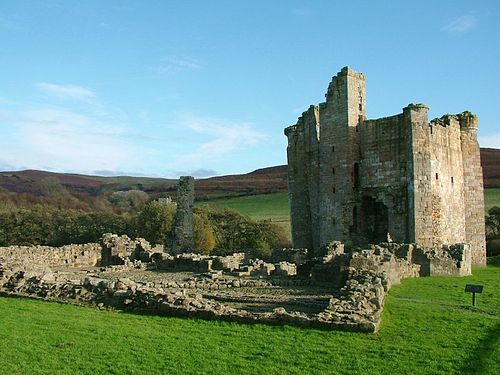
A low, polygonal granite blockhouse set on grassy Castle Down, its front formed as a broad gun battery with five embrasures looking seaward and a large central arched opening; the rear contains rectangular living rooms with doorway and window openings. Walls are of dressed and rubble granite, in places incorporating the underlying rock; surviving wall heights are uneven with collapsed upper sections and scattered fallen blocks. A rectangular earthen bank with a bastion and shallow ditch runs northeast from the building.
Its story
The story of King Charles's Castle.
The Building of Tresco's Fort, 1547–1558
When the nine-year-old Edward VI inherited the throne in 1547, England faced renewed war with France. The Lord Protector, Edward Seymour, made his brother Thomas Lord High Admiral, and Thomas inspected the Isles of Scilly himself and judged them open to a French invasion. Sir Francis Flemming, Lieutenant-General of the Ordnance, was set to improving the island defences. The work began on Tresco under John Killigrew, captain of Pendennis Castle at Falmouth, who also wanted the programme to enlarge his own standing on the island.
King Charles's Castle went up between 1548 and 1551 on the high ground of Castle Down, above the narrow northern entrance to New Grimsby harbour, to hold a battery of guns and its garrison: five embrasures facing the sea, with a hall, kitchen and two bedrooms behind. The plan appears somewhat backward-looking; its closest parallels are the blockhouses Henry VIII built along the Thames, while Harry's Walls, raised nearby at the same time, used bastions. At least 540 oak trees were shipped from South Wales in early 1550, the islands having no fit timber of their own; bows, arrows and the ingredients of gunpowder followed in 1551, and teams worked through 1552 until the Crown, its resources stretched, cut off further spending at the end of that year. Mary I meant to keep 150 soldiers in the Scillies, though whether that number was ever reached is uncertain; by 1558 Killigrew was styled "captain in the Castell of Tresco".
Guns That Could Not Fire Downwards, 1554–1594
The castle stood 40 metres above the sea, and its guns could reach ships in the harbour only by being angled downwards, a position 16th-century artillery could not fire from, the ball rolling out of the muzzle. By 1554 a small blockhouse had been built below it, on the future site of Cromwell's Castle just above the water, to compensate. Francis Godolphin, who rented Tresco from the Crown, complained at the end of the century that the castle "neither discovereth the whole harbour so through the iminent height thereof can make no good shot so steep downwards". The Star Castle, built on St Mary's between 1593 and 1594 to a more modern and better-sited design, rapidly became the key defensive work in the Scillies.
Blake's Landing and the Slighting of April 1651
The Scillies supported Charles I through the Civil War and, after a short spell in Parliamentary hands, declared for the king again in 1648. The Royalists on Tresco seem to have taken the castle for a critical point in the island's defence and probably threw up the rectangular earthwork around it, with a bastion and demi-bastion at its corners, against attack from the land; the earthwork may instead date from about 1627 and the king's engineer Bernard Johnson. The castle acquired its present name in these years.
Tresco became a base for Royalist privateers, and Parliament grew anxious that the Dutch, then hostile to England, might answer the piracy by occupying the islands. In 1651 Parliament sent Sir Robert Blake with a naval task force. He reached St Helen's Pool in April, took Old Grimsby harbour in an amphibious assault on 18 April, then bypassed the castle altogether and marched south, using Tresco as the stepping stone to St Mary's. The Royalist commander William Edgecumbe withdrew on 19 April and his men blew up part of the castle as they went, leaving the remains to Colonel George Fleetwood. Some of its stone appears to have been reused in the Parliamentarians' new Cromwell's Castle below, set in a far better position to defend the harbour.
From Sherburne's Report to English Heritage, 1660–1992
Charles II's restoration in 1660 brought Edward Sherburne to the Scillies to inspect the defences; he recommended repairs to King Charles's Castle, which was then housing soldiers. The Crown leased the islands through the Duchy of Cornwall to the Godolphin family in 1687 and to Augustus Smith in 1834. The antiquary William Borlase, visiting the ruin in 1752, called it a "work of labour and expense, rather than of skill" and put its abandonment down to its poor military use. John Troutbeck, at the end of the century, praised the walls but made the same complaint about the guns.
In 1922 the lease passed to Arthur Dorrien-Smith, who agreed to place several Tresco properties, the castle among them, in the guardianship of the Ministry of Works. Excavation in 1954 turned up coins, pottery and a buckle, and part of the battery's first floor was rebuilt from fallen stone. English Heritage, the Ministry's successor, controls the site and opens it to visitors; it is protected as a scheduled monument and has been Grade II* listed since 1992.
Step inside
9 places to explore in 1551.
The record describes 9 distinct spots at King Charles's Castle, including 5 interiors: inside the gun battery (interior), hall and kitchen (rear large room), north bedroom off the hall (interior) and more. Create your own photoreal reconstruction and explore every one, more scenes means more rooms, more angles, and more of the place to stand in.
Build Your Own Castle
Recreate King Charles's Castle with AI to explore it.
The artist rebuilds it as it stood in 1551, a photoreal reconstruction that belongs to you alone. Pay with coins, no subscription needed.
Recreate this castle →Defend this castle →Whose castle
Clans who held King Charles's Castle.
The families that held King Charles's Castle for a decade or more across its history, follow a name to its clan.
Godolphin
Held the Isles of Scilly, with the castle, on lease from the Duchy of Cornwall from 1687 to 1834.
Augustus Smith took the lease of the islands in 1834; in 1922 it passed to Arthur Dorrien-Smith, who put the castle into the guardianship of the Ministry of Works.