England · Partial ruin
Liddel Strength
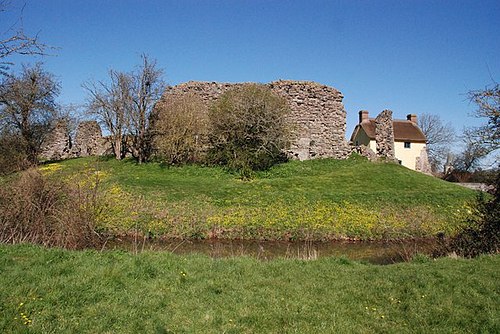
Liddel Strength is the earthwork remains of an Anglo‑Norman motte‑and‑bailey fortification on the south bank of the Liddel Water near its confluence with the River Esk. It was a timber stronghold recorded in the 13th–14th centuries and was attacked and destroyed in 1346. The surviving site today consists of a large motte, inner and outer bailey banks and ditches on a cliff above the rivers.
Its prime
1300
Today
Partial ruin
As it stood in 1300
What Liddel Strength looked like in its prime.
A compact wooden motte‑and‑bailey castle set on a grassy cliff above the meeting of two rivers: a raised circular motte about 8 m above the surrounding ditch backing onto a 150 ft drop to the river, with a semi‑circular inner bailey and an attached outer bailey defined by earthen banks and ditches. Defences at its height were timber palisades and simple timber buildings, a long timber hall with two attached solars, outbuildings and storage, set on beaten‑earth yards.
Its story
The story of Liddel Strength.
Liddel Strength was the seat of the barony of Liddel, an Anglo-Norman border fortification on a cliff above the south bank of the Liddel Water, overlooking its confluence with the River Esk, the last high ground before the Esk reaches the Solway Plain. The barony is thought to have been created by Ranulf le Meschin, 3rd Earl of Chester, in or before the first decade of the 12th century, and given to Turgis Brandos, descending through his son to the de Rossedale line.
The Stutevilles were later Barons of Liddel, though their principal seat lay at Cottingham in Yorkshire, where they entertained King John in 1200. In 1174, while besieging Carlisle, William the Lion took "the castle of Liddell, which belonged to Nicholas de Estuteville"; a Stuteville was in the party of knights that captured William at Alnwick later that year. At his death in 1300, John Wake held both Liddel and the Scottish barony of Liddesdale.
A wooden motte-and-bailey to the end, the Strength was destroyed by the Scots in 1346; fragmentary remains of a pele tower later built on the site survive among the earthworks. A 19th-century theory of William Forbes Skene made neighbouring Carwinley a corruption of Caer Wenddolau, fort of the Celtic ruler Gwenddoleu, killed at the Battle of Arfderydd in 573, an identification dismissed at a 1926 meeting of the local antiquarian society.
Step inside
10 places to explore in 1300.
The record describes 10 distinct spots at Liddel Strength, including 4 interiors: timber hall interior, solar chamber, cellars and storage areas and more. Create your own photoreal reconstruction and explore every one, more scenes means more rooms, more angles, and more of the place to stand in.
Build Your Own Castle
Recreate Liddel Strength with AI to explore it.
The artist rebuilds it as it stood in 1300, a photoreal reconstruction that belongs to you alone. Pay with coins, no subscription needed.
Recreate this castle →Defend this castle →Whose castle
Clans who held Liddel Strength.
The families that held Liddel Strength for a decade or more across its history, follow a name to its clan.
Stuteville
Held by the de Stuteville Barons of Liddel; William the Lion took the castle from Nicholas de Estuteville in 1174.