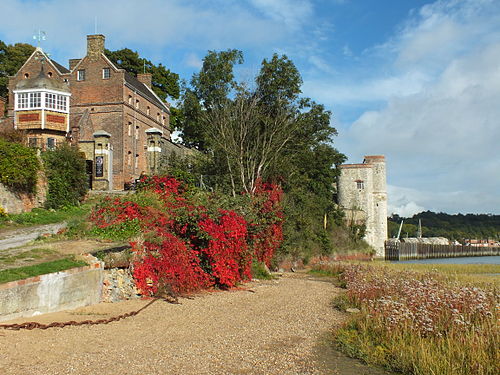
England · Ruin
Norham Castle
Norham Castle is a medieval border castle on the south bank of the River Tweed in Norham, Northumberland. Founded in the early 12th century, it was repeatedly besieged during Anglo-Scottish wars and was later allowed to fall into ruin; it is now cared for by English Heritage and open to visitors.
First raised
1121
Its prime
1521
Today
Ruin
As it stood in 1521
What Norham Castle looked like in its prime.
Perched on a raised inner mound above the River Tweed, the castle's profile is dominated by a large rectangular keep to the east of the inner ward and broad curtain walls forming inner and outer wards; multiple gatehouses guard the west and south approaches. The stone is a warm red-brown sandstone; windows are narrow, tall arched slits. At its prime the moat and drawbridges were intact, curtain-walls continuous with crenellated parapets and roofed halls standing within the inner ward.
Its story
The story of Norham Castle.
Flambard's Foundation, 1121-1208
Ranulf Flambard, Bishop of Durham from 1099 to 1128, gave orders in 1121 for a castle to protect the property of the bishopric in north Northumberland from Scottish incursions. David I of Scotland took it in his invasion of 1136; it was handed back to the bishopric, then captured again in 1138, which left its structure substantially damaged. It lay derelict until Hugh de Puiset, bishop from 1153 to 1195, had it rebuilt, work probably directed by the bishop's architect Richard of Wolviston.
Puiset then lost it to his own politics. He backed the rebels against Henry II in 1174, the revolt during which William the Lion of Scotland invaded Northumberland; the rising failed and the bishop had to relinquish Norham to the crown, which garrisoned it under its own constable until 1197, when it passed to his successor Philip of Poitou. On Philip's death in 1208 it reverted to royal control.
Forty Days Against Alexander II, 1209-1296
In 1209 Norham housed both King John and William the Lion, when the Scottish king did homage for his English lands. John kept the defences in good order and the garrison strong between 1208 and 1211, and in 1215 they were tested: Alexander II, William's son, besieged the castle for forty days without success. In 1217 it was restored once more to the bishopric of Durham.
Edward I came more than once: in 1292 John Balliol did homage to him at Norham as King of Scotland, and in 1296, with Edward invading Scotland, his queen Marguerite of France stayed at the castle.
Grey's Command and the Scottish Sieges, 1318-1327
The Scots invaded Northumberland several times in the early fourteenth century, though they did not always attack Norham. Robert the Bruce besieged it for nearly a year in 1318, his army occupying the outer ward for three days before being driven out. The Scots returned in 1319 and the castle withstood a seven-month siege; a further attempt in 1322 came to nothing. Through all three the command was held by Sir Thomas Grey of Heton, taken by the Scots at Bannockburn in 1314 and father to the chronicler of the same name. A Scottish army did capture Norham in 1327, but it was soon restored to Lewis de Beaumont, Bishop of Durham, when peace was declared.
Yorkists, Lancastrians and Flodden, 1462-1513
In 1462 Norham was held by Yorkists on behalf of Edward IV; the following year a Lancastrian army besieged it for eighteen days before Yorkist forces relieved it, and in 1464 those holding it changed sides to the Lancastrians, only to be forced to surrender to a Yorkist force. Bishop Richard Foxe of Durham (1494-1501) strengthened the defences again, and they held in 1497 when James IV of Scotland besieged the castle for a fortnight, artillery working at the walls until an English army relieved the garrison. One of the guns used in the siege was Mons Meg, a 20-inch calibre cannon now at Edinburgh Castle.
James returned in 1513 with a powerful army and artillery, pounding the outer defences for several days until the outer ward was taken; the castle surrendered soon after, most of its outer walls destroyed. Weeks later James was defeated and slain at Flodden, near Branxton, and Norham fell back into English hands.
Ship's Masts and Slow Ruin, from 1515
Wolsey's chaplain William Frankelayn inspected the castle on 29 August 1515 and found it well fortified with "contremurs and murderers". Bishop Thomas Ruthall began restoration that ran until 1521, and the Earl of Surrey viewed the defences in September 1523 during another invasion scare. In 1528 the Earl of Angus, threatened by his step-son James V, sought chambers at Norham for his daughter Margaret Douglas; she was received in October, though the refugee Douglases were kept out of the inner wards.
Brian Layton, Captain of Norham, reviewed its security in October 1542 after rumours that insiders would hand the castle to the Scots; he was killed at Ancrum Moor in February 1545 during the war of the Rough Wooing. Bishop Tunstal repaired it in 1554, but with an extended peace the garrison was reduced and the defences left to deteriorate. In 1574 Lord Hunsdon had the floors of the hall, parlour and kitchen propped up with ship's masts, and in 1596 Elizabeth gave her captain Sir Robert Carey her "resolute answer" that she would spend nothing on Norham.
The castle saw no further fighting. On his accession to the English throne James VI of Scotland granted castle and manor to George Home, 1st Earl of Dunbar, and it was left to fall into ruin - one J. M. W. Turner first painted in 1797 and returned to many times. Norham is a Grade I listed building and a scheduled monument, in the care of English Heritage and open to visitors.
Step inside
10 places to explore in 1521.
The record describes 10 distinct spots at Norham Castle, including 3 interiors: outer ward courtyard, bishop's hall (inner ward, north side), kitchen and service buildings (south-west of the keep). Create your own photoreal reconstruction and explore every one, more scenes means more rooms, more angles, and more of the place to stand in.
Build Your Own Castle
Recreate Norham Castle with AI to explore it.
The artist rebuilds it as it stood in 1521, a photoreal reconstruction that belongs to you alone. Pay with coins, no subscription needed.
Recreate this castle →Defend this castle →From the archive
Norham Castle on paper: the measured plan and period views.
The survey plan and photographs below are the ground truth this page's reconstructions are checked against, drawn and photographed while the castle was still a working garrison. Every image is public-domain or openly licensed, with its source named.
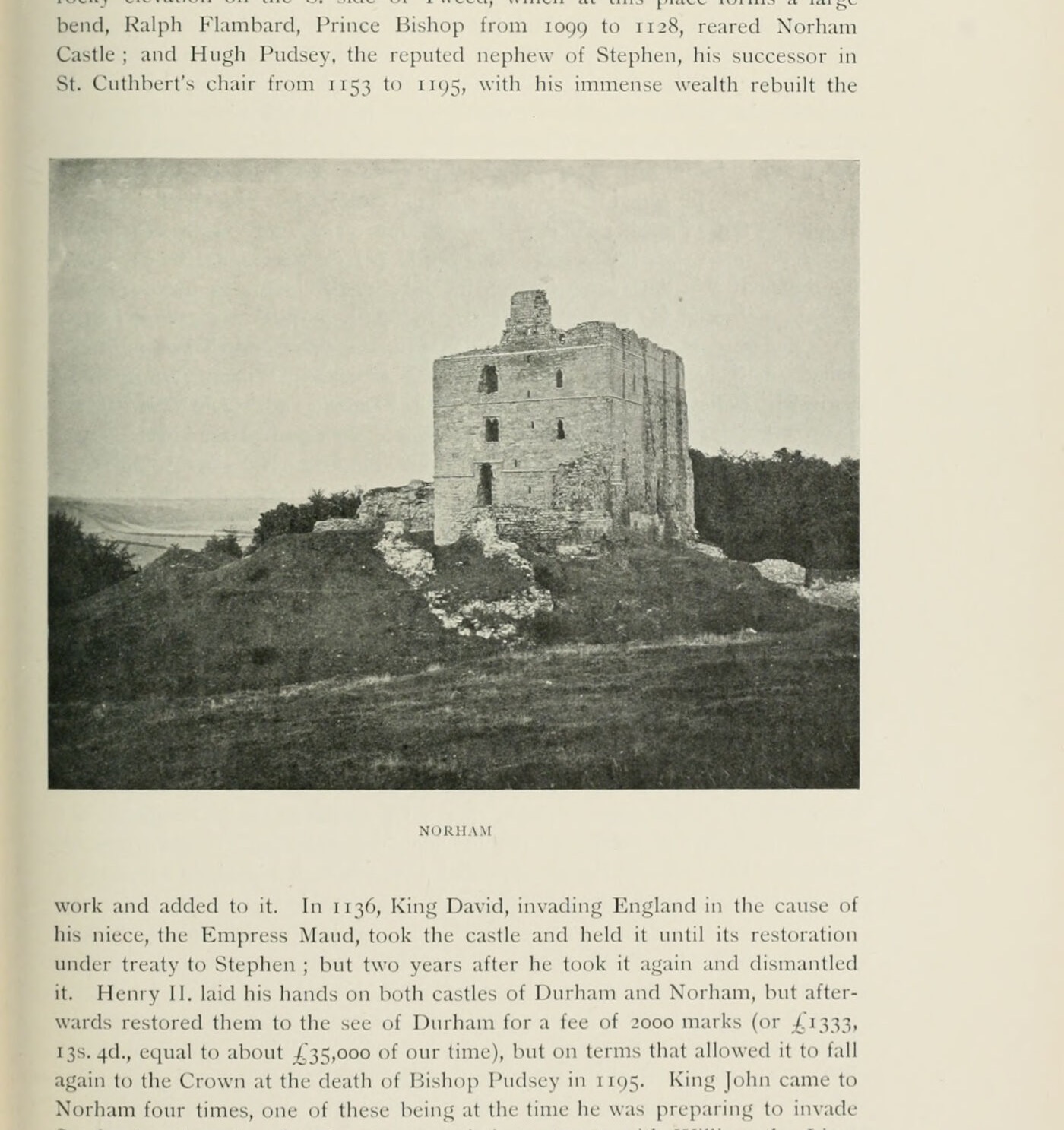
NORHAM
1897 · J. D. Mackenzie, The Castles of England, vol. 2 (1897)
Public domain