England · Partial ruin
Harewood Castle
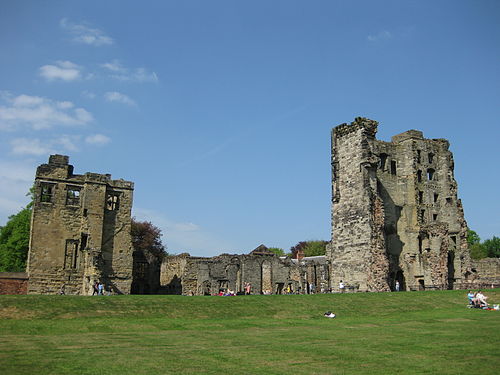
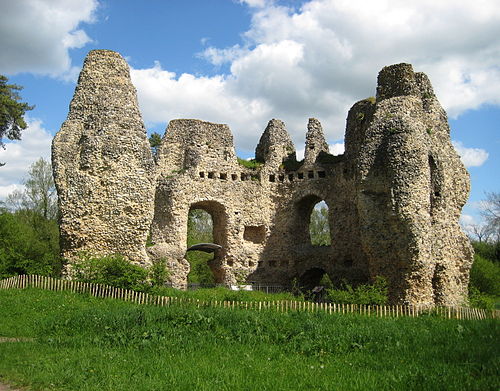
Harewood Castle is a 14th-century rectangular keep and courtyard fortress on the Harewood Estate in West Yorkshire. Laid out as a rectangular tower house with four angle towers, it contains a two-storey main hall, a three-storey accommodation wing and a lower four-storey kitchen wing with a barrel-vaulted basement and well. The castle fell from use in the 17th century and was later stabilised and conserved.
Its prime
1380
Today
Partial ruin
As it stood in 1380
What Harewood Castle looked like in its prime.
A rectangular stone keep set on a steep grassy slope, composed of a main two-storey hall block with an attached three-storey accommodation wing and a lower four-storey kitchen wing; four angle towers anchor the corners and a plain entrance tower with an arched gateway faces the slope. Walls of weathered pale sandstone blocks rise to crenellated parapets; narrow vertical windows punctuate the façades. At its prime the roofs and battlements were complete and the courtyard enclosed.
Its story
The story of Harewood Castle.
The De Lisle Inheritance and the Licence of 1366
The De Lisle family founded a castle at Harewood in the 12th century, and it passed to Sir William de Aldeburgh through his marriage to Elizabeth de Lisle, heiress of Harewood; a licence to crenellate followed in 1366. What stands on the Harewood Estate today is the 14th-century work: a stone hall house and courtyard fortress laid out as a rectangular keep with four angle towers, one of them a plain entrance tower. The chapel sits over the portcullis chamber, and the four-storey kitchen wing has a barrel-vaulted basement containing the well.
Ryther, Redman and the Debts of 1600
When the second Baron Aldeburgh died without issue in 1391, the castle transferred to the Ryther and Redmayne (Redman) families, into which his two daughters had married. The divided lordship lasted until 1574, when James Ryther and his partner William Plompton bought out the Redmans. Ryther's finances must have worsened after that, because he died in London's Fleet Prison in 1595; in 1600 his son and two daughters sold Harewood to Sir William Wentworth of Gawthorpe Hall to clear the debts. That sale is probably the point at which the castle ceased to be a main residence.
An Upstanding Source of Stone and Timber: From Wentworth to Lascelles
Harewood was last occupied in the 1630s, and by 1656 it was on the market as an 'upstanding source of stone and timber', a building valued for what could be carried away from it. The Wentworths sold Harewood and Gawthorpe to Sir John Cutler, 1st Baronet, by which time the castle had probably already been partly dismantled, though Cutler lived there at the end of his life.
At Cutler's death in 1693 the estate went to his only surviving daughter Elizabeth, Countess of Radnor, and on her death without heir to Cutler's nephew, the unmarried Edmund Boulter MP of Boston and Wimpole Hall, then to his nephew John Boulter of Gawthorpe and Westminster, who died unmarried in 1738. Boulter's executors sold to Henry Lascelles (1690–1753), whose son Edwin Lascelles, 1st Baron Harewood, built Harewood House.
Turner's Landmark and the £1 Million Rescue
Centuries after it was abandoned the castle was still a landmark, and J. M. W. Turner painted it several times in 1797. Decay and weathering eventually made the structure unstable, and English Heritage placed it on the Buildings at Risk Register. Around the year 2000 a £1 million rescue plan was drawn up, funded partly through English Heritage and partly by the Harewood Estate; architects, geologists, structural engineers and ecologists worked alongside Historic Property Restoration Ltd and estate staff, and by 2008 the project was nearing completion. The castle came off the Buildings at Risk Register that year. It has been a Grade I listed building since 30 March 1966 and is also a scheduled monument.
Step inside
8 places to explore in 1380.
The record describes 8 distinct spots at Harewood Castle, including 5 interiors: entrance tower and portcullis chamber, chapel over the portcullis chamber, main hall (two-storey) and more. Create your own photoreal reconstruction and explore every one, more scenes means more rooms, more angles, and more of the place to stand in.
Build Your Own Castle
Recreate Harewood Castle with AI to explore it.
The artist rebuilds it as it stood in 1380, a photoreal reconstruction that belongs to you alone. Pay with coins, no subscription needed.
Recreate this castle →Defend this castle →Whose castle
Clans who held Harewood Castle.
The families that held Harewood Castle for a decade or more across its history, follow a name to its clan.
de Lisle
Founded the castle in the 12th century; heiress Elizabeth de Lisle carried Harewood to Sir William de Aldeburgh.
Aldeburgh
Held from Sir William de Aldeburgh's 1366 licence to crenellate until the second Baron died without issue in 1391.
Ryther
Co-heirs from 1391; bought out the Redmans in 1574 and sold the castle in 1600.
Redman
Co-heirs from 1391 until bought out by James Ryther and William Plompton in 1574.
Wentworth
Sir William Wentworth of Gawthorpe Hall bought Harewood in 1600; the Wentworths later sold it to Sir John Cutler.
Lascelles
Bought by Henry Lascelles (1690–1753); his son Edwin, 1st Baron Harewood, built Harewood House on the estate.
Nearby