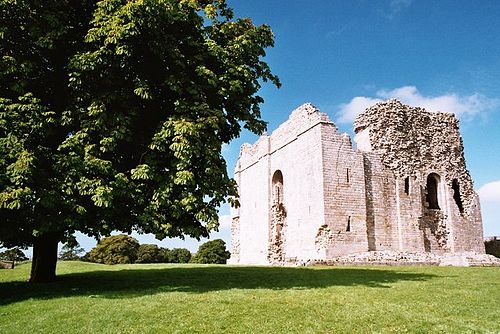
England · Partial ruin
Rufus Castle
Rufus Castle is a largely 15th-century pentagonal keep on the Isle of Portland, Dorset, sited on a rocky pinnacle above Church Ope Cove. The surviving stone keep has very thick Portland-stone walls pierced by circular gunports and corbelled parapets; parts of its foundations are earlier and cliff erosion has removed sections. The site is privately owned with no public access but is visible from coastal footpaths.
Its prime
1460
Today
Partial ruin
As it stood in 1460
What Rufus Castle looked like in its prime.
Pentagonal stone keep of pale Portland ashlar set on a rock pinnacle above Church Ope Cove; roughly squared rubble walls about 2.1 m thick rising directly from the cliff. Three sides are noticeably longer than the others, the north and west faces pierced at first-floor level by circular gun-ports and embrasures, with groups of three stone corbels supporting a projecting parapet. No roof survives; a stepped plinth and earlier foundations are exposed at the west and landward approaches.
Its story
The story of Rufus Castle.
Named for William Rufus, or for the Red Earl
The castle above Church Ope Cove is probably the second to have been built on Portland. In ancient times taxes were raised on the island to construct Portland's first castle for defence against attack. Rufus Castle itself was reportedly built for King William II, although the structure standing in ruins today is not of that date: it dates largely from the late 15th century, which makes it Portland's oldest surviving defensive structure.
Both the names Rufus Castle and Bow and Arrow Castle have been in wide use since the late 18th century. It was originally speculated that Rufus referred to William II, known as William Rufus, though more recent assessments also identify Gilbert de Clare, 7th Earl of Gloucester, the Red Earl, as a possible origin. The landward walls are pierced by numerous medieval gun ports, often mistakenly called arrow loops, and they gave the castle its second name.
Taken from King Stephen in 1142, and the Licences to Crenellate
In 1142 Robert, Earl of Gloucester, captured the castle from King Stephen on behalf of the Empress Maud. Richard de Clare, who owned it at that time, had additional fortifications added in 1238. Around 1256 Aylmer de Lusignan obtained a licence to crenellate the 'insulam de Portand', and Robert, Earl of Gloucester, was granted a similar licence just fourteen months later.
There are no further mentions of this earlier castle, or of where it may have stood, and it is generally presumed that Rufus Castle is the site of any work that resulted from the licences, with any remains of that period surviving only at foundation level or lost to cliff erosion. The pentagonal tower does rest on an earlier foundation to the north and a stepped plinth to the west that may have been a 12th-century keep.
Richard, Duke of York's Rebuilding, and the Shambles Below
The castle was rebuilt between 1432 and 1460 by Richard, Duke of York, and much of what remains today dates from that work. What survives appears to have been the keep of a stronghold whose foundation stood well above the top of the tower of St Andrew's church in the valley below. Built on a pinnacle of rock, it has lost some of the original structure to erosion and collapse over the years.
Roughly three miles out to sea the castle looks over the Shambles sandbank, one of the most feared navigational hazards in the area. It was beyond the Shambles that the Battle of Portland was fought in 1653 between the English navy, led by General at Sea Robert Blake, and the Dutch navy under Lieutenant-Admiral Maarten Tromp. It was there too, in 1805, that the East Indiaman Earl of Abergavenny foundered and eventually sank, killing 263. Among the dead was the ship's captain, John Wordsworth, brother of the Romantic poet William Wordsworth, who wrote the loss into his poem To the Daisy.
John Penn's Folly and the Red King's Castle
Between 1797 and 1800 the politician and writer John Penn built Pennsylvania Castle, a Gothic Revival mansion overlooking Church Ope Cove, on an estate that took in both Rufus Castle and the former parish church of St Andrew. Penn altered the old castle to turn it into a folly, throwing a bridge over the lane leading down to Church Ope and forming two large new openings in its walls: a rounded arch in the north elevation, and a Tudor pointed arch in the south that replaced the original door to the structure.
J. M. W. Turner painted the castle and, in a rare revision, drew the arch twice, giving it rather more prominence in the upper version than it has in reality; that painting is now held by the Victoria Gallery and Museum at the University of Liverpool. Thomas Hardy, who set The Well-Beloved on Portland, put the castle into the novel as 'Red King's Castle', a name he took from William II, also known as William the Red, for whom the castle is thought to have been built.
Collapse, Repair and Protection, 1989–2022
The castle's seaward arch collapsed in 1989, and by the end of the century English Heritage had proposed a restoration to preserve it. Around the middle of 2008 the castle was listed as ruinous and in need of conservation repair and consolidation, and in 2010 it went onto the Heritage at Risk Register. Work began that year under Russ Palmer, a historic building and church architect from Honiton, Devon, who investigated its condition and set out the first stage of recommended repairs, needed most urgently on the north walls. With an English Heritage grant, and after competitive tenders, the work ran from May to October 2010 at a cost of £150,000, consolidating the wall tops and exposed core, grouting voids and repointing, and was finished by that November. Work continued on English Heritage's behalf until 2012 under their scheme of repair and urgent works.
The structure, including its bridge, has been a Grade I listed building since January 1951, one of three buildings on Portland to hold that grade, and it has also become a scheduled monument under the Ancient Monuments and Archaeological Areas Act 1979. It remains privately owned with no public access, though it can be seen well from the public footpaths along the coast. In early 2022 Portland Museum launched a free 3-D virtual tour of the castle, funded by the Art Fund and including a historical tour given by Gordon Le Pard, a retired Dorset county archaeologist.
Step inside
8 places to explore in 1460.
The record describes 8 distinct spots at Rufus Castle, including 1 interior: interior of the pentagonal keep. Create your own photoreal reconstruction and explore every one, more scenes means more rooms, more angles, and more of the place to stand in.
Build Your Own Castle
Recreate Rufus Castle with AI to explore it.
The artist rebuilds it as it stood in 1460, a photoreal reconstruction that belongs to you alone. Pay with coins, no subscription needed.
Recreate this castle →Defend this castle →Whose castle
Clans who held Rufus Castle.
The families that held Rufus Castle for a decade or more across its history, follow a name to its clan.
de Clare
Richard de Clare owned the castle in 1238, when he added further fortifications.
York
Rebuilt between 1432 and 1460 by Richard, Duke of York; much of what remains dates from this time.
Nearby