
England · Restored
Scaleby Castle
Scaleby Castle is a medieval castle in the village of Scaleby, Cumbria, originally founded in the early 14th century and substantially remodelled in the late 15th century. It sits within a large circular, water-filled moat and developed as a fortified manor with a pele tower, curtain walls, a gateway with a polygonal barbican and ranges around a central courtyard. The site is a Grade I listed building and remains a private seat.
Its prime
1490
Today
Restored
As it stood in 1490
What Scaleby Castle looked like in its prime.
Scaleby Castle occupies a roughly circular island set inside a wide, water-filled moat about 7–8 metres across, with an outer bank and surrounding fields; a compact arrangement of stone ranges and a rectangular pele tower rise from the island. The entrance is defended by a pronounced gateway with a polygonal barbican and linked curtain wall. Rooflines are pitched with visible chimneys; a rectangular courtyard sits between the south range and the pele tower.
Its story
The story of Scaleby Castle.
Robert de Tilliol Builds After 1307
The Tilliols were a well-established family in the region from the reign of Henry I onwards, and it was Robert de Tilliol who built Scaleby Castle after 1307, beside the village of Scaleby some six miles from Carlisle. The land for it came to him from Edward I, and the authority to build a castle from Edward II.
What he raised was two sets of buildings linked by a small courtyard and protected on both sides by a curtain wall, the whole ringed by a large circular water-filled moat about 7.4 metres wide. There was an inner moat as well, since largely destroyed.
Colville and Musgrave Rebuilding, 1435–1596
The male Tilliol line died out in 1435 and the castle passed by marriage to the Colville family. They rebuilt much of it in the late 15th century, remodelling the pele tower, the great hall and the gateway, the last given a polygonal barbican. The pele tower made a substantial fortification in its own right, about 40 feet by 30 feet across, of three floors and thick walls.
The Musgrave family acquired the castle afterwards, and Sir Edward Musgrave rebuilt its south range in 1596.
Twice Taken by Parliament, 1645 and 1648
When war broke out in 1641 between the Royalist supporters of Charles I and Parliament, the Sir Edward Musgrave of the day, grandson of the builder of the south range, was a strong Royalist and declared for the king. In February 1645 the Parliamentary forces then besieging Carlisle also laid siege to Scaleby and in time seized it, causing considerable damage. Edward recovered the castle.
At the start of the Second English Civil War in 1648 he again took up arms for the king. This time Scaleby fell to the Parliamentary forces at once, and they set fire to it.
Gilpins, Fawcetts and Baron Henley
Sir Edward was heavily in debt and sold the castle after the war to Richard Gilpin, who restored the property around 1800. It remained in the hands of the Gilpins until it fell into disrepair, and was restored a second time by Rowland Fawcett; the restoration work turned it into a country house. James Fawcett was resident there in 1847.
The castle is today a Grade I listed building, listed since 1957, and a scheduled monument. It is the seat of Oliver Eden, 8th Baron Henley.
Step inside
9 places to explore in 1490.
The record describes 9 distinct spots at Scaleby Castle, including 3 interiors: passage through the gateway, great hall, pele tower interior (first floor). Create your own photoreal reconstruction and explore every one, more scenes means more rooms, more angles, and more of the place to stand in.
Build Your Own Castle
Recreate Scaleby Castle with AI to explore it.
The artist rebuilds it as it stood in 1490, a photoreal reconstruction that belongs to you alone. Pay with coins, no subscription needed.
Recreate this castle →Defend this castle →Whose castle
Clans who held Scaleby Castle.
The families that held Scaleby Castle for a decade or more across its history, follow a name to its clan.
Tilliol
Granted land by Edward I and licence by Edward II in the early 14th century; held until the male line died out in 1435.
Colville
The castle passed to the Colvilles by marriage in 1435.
Musgrave
Acquired the castle and rebuilt the south range in 1596; sold, heavily in debt, after the Civil War.
Gilpin
Bought by Richard Gilpin after the Civil War, who restored the property.
Eden
The present seat of Oliver Eden, 8th Baron Henley.
From the archive
Scaleby Castle on paper: the measured plan and period views.
The survey plan and photographs below are the ground truth this page's reconstructions are checked against, drawn and photographed while the castle was still a working garrison. Every image is public-domain or openly licensed, with its source named.
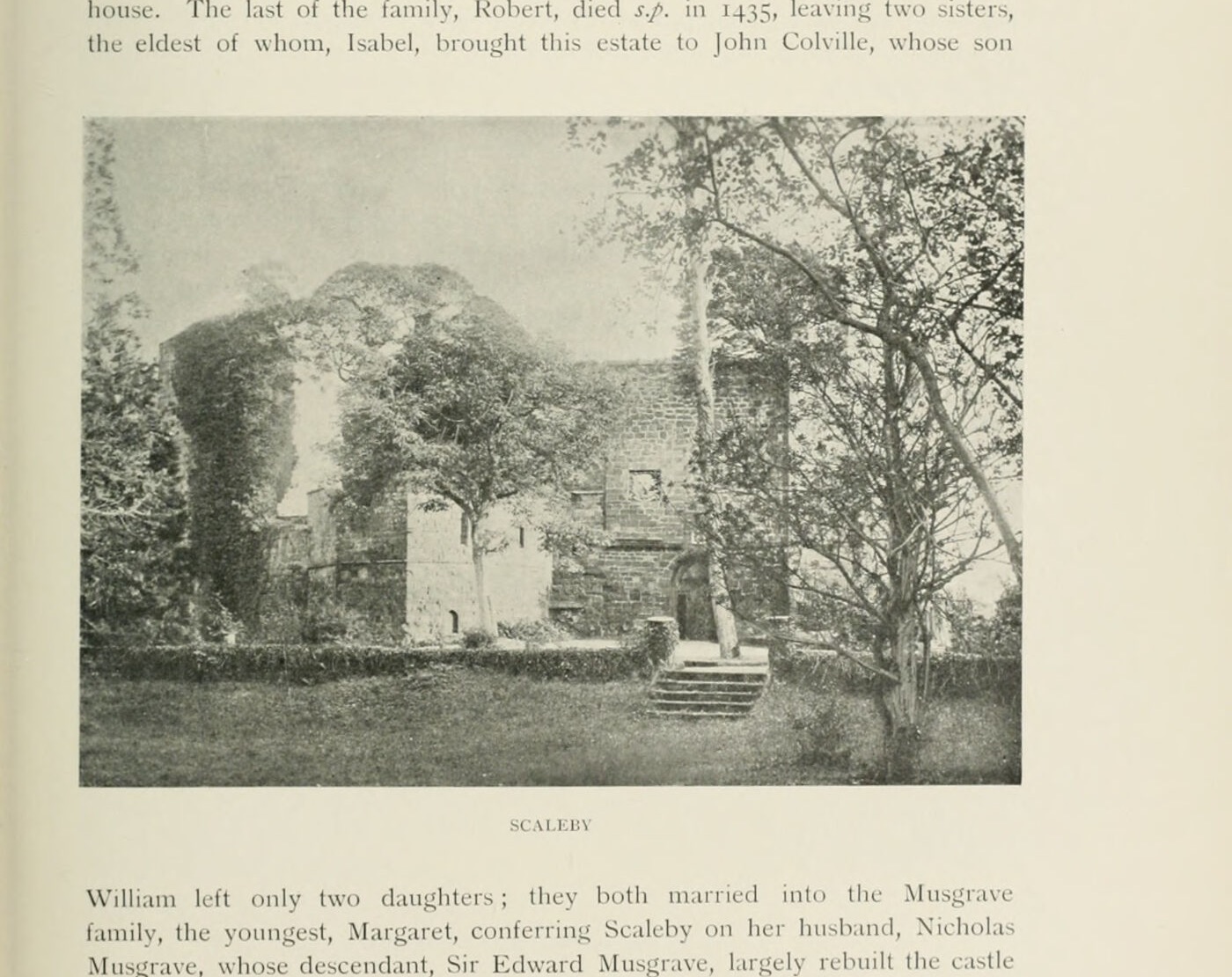
SCALEBY
1897 · J. D. Mackenzie, The Castles of England, vol. 2 (1897)
Public domain
Nearby


