England · Restored
Stokesay Castle
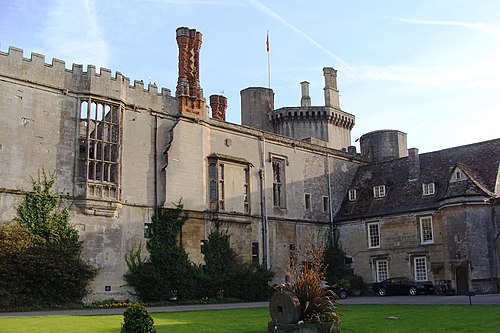
Stokesay Castle is a largely intact fortified medieval manor house at Stokesay, Shropshire, built mainly in the late 13th century for Laurence of Ludlow. It comprises a moated, walled enclosure containing a long stone hall, a projecting timber-framed solar, and two stone towers, and survives as a near-complete set of medieval domestic buildings now cared for by English Heritage.
First raised
1285
Its prime
1290
Today
Restored
As it stood in 1290
What Stokesay Castle looked like in its prime.
A compact moated stone enclosure of honey-coloured sandstone with a low curtain wall and two stout stone towers flanking a long two-storey hall block; a jettied timber-framed solar projects from the wall with diamond-leaded windows and exposed oak framing. Steep stone-tiled rooflines rise behind crenellated parapets and narrow slit windows; the courtyard sits within the enclosure and the site occupies a gentle Shropshire valley beside open fields.
Its story
The story of Stokesay Castle.
Laurence of Ludlow's Wool Fortune, 1281–1294
Stokesay takes its name from the Anglo-Saxon stoches, a cattle farm, and the de Say family, who held the land from the early 12th century under its original owners, the de Lacys, builders of the first Ludlow Castle. When Walter de Lacy died in 1241 his estates were divided among his granddaughters, and Stokesay passed to the de Verduns, who retained feudal overlordship until at least 1317. In 1270 John de Verdun, raising money for the Eighth Crusade, conveyed a tenancy to Philip de Whichecote.
Laurence de Ludlow had become the most important wool merchant in England, exporting from the Welsh Marches, lending money to the major nobility and helping to set government trade policy. In 1281 he bought the tenancy from Whichecote, and through the 1280s and 1290s built the castle largely as it stands: living accommodation and a north tower first, then (shortly after receiving a licence to crenellate from the King in 1291) the martial-looking south tower. Laurence moved in early in the 1290s and drowned at sea off the south of England in November 1294; his son William may have finished the final work. His descendants held Stokesay until the end of the 15th century, when it passed by marriage to the Vernons.
A Castle for Show, Not for Siege
Stokesay was never intended as a serious fortification. The gatehouse sat on the wrong side of the castle, facing away from the road, and the hall's huge windows reached down to the ground, a vulnerability that may have been deliberate, since the newly moneyed Laurence had little reason to raise a work that would threaten the Marcher Lords. Yet the silhouette was calculated to impress: it echoed the castles Edward I was then building in North Wales, and the south tower was probably meant to recall the gatehouses of Caernarfon and Denbigh.
The Bloodless Siege of June 1645
Henry Vernon, to whom the castle passed from his grandfather in 1563, ruined himself standing surety for an associate's debts and sold Stokesay in 1598 for £6,000; it changed hands again in 1620, when Dame Elizabeth Craven, former Mayoress of London, paid £13,500. Her son William Craven, 1st Earl of Craven, leased it by the 1640s to Charles and Samuel Baldwyn, who rebuilt the gatehouse in 1640–41 for around £533. When civil war came, William funded the King from The Hague and installed a garrison; by late 1644 Shropshire's clubmen were demanding its removal.
Shrewsbury fell to Parliament in February 1645, exposing the county, and in June 800 Parliamentary soldiers pushed south towards Ludlow, attacking Stokesay on the way. Captain Daurett's heavily outnumbered garrison could never have held the ornamental gatehouse, and both sides observed the protocols of war: a demand to surrender, a refusal, a second demand, and a surrender with dignity, bloodless. On 9 June a Royalist force under Sir Michael Woodhouse tried to retake the castle and was routed in a skirmish at Wistanstow. Parliament sequestrated the property and ordered it slighted in 1647, but pulled down only the curtain wall; Samuel Baldwyn was back as tenant by 1649, fitting wood panelling and new windows.
Smithy Fire and Careful Hands, 1813–1992
Sublet through the 18th century, Stokesay ceased to be a dwelling and by the early 1800s housed grain stores, barrel-making and a smithy. The antiquarian John Britton found it in 1813 "abandoned to neglect, and rapidly advancing to ruin", and in 1830 the smithy started a fire that gutted the south tower, while the decaying cruck roof slowly pushed the hall's walls apart.
William Craven, 2nd Earl of Craven, began conserving rather than rebuilding in the 1830s, a very unusual approach for the time, and in 1853 the landowner Frances Stackhouse Acton persuaded him to further repairs under her supervision. In 1869 the heavily mortgaged Craven estate went for £215,000 to John Derby Allcroft, head of the glove-makers Dents, who from around 1875 funded years of restrained restoration; Henry James still found "a state of extreme decay" in 1877, but by the late 1880s the castle was sound.
Opened to paying visitors in 1908, Stokesay strained the Allcrofts' shrinking means, and death duties in 1946 and 1950 deepened the trouble. Philip and Jewell Magnus-Allcroft resisted calls for state ownership for decades, until Jewell placed the castle in English Heritage guardianship in 1986 and left it to the organisation on her death in 1992. A restoration ran from 1986 to 1989, and the interior was deliberately kept unfurnished, preserving what the historian Henry Summerson calls one of the best-preserved medieval fortified manor houses in England.
Step inside
8 places to explore in 1290.
The record describes 8 distinct spots at Stokesay Castle, including 2 interiors: great hall interior under wooden beams, solar chamber (jettied timber upper room). Create your own photoreal reconstruction and explore every one, more scenes means more rooms, more angles, and more of the place to stand in.
Build Your Own Castle
Recreate Stokesay Castle with AI to explore it.
The artist rebuilds it as it stood in 1290, a photoreal reconstruction that belongs to you alone. Pay with coins, no subscription needed.
Recreate this castle →Defend this castle →Whose castle
Clans who held Stokesay Castle.
The families that held Stokesay Castle for a decade or more across its history, follow a name to its clan.
Lacy
Original owners of Stokesay, Roger de Laci held it of the King in Domesday Book, until Walter de Lacy's death in 1241 divided the estates among his granddaughters.
Say
Held the land under the de Lacys from the beginning of the 12th century, attaching their name to 'Stoke' to create Stokesay.
Verdun
De Verdun heirs of the de Lacys retained feudal overlordship of Stokesay until at least 1317.
Ludlow
Laurence of Ludlow built the castle in its present form in the late 13th century, and his descendants owned it until the 16th century.
Craven
Owned by William Craven, 1st Earl of Craven, by 1642; the second Earl restored the castle in the 1830s and 1850s before the indebted estate was sold in 1869.
Baldwyn
Used Stokesay as a house until the end of the 17th century, then rented it out in the 18th for agricultural and manufacturing purposes.
Allcroft
John Derby Allcroft bought the estate in 1869 and funded extensive restoration in the 1870s; his descendants held the castle until Jewell Magnus-Allcroft left it to English Heritage in 1992.
From the archive
Stokesay Castle on paper: the measured plan and period views.
The survey plan and photographs below are the ground truth this page's reconstructions are checked against, drawn and photographed while the castle was still a working garrison. Every image is public-domain or openly licensed, with its source named.
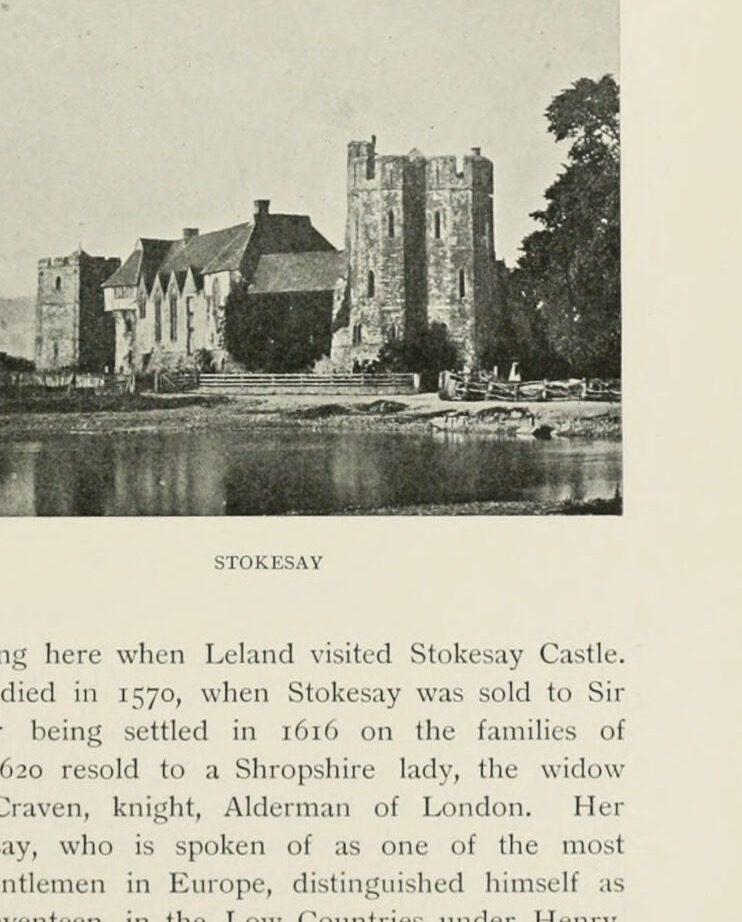
STOKESAY
1897 · J. D. Mackenzie, The Castles of England, vol. 2 (1897)
Public domain
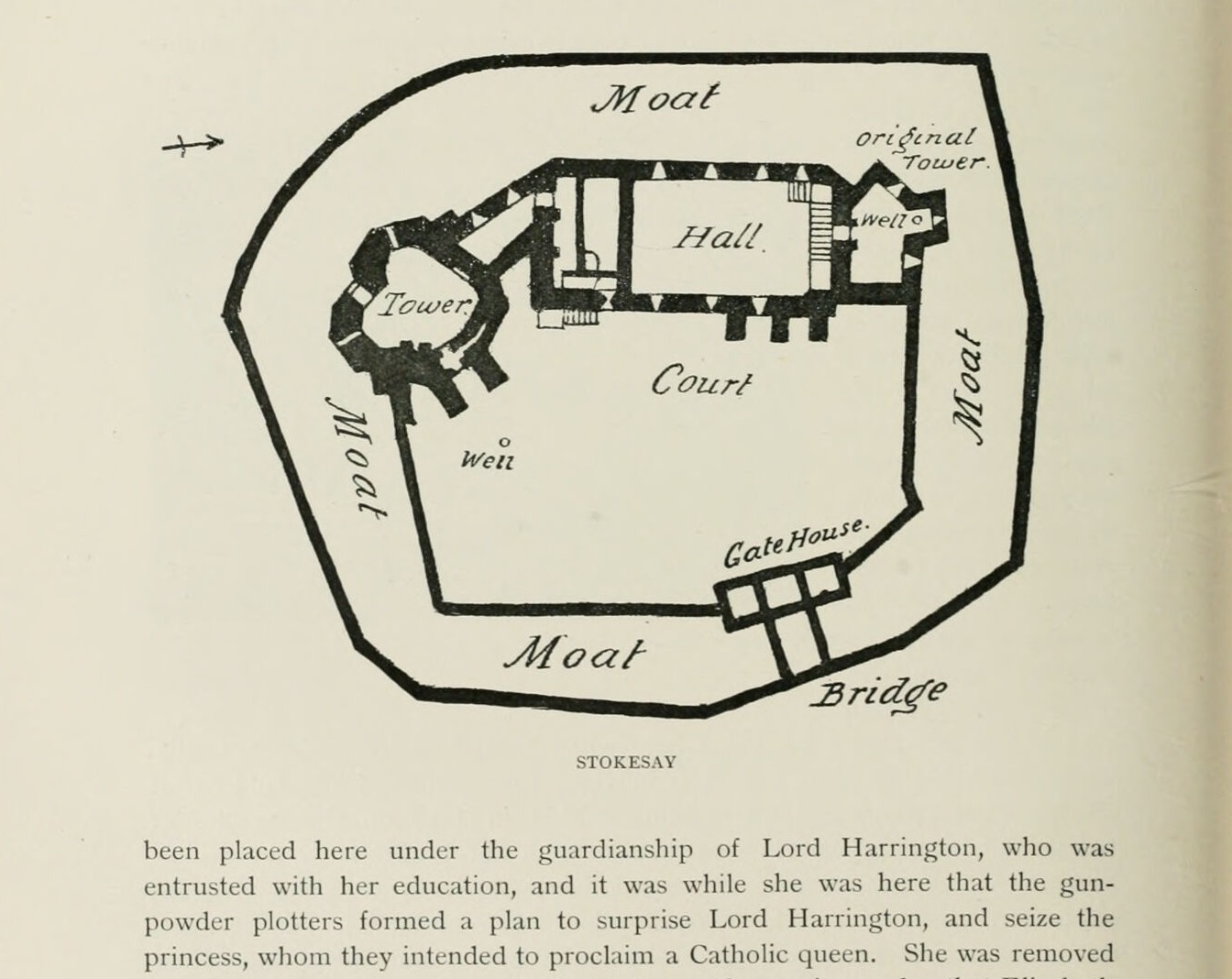
STOKESAY
1897 · J. D. Mackenzie, The Castles of England, vol. 2 (1897)
Public domain
Nearby