England · Partial ruin
Wallingford Castle
Wallingford Castle is a medieval motte-and-bailey castle in Wallingford, historically in Berkshire, constructed soon after the Norman Conquest and expanded in stone in the 12th century. It became a major royal fortress and luxurious residence in the 12th–13th centuries, was slighted after the English Civil War, and today survives as earthworks, sections of wall and the motte open to the public.
First raised
1067
Its prime
1250
Today
Partial ruin
As it stood in 1250
What Wallingford Castle looked like in its prime.
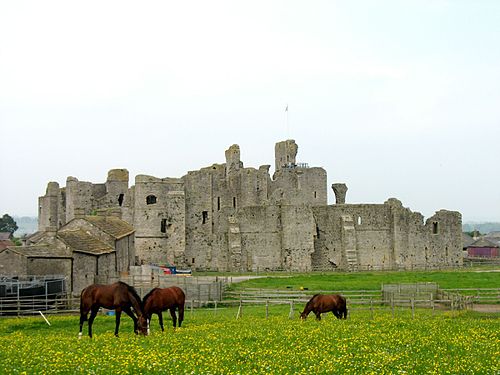
Sited beside the River Thames with a large circular motte rising above the town, the castle in its prime had a stone shell-keep atop the motte and a continuous curtain wall enclosing the bailey. The masonry is pale, chalky rubble and flint with later brick patching visible at lower courses; the curtain wall included crenellated towers and arrow-slits. Domestic ranges and a substantial hall adjoined the inner bailey, with the whole complex set amid broad earthwork banks and river meadows.
Its story
The story of Wallingford Castle.
Robert D'Oyly's Castle in the Saxon Burgh, 1067–1071
Wallingford was a prosperous Saxon burgh with its own mint at a key crossing of the Thames. Its lord, Wigod of Wallingford, backed William the Conqueror, who secured the Thames Valley with three castles, at Windsor, Wallingford and Oxford. Wallingford Castle was probably built between 1067 and 1071 by Robert D'Oyly, who had married Wigod's daughter Ealdgyth. The motte-and-bailey reused the old ramparts in the town's north-east corner, apparently built over high-status Saxon housing, probably of housecarls. The motte still measures 60 metres across and 13 metres high.
Brien FitzCount Declares for the Empress, 1139
The castle passed to Robert's son-in-law Miles Crispin, and after his death to Brien FitzCount, who married Robert's daughter Matilda and strengthened it in stone, probably in the 1130s, with a shell keep and a curtain wall, what the historian Nicholas Brooks has called "one of the most powerful royal castles of the 12th and 13th centuries".
When the Empress Matilda came to England in 1139 to contest Stephen's crown, Brien declared for her, making Wallingford the most easterly stronghold of her faction, the closest base to London, or the first in line to be attacked. Stephen attacked that year but judged the walls impregnable and the castle provisioned, contemporaries thought, to hold out for years; he built two counter-castles to contain it and moved on. Miles of Gloucester destroyed one the next year, and when Oxford fell to Stephen the Empress herself fled to Wallingford. Brien meanwhile ran a notorious prison in the castle, the Cloere Brien; Stephen's steward William Martel was held there, and chroniclers reported that the cries of tortured prisoners disturbed the town.
The Blockade and the Treaty of Wallingford, 1145–1153
Stephen tried again between 1145 and 1146, building a counter-castle at Crowmarsh Gifford and works at Brightwell, South Moreton and Cholsey, but still could not take the castle. In 1152 he returned in strength, re-established Crowmarsh, added a fort overlooking Wallingford bridge, and settled down to starve the garrison out. Brien and Roger of Hereford, trapped inside, failed to break the blockade, and by 1153 food was running low.
Henry, the Empress's son, then marched to its relief and besieged Stephen's counter-castles himself. The king hurried back from Oxford, and the two armies faced each other on the meadows outside the walls. The result was not battle but the Treaty of Wallingford, an embryonic peace leading on to the Treaty of Winchester and Henry's accession as Henry II. The castle had survived every siege of the Anarchy untaken. Brien, childless, surrendered it to Henry in 1153 and entered a monastery.
King John's Garrison and the Earls of Cornwall
Richard I granted the town to John in 1189; John seized the castle during his revolt of 1191, was forced to return it, and reclaimed it on becoming king in 1199. In the First Barons' War of 1215–16 he reinforced the fortifications and mobilised a substantial garrison. In 1231 Richard, 1st Earl of Cornwall, was granted the castle as his main residence and built a new hall; in the Second Barons' War Simon de Montfort seized it after Lewes and imprisoned the royal family there before moving them to Kenilworth.
Edward II gave Wallingford first to his favourite Piers Gaveston, then to his queen, Isabella of France, and used it as a royal prison until his fall in 1326; Isabella then made it an early headquarters of her invasion. Edward III settled it on the new Duchy of Cornwall. When Richard II was deposed in 1399 the still-well-fortified castle hosted the royal government when it first fled London. Henry VIII used it for the last time in 1518.
Fairfax's Sixteen-Week Siege and the Slighting of 1652
John Leland described the castle in 1540 as "nowe sore yn ruine, and for the most part defaced", and under Queen Mary it was stripped of lead for use at Windsor. The Civil War revived it: Royalist Wallingford was garrisoned in 1642 to block any advance on Oxford, and in 1643 Charles I ordered its governor, Colonel Thomas Blagge, to refortify the castle. A Parliamentary attack failed in 1645; General Thomas Fairfax laid siege in 1646; after sixteen weeks the garrison surrendered in July on generous terms.
It remained a surprisingly powerful fortress, and in 1652 Parliament ordered it slighted lest it serve a fresh uprising; it was virtually razed. A mansion later built in the bailey was demolished in 1972, and the earthworks, motte and two sections of wall are open to the public. Excavations between 2002 and 2010 explored the passage from Saxon burgh to Norman castle, and the Round Mounds Project of 2015–16 confirmed the motte's Norman origins.
Step inside
8 places to explore in 1250.
The record describes 8 distinct spots at Wallingford Castle, including 3 interiors: great hall (richard of cornwall's hall), st nicholas college chapel and precinct, cloere brien (the prison). Create your own photoreal reconstruction and explore every one, more scenes means more rooms, more angles, and more of the place to stand in.
Build Your Own Castle
Recreate Wallingford Castle with AI to explore it.
The artist rebuilds it as it stood in 1250, a photoreal reconstruction that belongs to you alone. Pay with coins, no subscription needed.
Recreate this castle →Defend this castle →Whose castle
Clans who held Wallingford Castle.
The families that held Wallingford Castle for a decade or more across its history, follow a name to its clan.
D'Oyly
Built by Robert D'Oyly between 1067 and 1071; passed through his daughter's marriages to Miles Crispin and Brien FitzCount.
Nearby