England · Restored
Colchester Castle
Colchester Castle is a large Norman stone keep built in the late 11th–early 12th century on the Roman podium of the Temple of Claudius in Colchester, Essex. The squat rectangular keep has the largest ground-plan of any medieval tower in Britain and was the centre of a defended bailey; it later served varied civic uses and today houses a museum.
First raised
1069
Its prime
1216
Today
Restored
As it stood in 1216
What Colchester Castle looked like in its prime.
A massive, squat rectangular Norman keep set on the raised Roman podium, its walls of coursed rubble incorporating septaria and robbed Roman brick with ashlar dressings; a semicircular projection stands at the south‑east corner. The façade shows a rounded-arch main doorway in the south‑west tower and tall, narrow rounded-arch windows; remnants of crenellations mark the low roofline. The keep sits within a wide earthen bailey and surrounding ditch with a timber bridge approach, in an urban park setting.
Its story
The story of Colchester Castle.
A Keep Raised on the Temple of Claudius
Colchester Castle belongs to the generation of stone keeps the Normans built to impress their authority on the conquered Anglo-Saxons, and alongside the White Tower in London it is one of the earliest stone towers in England. At 152 by 112 feet (one and a half times the ground plan of the White Tower), its keep has the largest area of any medieval tower built in Europe. That enormous footprint was dictated by the decision to build on the masonry podium of the Temple of Claudius, the largest Roman temple in Britain. The site offered ready-made foundations and Roman brick in a district with no natural stone, but there was ideology in it too: the Normans liked to cast themselves as heirs of Rome, William's biographer compared him to Julius Caesar, and the Colchester Chronicle went further, calling the temple site a palace of the mythical King Coel.
A charter of Henry I from 1101, granting town and castle to Eudo Dapifer as his father William the Conqueror had held them, marks it as a royal foundation. The late-13th-century Colchester Chronicle, not always reliable, credits Eudo with the building and gives a start date of 1076; the design has been linked to Gundulf of Rochester only on its resemblance to the White Tower.
A Keep Built in Two Phases, Its Height Still Argued
The keep was at first carried up only to first-floor height, and the crenellations that crowned this stub can still be seen in the outer walls: evidence, perhaps, that a crisis forced the half-built tower to be made defensible. The Danish raid supporting the Revolt of the Earls in 1075 and the invasion threatened by Canute IV in 1085 have both been suggested. A second phase after about 1100, probably Eudo's work, added the first floor and staircases.
In 1882 J. Horace Round argued for four storeys, a view accepted for most of the 20th century; more recent research supports three, and some of the latest work suggests there may only ever have been two; every pre-demolition picture shows the squat profile the castle has today.
Magna Carta and the Siege of 1216
After Eudo's death in 1120 the castle reverted to the Crown and was run by appointed constables; the purchase of 26 military tunics in 1190 shows a permanent garrison. In 1214 the hereditary constable was William de Lanvalai, one of the barons opposed to King John. John came to Colchester that November, probably in a failed bid to win him over; Lanvalai joined the rebels, and John installed a replacement constable, Stephen Harengood, probably a Flemish mercenary, with orders to strengthen the defences. Magna Carta, forced on John at Runnymede in June 1215, included a provision that Colchester be returned to Lanvalai.
When John repudiated the charter and the First Barons' War broke out, a French contingent arrived to hold Colchester for the barons. The siege began in January 1216 and ended in March when John himself arrived; the French garrison of 116 men negotiated safe passage to London. In 1217 the castle was handed to the French and the barons under a truce, then recovered for the boy king Henry III by the Treaty of Lambeth that September.
Witchfinder, Executions and Gunpowder
As a county prison the castle held the suspected witches interrogated in 1645 by the self-styled Witchfinder General, Matthew Hopkins. In 1648 the Royalist commanders Sir Charles Lucas and Sir George Lisle were executed just behind the castle, local legend insists grass will not grow where they fell, and a small obelisk marks the spot. The Quaker James Parnell died a martyr there in 1656.
A Parliamentary survey of 1650 condemned the building and valued its stone at five pounds. In 1683 an ironmonger, John Wheely, was licensed to pull the whole castle down; after "great devastations" in which much of the upper structure was brought down with screws and gunpowder, he abandoned the work as unprofitable.
From Charles Gray's Park to the Borough's Museum
In 1727 Mary Webster bought the castle for her daughter Sarah, wife of Charles Gray, MP for Colchester. Gray restored the south front in the late 1740s, added a library and cupola by 1760, and laid out a private park around the ruin; part of the castle stayed in use as the county jail, enlarged in 1801.
A museum of the borough's artefacts has been shown in the castle since 1860, and between 1920 and 1922 the Borough of Colchester bought castle and parkland outright, helped by a large donation from Viscount Cowdray. Roofing the keep in the mid-1930s let the collection, notably strong in Roman material, expand; a £4.2 million refurbishment followed in 2013–14, and in December 2025 a new £1.3 million restoration of the tower and foundations began.
Step inside
9 places to explore in 1216.
The record describes 9 distinct spots at Colchester Castle, including 3 interiors: great hall (first floor), south‑east apse (possible chapel), interior dividing walls and chambers. Create your own photoreal reconstruction and explore every one, more scenes means more rooms, more angles, and more of the place to stand in.
Build Your Own Castle
Recreate Colchester Castle with AI to explore it.
The artist rebuilds it as it stood in 1216, a photoreal reconstruction that belongs to you alone. Pay with coins, no subscription needed.
Recreate this castle →Defend this castle →From the archive
Colchester Castle on paper: the measured plan and period views.
The survey plan and photographs below are the ground truth this page's reconstructions are checked against, drawn and photographed while the castle was still a working garrison. Every image is public-domain or openly licensed, with its source named.
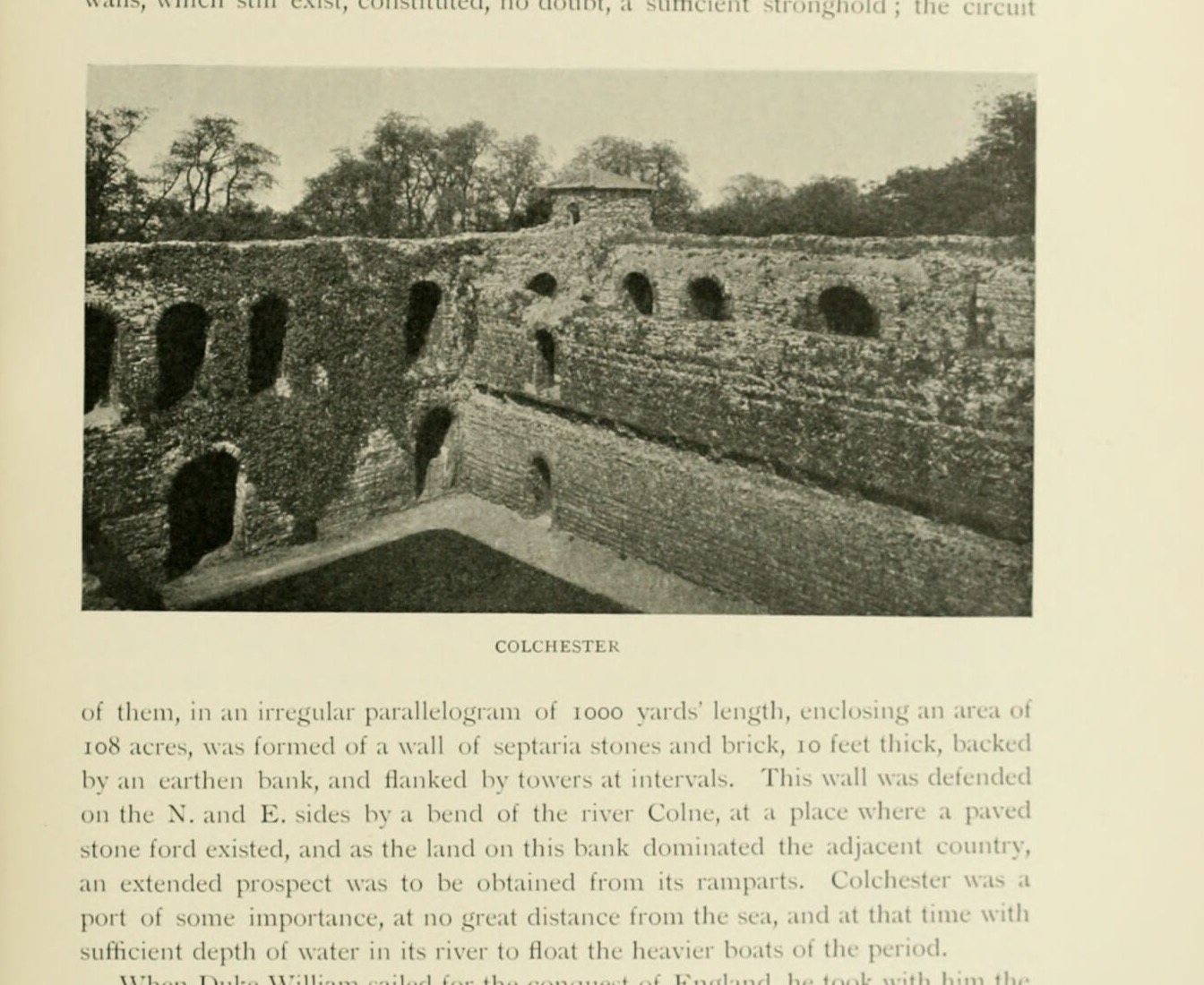
COLCHESTER
1897 · J. D. Mackenzie, The Castles of England, vol. 1 (1897)
Public domain
Nearby